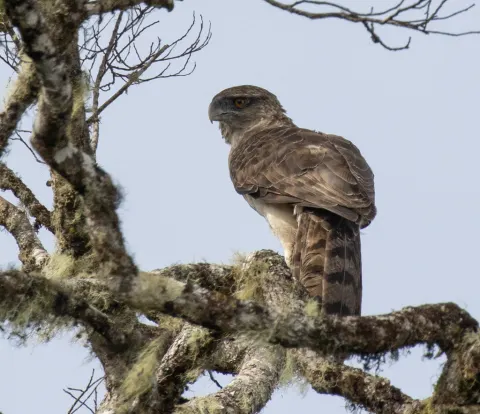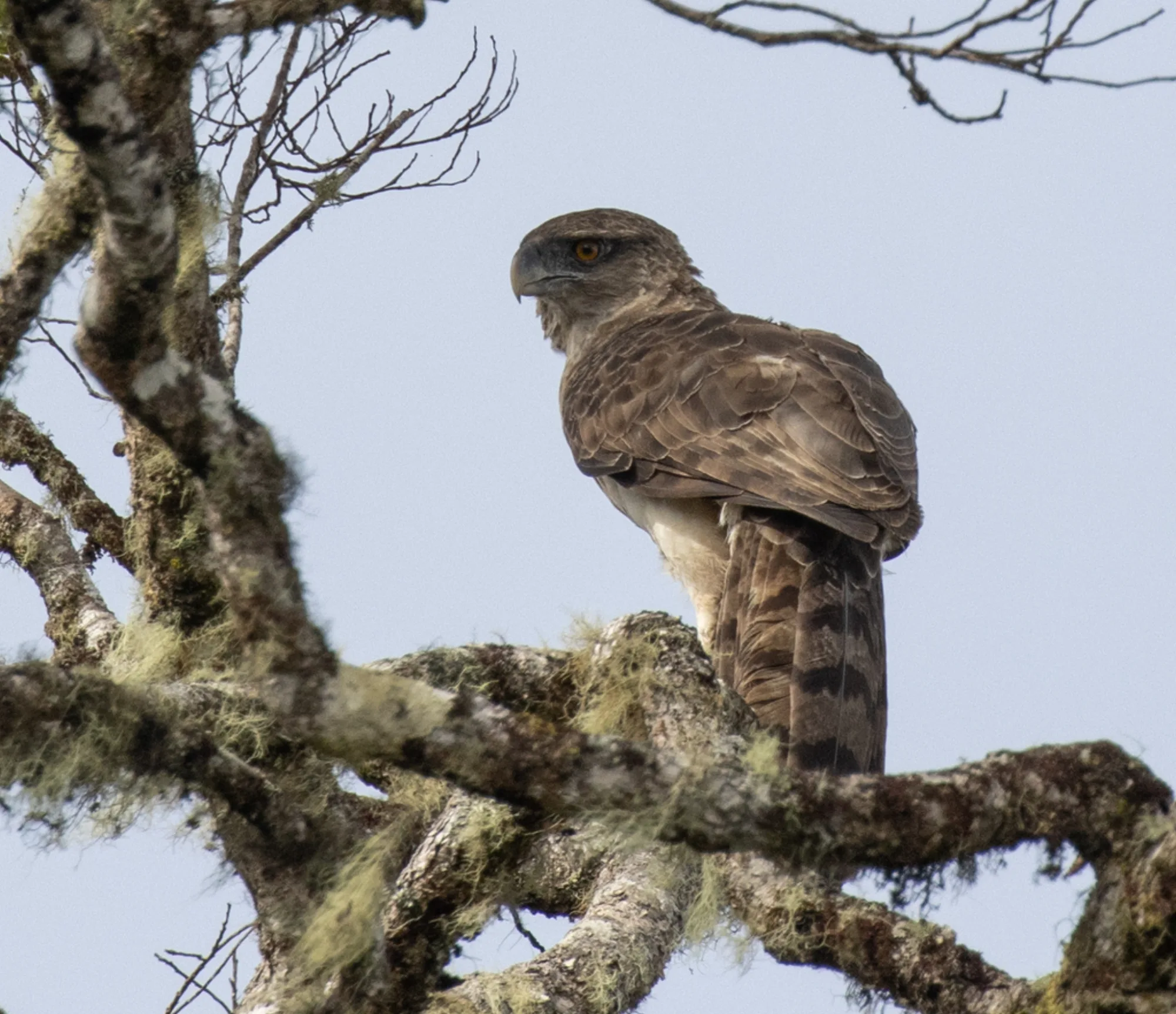
Papuan Eagle
Harpyopsis novaeguineae
A large bird of prey found only on New Guinea, the Papuan Eagle lives mainly in undisturbed tropical rainforest. It has been seen across almost every part of the island, from Indonesian Papua in the west to Papua New Guinea in the east. It also uses gallery forest, monsoon scrub forest and dry woodland, and occurs from sea level to 2,000 m on a regular basis. Adults measure 75 to 90 cm in length, with greyish brown upperparts, a creamy underside and a long, dark-banded tail. A short, full crest, prominent head and large black bill add to its distinctive appearance. Its loud call can carry through the forest, and pairs may call at dawn, dusk or even at night.
Finding one can be difficult: it perches unobtrusively in the thick canopy and often slips away quietly. When hunting, it glides between perches, listens for movement below and may tilt or bob its head before dropping towards prey. It also searches holes and vegetation, shakes foliage to expose small mammals and runs swiftly on the forest floor. Its varied diet includes phalangers, tree-kangaroos and rats, as well as birds, snakes and monitor lizards.
Breeding remains poorly known, but the eagle appears to nest deep in forest, often high in a large tree rising above the canopy. Its huge nest may be reused, and it may breed only every other year. Forest clearance threatens the species, which appears to abandon areas where logging roads have been cut. People also hunt it for ceremonial feathers or kill it in competition for bushmeat.
Written from the English Wikipedia article Papuan eagle (CC BY-SA 4.0).
- Records
- 447
- Countries
- 2
No atlas park has a record of the Papuan Eagle in or around it yet.
These are open occurrence records, so they show where people looked for and recorded the Papuan Eagle as much as where it lives. Cells are up to 25 km across, and every location is generalised to its cell.
Generalised encounter areas, not exact locations. Each shape is a grid cell coloured by how likely the species is there.
- Very likelyPapua New Guinea25 km zone · medium confidence · 295 records · updated 80 days ago
- Very likelyIndonesia25 km zone · high confidence · 152 records · updated 80 days ago
Conservation status not assessed here yet, so every location is generalised to its grid cell.