Grey Seal
Halichoerus grypus
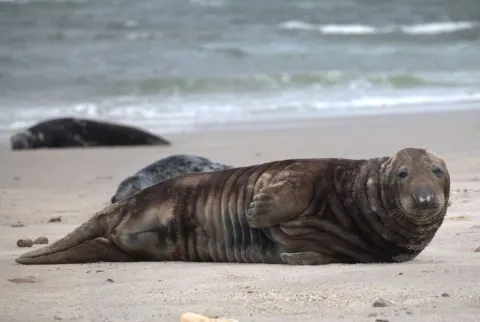
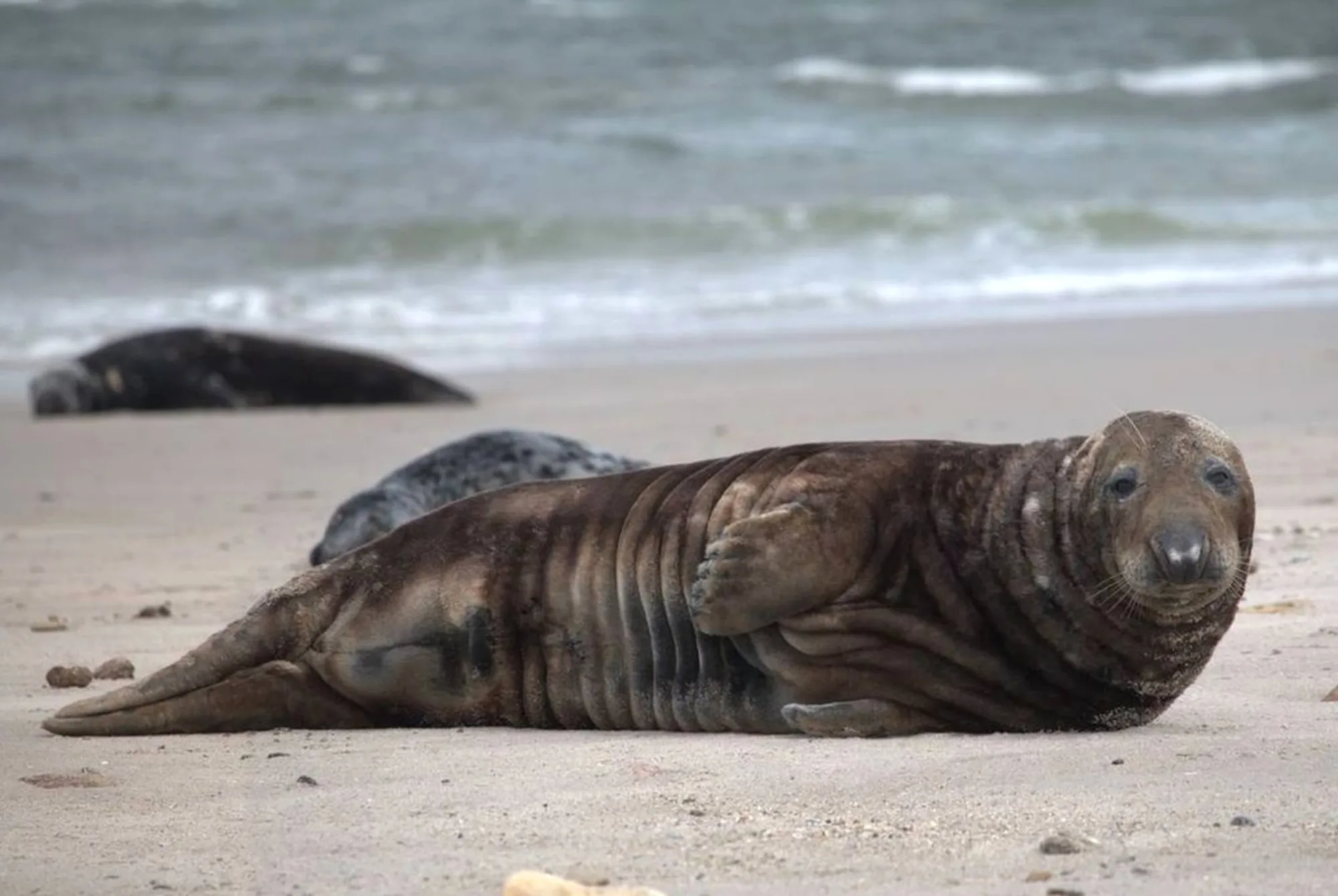
A long, sloping snout and a large head give the Grey Seal a distinctive profile. This heavy seal has no external ear flaps, and its nostrils appear more parallel than those of the harbour seal. Colour varies: males tend to have light markings on a dark background, while females often have dark markings on a lighter coat. Eastern Atlantic seals range from 1.6 to 2.3 m in length, while western Atlantic individuals can reach 2.7 m.
Grey seals live on both sides of the North Atlantic, from the US to Russia, with the largest populations in Canada and the UK. They spend most of their time at sea, but can be seen resting on rocks, islands and shoals near shore. In Britain, breeding sites include Horsey Beach and Blakeney Point in Norfolk, as well as islands off Scotland. The seals eat mainly fish, including sand eels, herring and flatfish, but also take octopus and lobster. Underwater, they can clap their flippers, perhaps to discourage predators or attract a mate.
Breeding colonies are generally on beaches and remote islands, though seals sometimes breed on sea ice in the Baltic Sea and Canada's Gulf of St Lawrence. Each female gives birth to a single pup, usually returning to her own birthplace. Pups arrive between September and March, depending on location, and are born with soft white fur. They gain weight quickly on their mother's milk, then shed their white coat and eventually head to sea to learn to fish. Hunting and drowning in fishing gear cause deaths, while orcas and sharks also prey on grey seals. Seal watching can disturb them: private watercraft are a major cause, and dogs can send seals rushing into the water.
Written from the English Wikipedia article Grey seal (CC BY-SA 4.0).
- Records
- 40,147
- Countries
- 15
No atlas park has a record of the Grey Seal in or around it yet.
These are open occurrence records, so they show where people looked for and recorded the Grey Seal as much as where it lives. Cells are up to 25 km across, and every location is generalised to its cell.
Generalised encounter areas, not exact locations. Each shape is a grid cell coloured by how likely the species is there.
- Very likelySweden25 km zone · high confidence · 15188 records · updated 80 days ago
- Very likelyDenmark25 km zone · high confidence · 12593 records · updated 80 days ago
- Very likelyUnited Kingdom25 km zone · medium confidence · 4989 records · updated 80 days ago
- Very likelyFrance25 km zone · medium confidence · 3212 records · updated 80 days ago
- Very likelyNorway25 km zone · high confidence · 1605 records · updated 80 days ago
- Very likelyFinland25 km zone · high confidence · 812 records · updated 80 days ago
- Very likelyIreland25 km zone · high confidence · 678 records · updated 80 days ago
- Very likelyUnited States25 km zone · high confidence · 335 records · updated 80 days ago
- Very likelyEstonia25 km zone · high confidence · 247 records · updated 80 days ago
- Very likelyÅland Islands25 km zone · high confidence · 145 records · updated 80 days ago
Conservation status not assessed here yet, so every location is generalised to its grid cell.