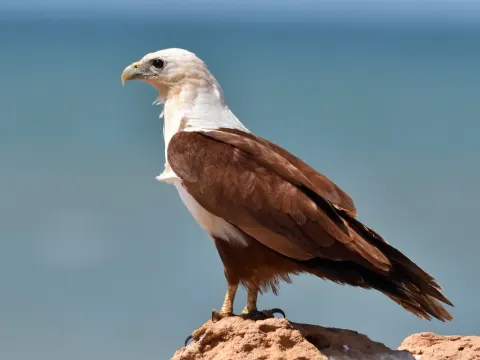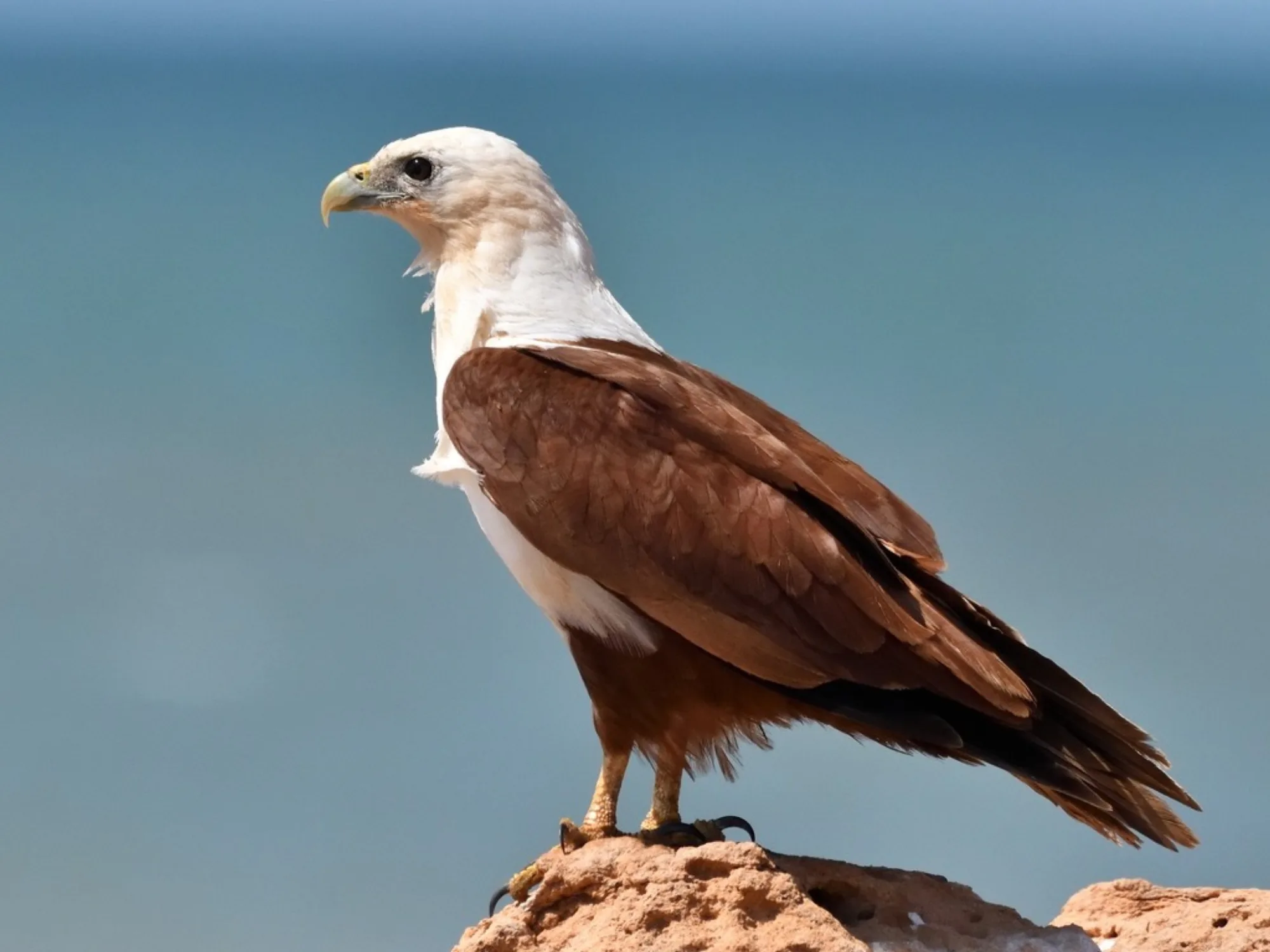
Brahminy Kite
Haliastur indus
Look for the Brahminy Kite above coasts and inland wetlands, where its white head and breast stand out against a chestnut body. This medium-sized bird of prey has black wingtips and a rounded tail, and flies with its wings angled. Younger birds are browner, with a paler appearance and shorter wings than the black kites found in Asia. Listen, too, for a mewing call rendered as keeyew.
The kite ranges across the Indian subcontinent, Southeast Asia and Australia, reaching as far south as New South Wales. It is widespread and resident across this region, although some populations move seasonally in response to rainfall. Most sightings are in the plains, but the bird also occurs high in the Himalayas. It often scavenges in wetlands and marshes, feeding mainly on dead fish and crabs. It also hunts live animals, including hares and bats, and sometimes tries to steal food from other birds. On the Mekong River, it has been recorded taking advantage of Irrawaddy dolphins as they drive fish towards the surface. Young kites may play by dropping leaves and trying to catch them in mid-air.
Pairs build nests from small branches and sticks, lining the inner bowl with leaves and placing them in trees, often mangroves. They tend to return to the same nesting area year after year, and both parents help build the nest and feed the young. Kites also gather to roost in large, isolated trees, with as many as 600 recorded at one site. The species is declining in some places, including Java, although no cause is given here. Individual birds have also been injured or killed after mobbing steppe eagles.
Written from the English Wikipedia article Brahminy kite (CC BY-SA 4.0).
- Records
- 508,151
- Countries
- 23
- Atlas places
- 14
- Bandipur National Park· India
- Annapurna Conservation Area· Nepal
- Daintree National Park· Australia
- Nagarhole National Park· India
- Periyar National Park· India
- Yala National Park· Sri Lanka
- Eravikulam National Park· India
- Great Sandy National Park (K'gari)· Australia
- Komodo National Park· Indonesia
- Koshi Tappu Wildlife Reserve· Nepal
- Minneriya National Park· Sri Lanka
- Sundarbans National Park· India
- Udawalawe National Park· Sri Lanka
- Wasgamuwa National Park· Sri Lanka
These are open occurrence records, so they show where people looked for and recorded the Brahminy Kite as much as where it lives. Cells are up to 25 km across, and every location is generalised to its cell.
Generalised encounter areas, not exact locations. Each shape is a grid cell coloured by how likely the species is there.
- Very likelyIndia25 km zone · high confidence · 375866 records · updated 86 days ago
- Very likelyAustralia25 km zone · high confidence · 55164 records · updated 86 days ago
- Very likelySri Lanka25 km zone · high confidence · 20657 records · updated 86 days ago
- Very likelyIndonesia25 km zone · high confidence · 13100 records · updated 86 days ago
- Very likelyThailand25 km zone · high confidence · 11901 records · updated 86 days ago
- Very likelyMalaysia25 km zone · high confidence · 9740 records · updated 86 days ago
- Very likelySingapore25 km zone · high confidence · 8999 records · updated 86 days ago
- Very likelyBangladesh25 km zone · high confidence · 3647 records · updated 86 days ago
- Very likelyPhilippines25 km zone · high confidence · 3508 records · updated 86 days ago
- Very likelyPapua New Guinea25 km zone · high confidence · 3036 records · updated 86 days ago
Conservation status not assessed here yet, so every location is generalised to its grid cell.