Steller's Sea Eagle
Haliaeetus pelagicus
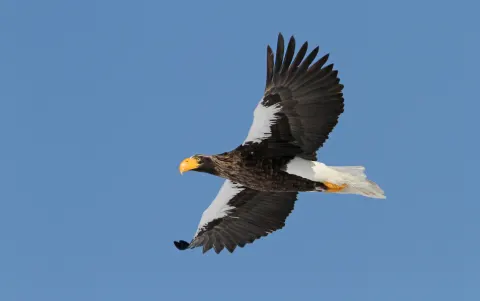
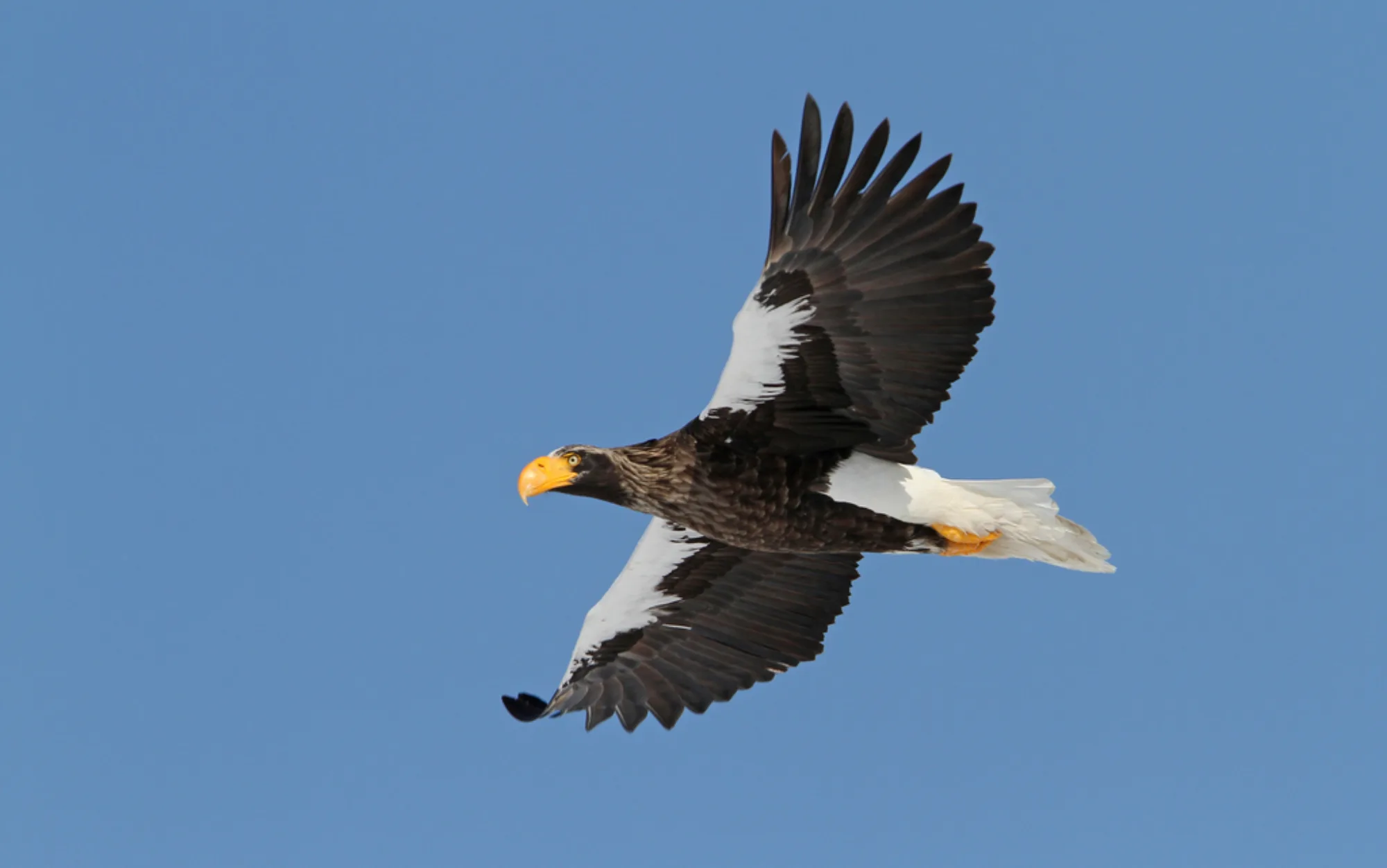
With a massive yellow beak and contrasting dark brown and white plumage, the Steller's Sea Eagle is a striking sight along the coasts of northeastern Asia. Adults have white on their wings and diamond-shaped tails, while young birds are mostly dark brown, with mottled tails. This large bird of prey measures 85 to 105 cm long, and females are generally bigger than males. Its calls include a deep bark and honking sounds.
The eagle breeds in parts of eastern Russia, including Kamchatka, the Sea of Okhotsk coast and the lower Amur River. It nests on rocky outcrops or in large trees beside the coast and rivers, favouring mature trees and floodplain forests. Many migrate south for winter, with birds gathering around coastal waters and lakes on Hokkaido in Japan. Usually solitary, they can gather in numbers on productive salmon rivers in late summer. They hunt fish in shallow water, often diving from a tree or rocky perch, and also take water birds. In autumn they frequently eat dead salmon, while some wintering birds feed on mammal carcasses. Pairs build bulky stick nests, and their young leave the nest in August or early September.
Habitat alteration, industrial pollution and overfishing threaten the eagle and can reduce its food supply. Heavy flooding has caused widespread nesting failure on Russian rivers by preventing parents from catching fish for their chicks. In Hokkaido, some eagles feeding on deer carcasses left by hunters risk lead poisoning from swallowed shot. The bird is also persecuted in Russia for taking fur-bearing animals from trappers.
Written from the English Wikipedia article Steller's sea eagle (CC BY-SA 4.0).
- Records
- 7,990
- Countries
- 9
No atlas park has a record of the Steller's Sea Eagle in or around it yet.
These are open occurrence records, so they show where people looked for and recorded the Steller's Sea Eagle as much as where it lives. Cells are up to 25 km across, and every location is generalised to its cell.
Generalised encounter areas, not exact locations. Each shape is a grid cell coloured by how likely the species is there.
- Very likelyJapan25 km zone · high confidence · 4197 records · updated 80 days ago
- Very likelyUnited States25 km zone · high confidence · 2147 records · updated 80 days ago
- Very likelyCanada25 km zone · high confidence · 590 records · updated 80 days ago
- Very likelySouth Korea25 km zone · high confidence · 469 records · updated 80 days ago
- Very likelyRussia25 km zone · high confidence · 457 records · updated 80 days ago
- Very likelyChina25 km zone · high confidence · 108 records · updated 80 days ago
- LikelyCzechia25 km zone · medium confidence · 22 records · updated 80 days ago
- RareBelgium25 km zone · low confidence · 0 records · updated 80 days ago
- RareDenmark25 km zone · low confidence · 0 records · updated 80 days ago
Conservation status not assessed here yet, so every location is generalised to its grid cell.