White-tailed Eagle
Haliaeetus albicilla
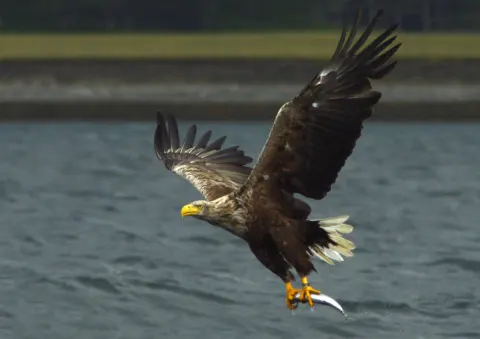
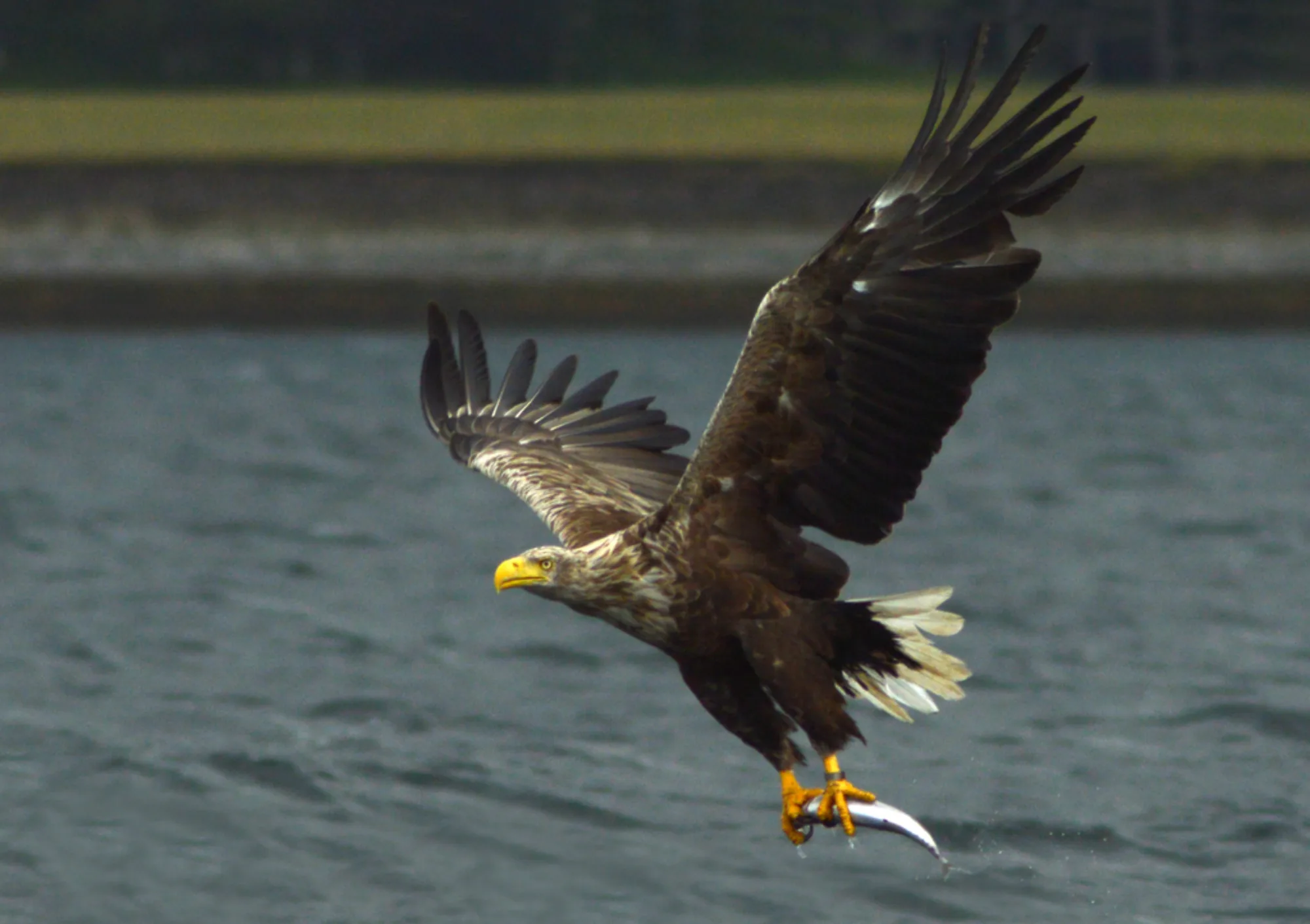
With immense, broad wings and a short, wedge-shaped tail, the White-tailed Eagle ranks among the biggest birds of prey alive today. Adults are mostly greyish brown, with a paler head and neck, a white tail and a yellow bill, feet and eyes. Young birds are darker and more unevenly marked, and their tails are greyish cream with dark edges and tips. In flight, look for shallow wingbeats interspersed with gliding, or a bird soaring with its wings held flat or slightly raised at the tips.
The eagle breeds from southern Greenland and Iceland across northern Europe and Asia to Hokkaido in Japan. For much of the year it stays near large expanses of water, from coasts and islands to freshwater lakes, wetlands and rivers. Inland, it usually needs secluded woodland or groups of mature trees close to freshwater wetlands, while coastal birds can use sea cliffs. It may spend hours perched on a tree or crag, alternating rest with soaring over water or well-watered ground. Both a hunter and a scavenger, it depends especially on fish and birds, particularly waterbirds, for food. Pairs often roost together near their nest, and in early spring they may call in duet from a perch or while flying.
Nesting sites need old-growth trees or ample sea cliffs, along with an abundant supply of food. Habitat alteration and the destruction of wetlands have made nesting sparse in parts of its range, alongside a long history of human persecution. Poisoning and nesting failures linked to pesticides and organic compounds remain a concern, although protection and reintroduction have helped some populations recover.
Written from the English Wikipedia article White-tailed eagle (CC BY-SA 4.0).
- Records
- 281,137
- Countries
- 62
- Atlas places
- 4
These are open occurrence records, so they show where people looked for and recorded the White-tailed Eagle as much as where it lives. Cells are up to 25 km across, and every location is generalised to its cell.
Generalised encounter areas, not exact locations. Each shape is a grid cell coloured by how likely the species is there.
- Very likelyNorway25 km zone · high confidence · 135533 records · updated 86 days ago
- Very likelyFinland25 km zone · high confidence · 58336 records · updated 86 days ago
- Very likelySweden25 km zone · high confidence · 18517 records · updated 86 days ago
- Very likelyUnited Kingdom25 km zone · high confidence · 6852 records · updated 86 days ago
- Very likelyÅland Islands25 km zone · high confidence · 5966 records · updated 86 days ago
- Very likelyPoland25 km zone · high confidence · 4775 records · updated 86 days ago
- Very likelyCzechia25 km zone · high confidence · 4382 records · updated 86 days ago
- Very likelyDenmark25 km zone · high confidence · 4159 records · updated 86 days ago
- Very likelyHungary25 km zone · high confidence · 3911 records · updated 86 days ago
- Very likelyGermany25 km zone · high confidence · 3552 records · updated 86 days ago
Conservation status not assessed here yet, so every location is generalised to its grid cell.