White-throated Kingfisher
Halcyon smyrnensis
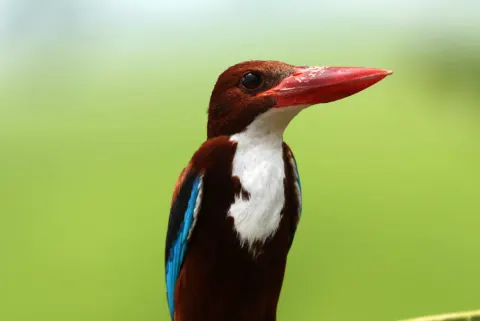
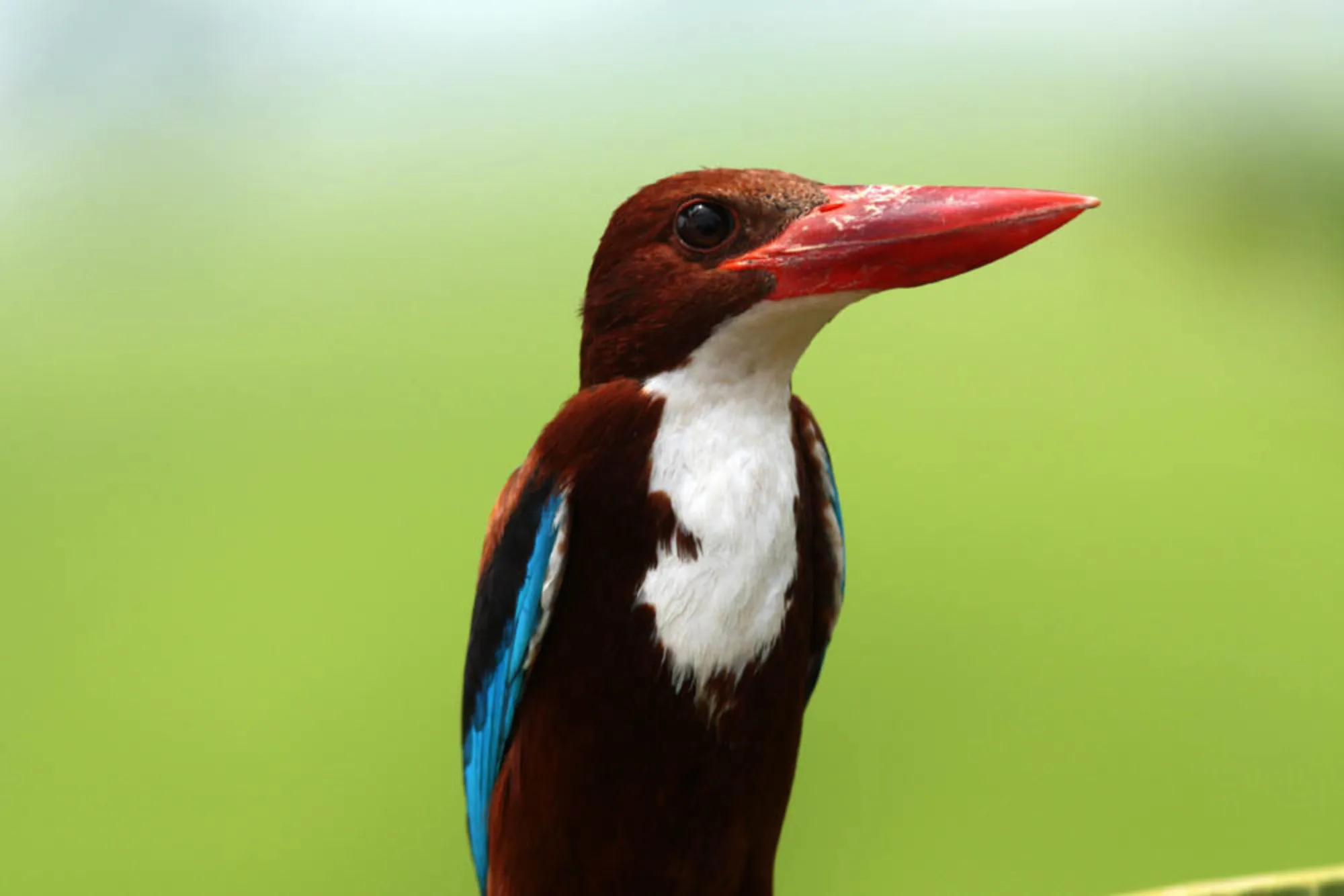
A flash of blue and a bright red bill can signal a White-throated Kingfisher on an exposed perch. This large tree kingfisher measures 27 to 28 cm, with a chestnut head and body, a white throat and breast, and a blue back, wings and tail. Its legs are red too, while juveniles have duller colours than adults. In its rapid, direct flight, white patches show on the blue and black wings.
The species ranges across Asia, from Sinai eastwards to China and Indonesia, including the Indian subcontinent. It is common in a variety of habitats, particularly open country on the plains where trees, wires and other perches are available. Often found far from water, it is resident across much of its range, though some populations make short movements. In south Asia it is frequently seen perched in the open, and during the breeding season its loud morning calls can come from wires or the tops of buildings.
From its perch, the kingfisher has a wide choice of prey, including insects, crabs, rodents, lizards, snakes, fish and frogs. It also takes small birds, while its young are fed mostly on invertebrates. Breeding begins with the onset of the monsoons, when pairs dig a nest tunnel in an earth bank; tunnels have also been recorded in haystacks. A typical clutch contains 4 to 7 white eggs, which hatch after 20 to 22 days. Healthy birds have few predators, although black kites and jungle crows have been recorded taking them. In the 1800s, people hunted these kingfishers for feathers to decorate hats.
Written from the English Wikipedia article White-throated kingfisher (CC BY-SA 4.0).
- Records
- 797,957
- Countries
- 33
- Atlas places
- 18
- Bandipur National Park· India
- Kanha National Park· India
- Jim Corbett National Park· India
- Nagarhole National Park· India
- Ranthambore National Park· India
- Way Kambas National Park· Indonesia
- Annapurna Conservation Area· Nepal
- Chitwan National Park· Nepal
- Eravikulam National Park· India
- Kaziranga National Park· India
- Kerinci Seblat National Park· Indonesia
- Koshi Tappu Wildlife Reserve· Nepal
- Langtang National Park· Nepal
- Pench National Park· India
- Periyar National Park· India
- Sundarbans National Park· India
- Tadoba Andhari Tiger Reserve· India
- Yala National Park· Sri Lanka
These are open occurrence records, so they show where people looked for and recorded the White-throated Kingfisher as much as where it lives. Cells are up to 25 km across, and every location is generalised to its cell.
Generalised encounter areas, not exact locations. Each shape is a grid cell coloured by how likely the species is there.
- Very likelyIndia25 km zone · high confidence · 618177 records · updated 86 days ago
- Very likelyPalestinian Territories25 km zone · high confidence · 31206 records · updated 86 days ago
- Very likelyIsrael25 km zone · high confidence · 26177 records · updated 86 days ago
- Very likelySri Lanka25 km zone · high confidence · 24349 records · updated 86 days ago
- Very likelyMalaysia25 km zone · high confidence · 14686 records · updated 86 days ago
- Very likelyTaiwan25 km zone · high confidence · 13517 records · updated 86 days ago
- Very likelyNepal25 km zone · high confidence · 10681 records · updated 86 days ago
- Very likelySingapore25 km zone · high confidence · 10533 records · updated 86 days ago
- Very likelyHong Kong SAR China25 km zone · high confidence · 10326 records · updated 86 days ago
- Very likelyThailand25 km zone · high confidence · 8419 records · updated 86 days ago
Conservation status not assessed here yet, so every location is generalised to its grid cell.