House Finch
Haemorhous mexicanus
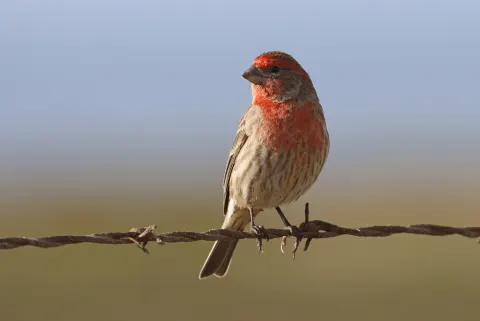
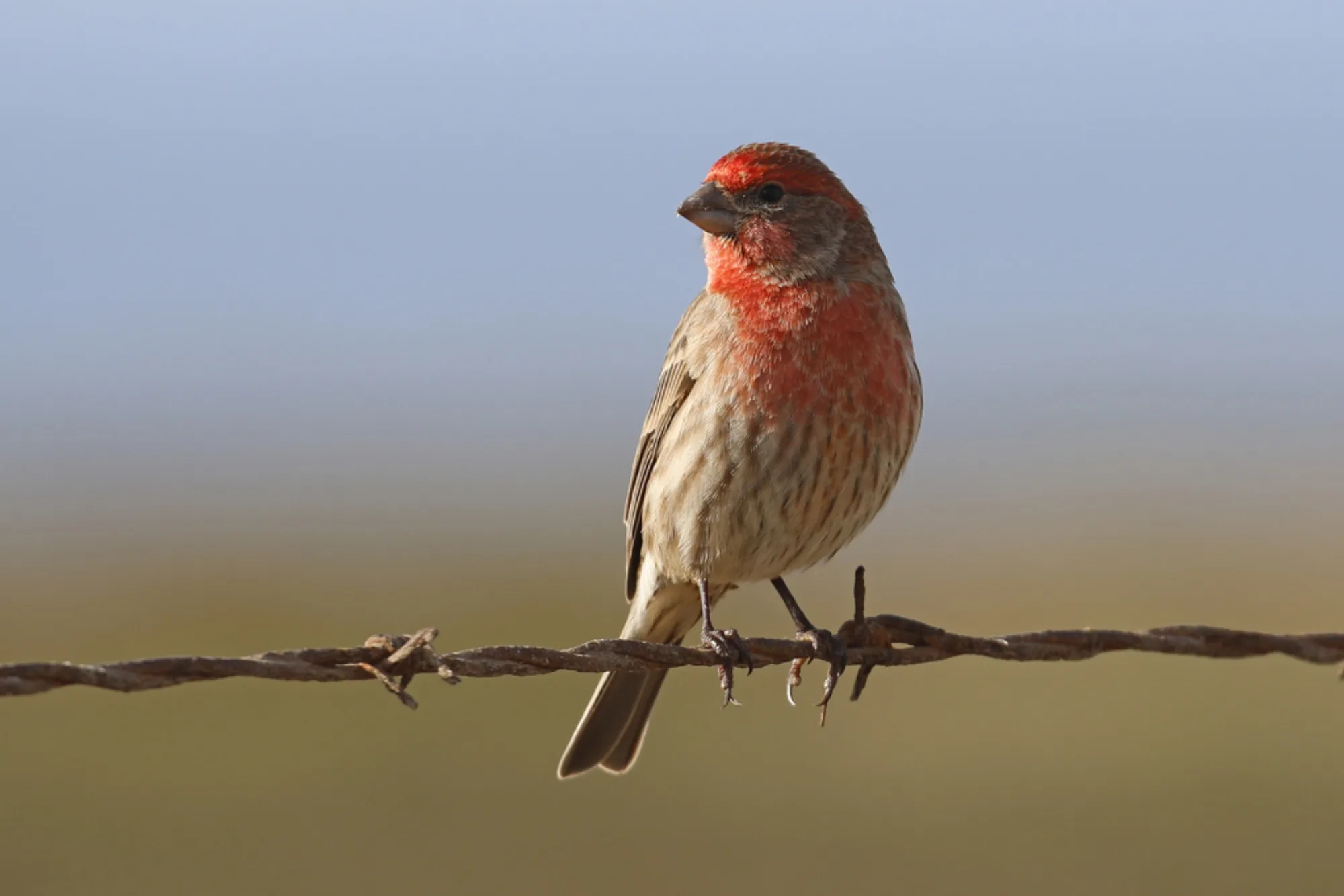
A familiar bird of towns and suburbs, the House Finch measures 12.5 to 15 cm long and has a long, square-tipped brown tail. Its back is brown to dull brown, with darker grey in the wings, while its flanks are usually streaked. Most adult males have reddish heads, necks and shoulders, although their colour can range from pale straw-yellow to deep red. Females have brown upperparts and streaked underparts. Listen for a high-pitched jumble of musical notes ending in a distinct high note.
Native to Mexico and the southwestern United States, the finch was introduced to eastern North America and Hawaiʻi. It now lives year-round throughout much of Mexico and nearly all of the United States, and breeds as far north as northern Alberta. Alongside urban and suburban areas, it breeds in semi-open country in the west. Most stay in their range throughout the year, though some migrate south. Look for them feeding on the ground or among vegetation, or visiting bird feeders, where they may drive other birds away. Grains, seeds and berries make up most of their diet, with small insects eaten incidentally.
The female builds a cup-shaped nest from twigs and debris, often in a building opening, hanging plant or other outdoor decoration. From February through August, she lays clutches of 2 to 6 eggs, with two or more broods per year. Both parents usually feed the young, which receive only plant matter and typically leave the nest about 11 to 19 days after hatching. Parasites are among the threats: Mycoplasma gallisepticum caused the eastern North American population to crash during the 1990s, and mites can harm chicks.
Written from the English Wikipedia article House finch (CC BY-SA 4.0).
- Records
- 7,453,399
- Countries
- 11
- Atlas places
- 2
These are open occurrence records, so they show where people looked for and recorded the House Finch as much as where it lives. Cells are up to 25 km across, and every location is generalised to its cell.
Generalised encounter areas, not exact locations. Each shape is a grid cell coloured by how likely the species is there.
- Very likelyUnited States25 km zone · high confidence · 6954253 records · updated 86 days ago
- Very likelyCanada25 km zone · high confidence · 429382 records · updated 86 days ago
- Very likelyMexico25 km zone · high confidence · 66686 records · updated 86 days ago
- Very likelyGreece25 km zone · high confidence · 1702 records · updated today
- LikelySpain25 km zone · high confidence · 1303 records · updated today
- PossibleCuba25 km zone · medium confidence · 34 records · updated today
- UncommonGuatemala25 km zone · medium confidence · 16 records · updated today
- UncommonUnited Kingdom25 km zone · medium confidence · 14 records · updated today
- RareGermany25 km zone · medium confidence · 4 records · updated today
- RareBelgium25 km zone · medium confidence · 3 records · updated today
Conservation status not assessed here yet, so every location is generalised to its grid cell.