Eurasian Oystercatcher
Haematopus ostralegus
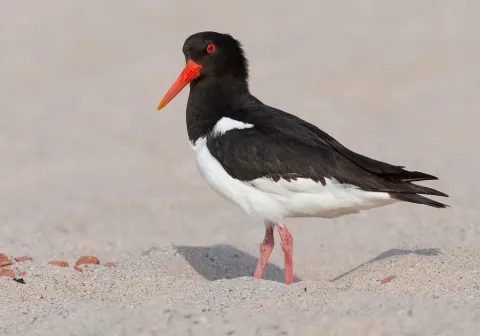
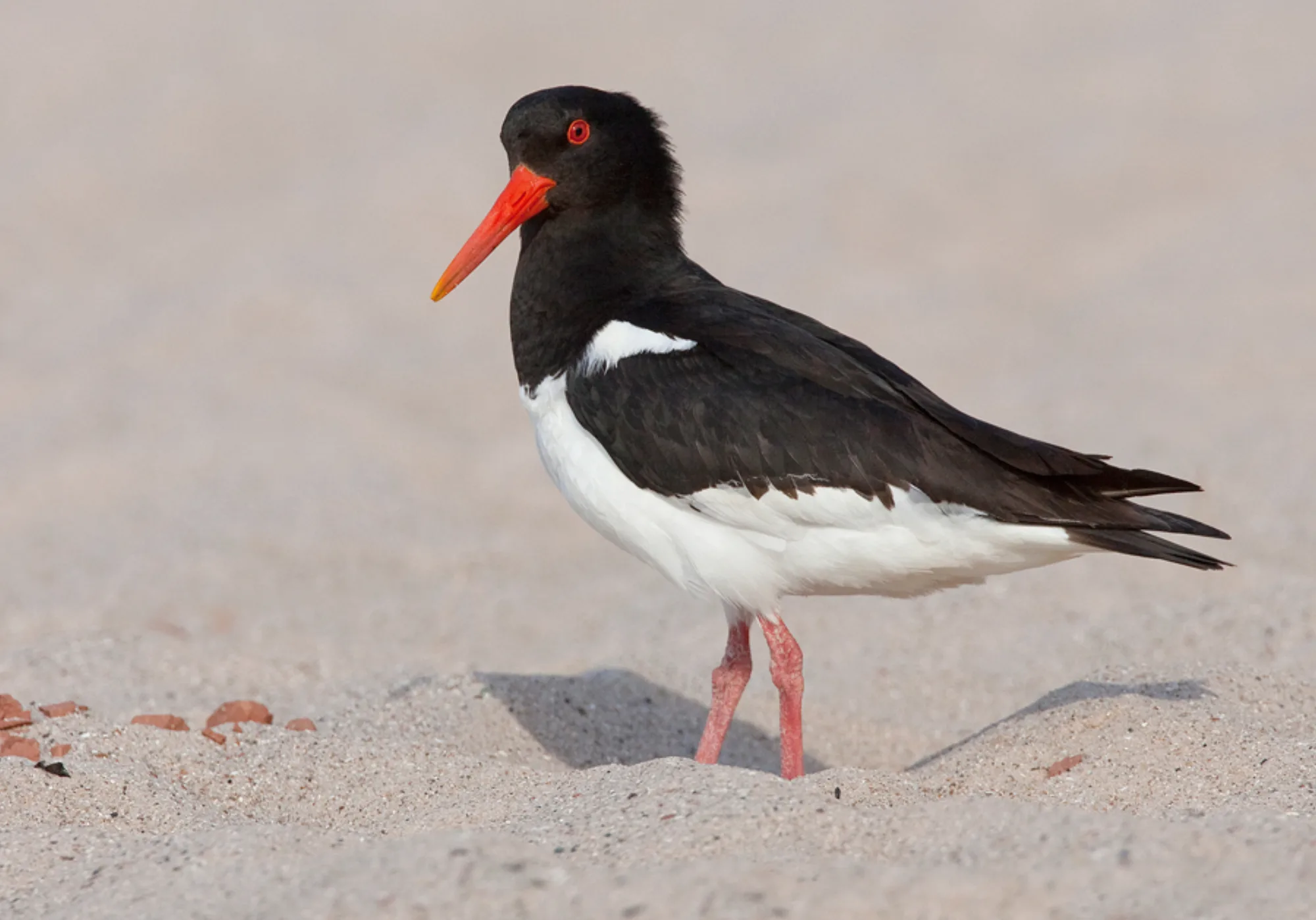
A loud piping call can draw attention to the Eurasian Oystercatcher, a large wader with black and white plumage, red eyes, pink legs and a long orange-red bill. In flight, its dark back contrasts with a white belly and patches of white on the wings and tail. Young birds are browner, with a white collar and a duller bill. Adults briefly show a white throat collar in winter, while immature birds retain it for longer.
Its breeding range extends from western Europe through central Eurosiberia, reaching Kamchatka, China and Korea's western coast. It often lives on flat lowland plains with short vegetation near water, and also nests on coasts and inland gravelly islands. Most populations migrate, although birds are present throughout the year in Ireland, Great Britain and nearby European coasts. In winter, large flocks gather in the estuaries of south-west England, and birds are also found in southern Europe and north Africa. Outside the breeding season, oystercatchers are highly sociable.
Despite their name, oysters make up little of their diet. Birds prise molluscs apart or hammer through their shells, while others dig for worms, specialising in techniques learned from their parents. Pairs usually stay together for many years and lay two to four eggs in a bare scrape among pebbles. Both parents incubate the eggs, feed the chicks and brood them after they hatch. Ravens and other aerial predators threaten the nest, as do threats on the ground: parents may attack flying predators or try to distract ground threats away from their young.
Written from the English Wikipedia article Eurasian oystercatcher (CC BY-SA 4.0).
- Records
- 1,811,823
- Countries
- 98
- Atlas places
- 8
These are open occurrence records, so they show where people looked for and recorded the Eurasian Oystercatcher as much as where it lives. Cells are up to 25 km across, and every location is generalised to its cell.
Generalised encounter areas, not exact locations. Each shape is a grid cell coloured by how likely the species is there.
- Very likelyNetherlands25 km zone · high confidence · 1039588 records · updated 86 days ago
- Very likelyNorway25 km zone · high confidence · 295687 records · updated 86 days ago
- Very likelyUnited Kingdom25 km zone · high confidence · 245490 records · updated 86 days ago
- Very likelyBelgium25 km zone · high confidence · 64433 records · updated 86 days ago
- Very likelyFrance25 km zone · high confidence · 14734 records · updated 86 days ago
- Very likelyGermany25 km zone · high confidence · 14506 records · updated 86 days ago
- Very likelyIceland25 km zone · high confidence · 14184 records · updated 86 days ago
- Very likelyIreland25 km zone · high confidence · 13673 records · updated 86 days ago
- Very likelyFinland25 km zone · high confidence · 13411 records · updated 86 days ago
- Very likelyDenmark25 km zone · high confidence · 13187 records · updated 86 days ago
Conservation status not assessed here yet, so every location is generalised to its grid cell.