Gyps rueppelli
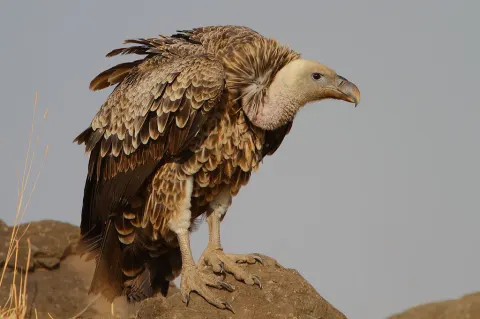
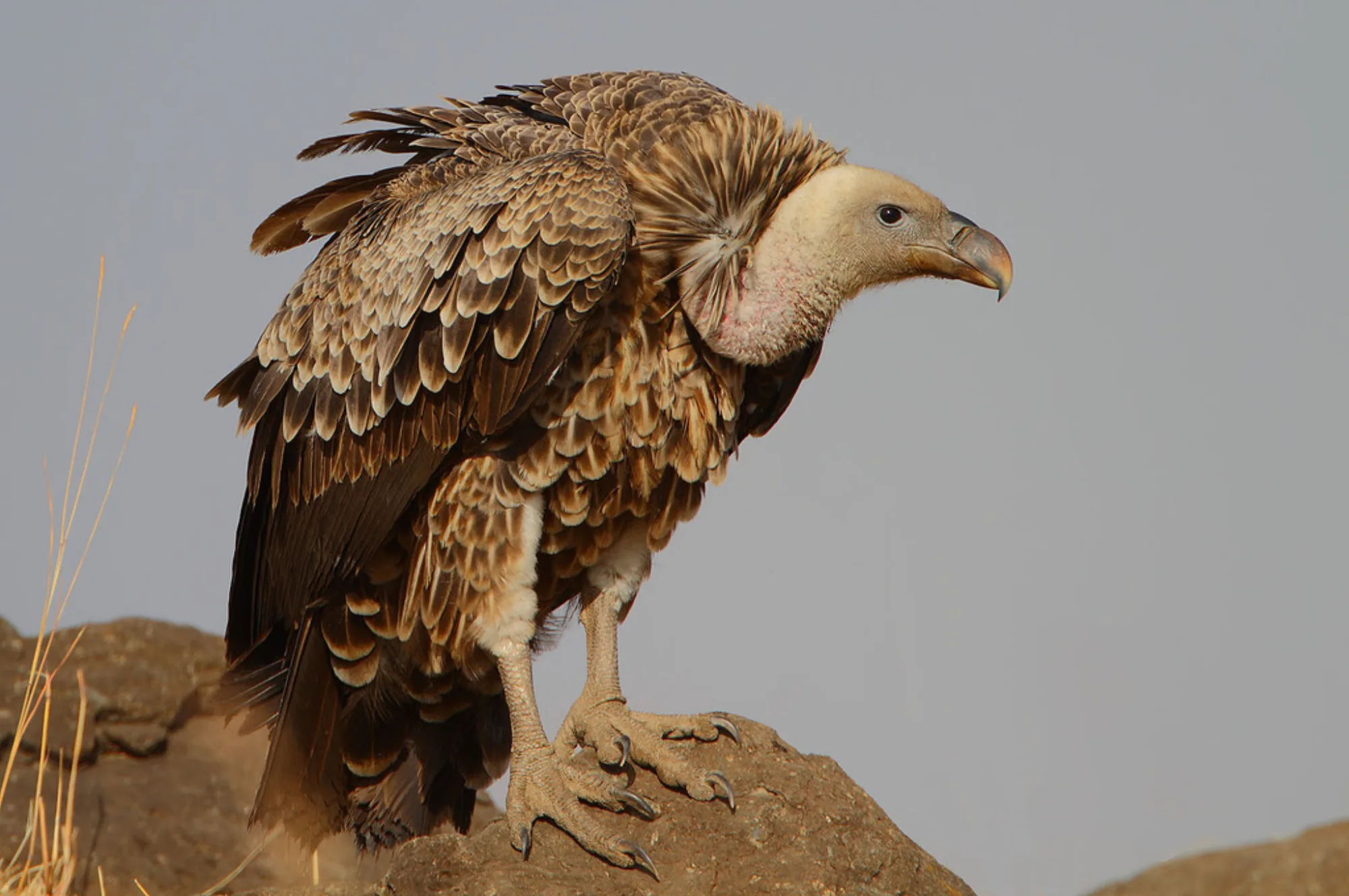
Over the Sahel and East Africa, Gyps rueppelli is a large resident vulture that can travel more than 100 km from its nest in search of food. Adults measure 85 to 103 cm from end to end, and their wings span 2.26 to 2.6 m. Both sexes have mottled brown or black plumage, a whitish-brown underside, a white collar and a thin covering of dirty-white fluff on the head and neck. Usually silent, they squeal at nests and carcasses. They commonly fly as high as 6,000 m, and one bird was recorded at 11,300 m.
Rüppell's vultures eat carrion, sometimes following game herds on their seasonal migrations and gathering in large numbers with other vultures at carcasses. They favour fresh meat but also eat older remains, and can continue feeding on hide and bones after the softer parts are gone. Breeding pairs stay together for life and build nests on cliffs from sticks, grass and leaves. In major breeding areas, hundreds of pairs may nest in a colony. Both parents incubate the egg for 55 days and tend the chick for about 150 days until it flies, though it remains dependent until the next breeding season.
Populations are declining across the species' range as habitat and nesting sites are lost, food becomes scarcer, and birds are poisoned or killed for medicine or meat. Poisoned carcasses set out against predators can also kill vultures that gather to feed. In one assessment of 10 poisoning events, each event killed 37 to 600 birds.
Written from the English Wikipedia article Rüppell's vulture (CC BY-SA 4.0).
- Records
- 16,970
- Countries
- 15
- Atlas places
- 26
- Serengeti National Park· Tanzania
- Ngorongoro Conservation Area· Tanzania
- Maasai Mara National Reserve· Kenya
- Tsavo West National Park· Kenya
- Murchison Falls National Park· Uganda
- Tsavo East National Park· Kenya
- Tarangire National Park· Tanzania
- Lake Manyara National Park· Tanzania
- Aberdare National Park· Kenya
- Queen Elizabeth National Park· Uganda
- Samburu National Reserve· Kenya
- Kidepo Valley National Park· Uganda
- Nairobi National Park· Kenya
- Nyerere National Park· Tanzania
- Amboseli National Park· Kenya
- Hell's Gate National Park· Kenya
- Kilimanjaro National Park· Tanzania
- Mount Kenya National Park· Kenya
- Ruaha National Park· Tanzania
- Arusha National Park· Tanzania
- Lake Mburo National Park· Uganda
- Lake Nakuru National Park· Kenya
- Meru National Park· Kenya
- Mikumi National Park· Tanzania
- Rwenzori Mountains National Park· Uganda
- Udzungwa Mountains National Park· Tanzania
These are open occurrence records, so they show where people looked for and recorded the Gyps rueppelli as much as where it lives. Cells are up to 25 km across, and every location is generalised to its cell.
Generalised encounter areas, not exact locations. Each shape is a grid cell coloured by how likely the species is there.
- Very likelyKenya25 km zone · high confidence · 4988 records · updated 80 days ago
- Very likelyTanzania25 km zone · medium confidence · 4964 records · updated 80 days ago
- Very likelySpain25 km zone · high confidence · 2079 records · updated 80 days ago
- Very likelyEthiopia25 km zone · medium confidence · 1960 records · updated 80 days ago
- Very likelyUganda25 km zone · high confidence · 1612 records · updated 80 days ago
- Very likelySenegal25 km zone · high confidence · 565 records · updated 80 days ago
- Very likelyGambia25 km zone · high confidence · 268 records · updated 80 days ago
- Very likelyPortugal25 km zone · high confidence · 263 records · updated 80 days ago
- Very likelyCongo - Kinshasa25 km zone · high confidence · 123 records · updated 80 days ago
- LikelyCameroon25 km zone · medium confidence · 39 records · updated 80 days ago
Conservation status not assessed here yet, so every location is generalised to its grid cell.