Indian Vulture
Gyps indicus
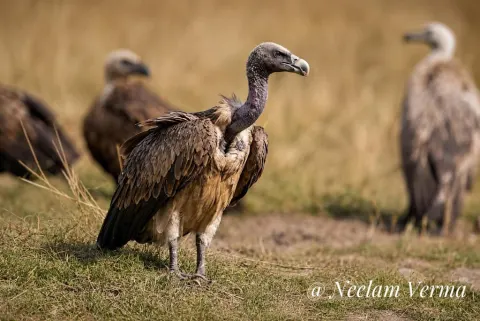
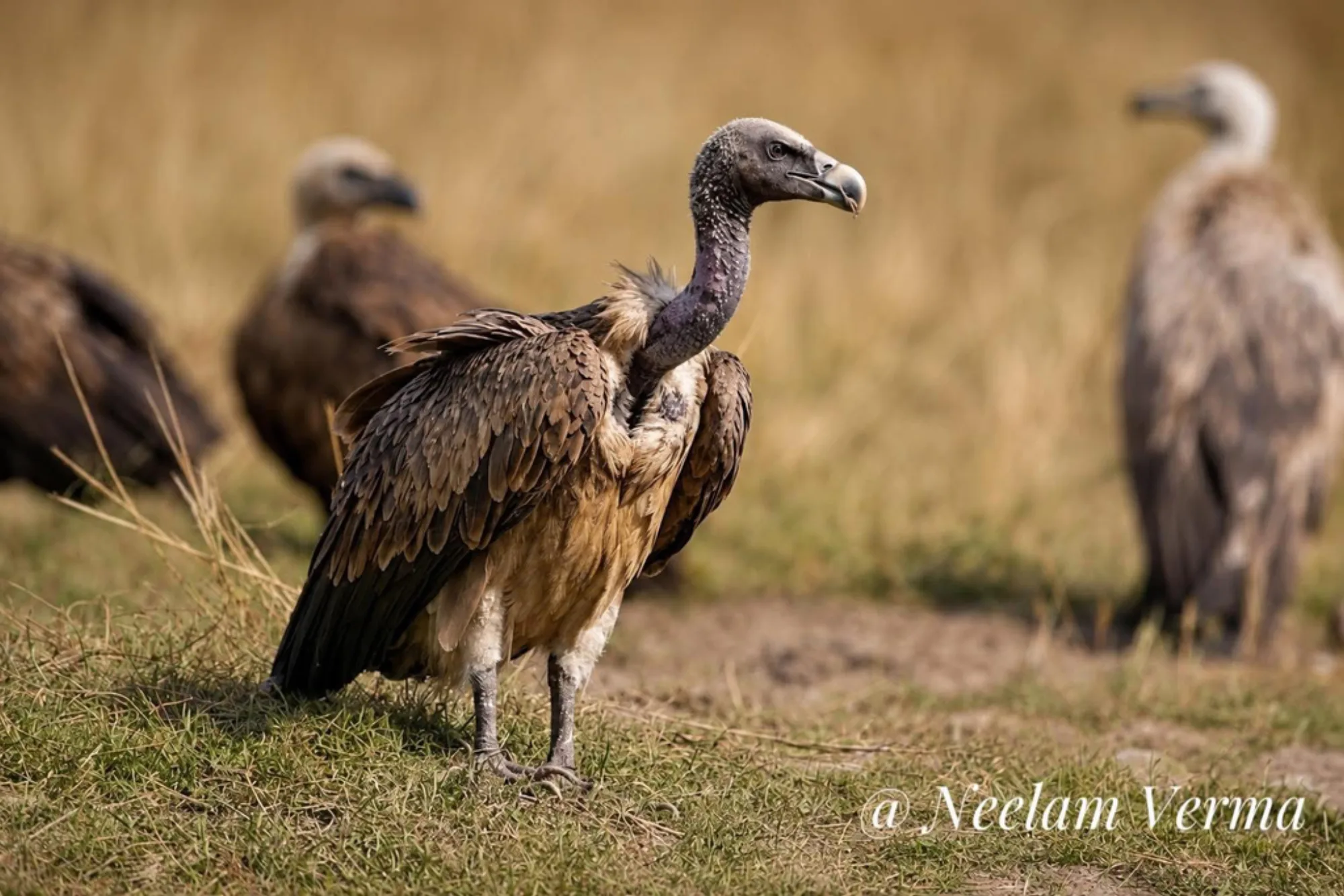
Look for the Indian Vulture soaring on rising currents of warm air, often in a small flock and sometimes alongside other vulture species. This bulky, medium-sized bird of prey has pale brown body feathers, darker flight feathers, broad wings and a short tail. Its small, bare dark-brown head and long, featherless neck lead to a long yellowish beak. It measures 89 to 103 cm in length, with a wingspan of 2.22 to 2.58 m.
Most remaining populations live south of the Gangetic plains, across central India and the peninsula, with others in southwest Pakistan, Bangladesh and Nepal. The bird uses a range of landscapes, from semi-desert and dry foothills to open fields and farmland near villages. It also occurs near urban rubbish dumps and slaughterhouses. Although it does not migrate, it travels widely in search of food, using its eyesight to find carcasses. Dead cattle and remains left by large predators are regular meals, and birds may fight for a good position at a carcass. Indian vultures usually nest on cliffs or high buildings, occasionally using trees, old monuments or towers. Nest building begins in September, breeding takes place between November and March, and the female lays one egg a year. Both parents take turns incubating it, and it hatches after about 50 days.
The population fell sharply after vultures ate dead cattle treated with diclofenac, a drug that can cause kidney failure in the birds. Although diclofenac was banned in India, Pakistan and Nepal, it remained available for veterinary use, and other harmful drugs were also in use. Near human settlements, road traffic, power lines, trains and windmills pose further risks.
Written from the English Wikipedia article Indian vulture (CC BY-SA 4.0).
- Records
- 11,982
- Countries
- 3
- Atlas places
- 8
These are open occurrence records, so they show where people looked for and recorded the Indian Vulture as much as where it lives. Cells are up to 25 km across, and every location is generalised to its cell.
Generalised encounter areas, not exact locations. Each shape is a grid cell coloured by how likely the species is there.
- Very likelyIndia25 km zone · high confidence · 11934 records · updated 80 days ago
- LikelyNepal25 km zone · medium confidence · 37 records · updated 80 days ago
- PossiblePakistan25 km zone · medium confidence · 11 records · updated 80 days ago
Conservation status not assessed here yet, so every location is generalised to its grid cell.