Griffon Vulture
Gyps fulvus
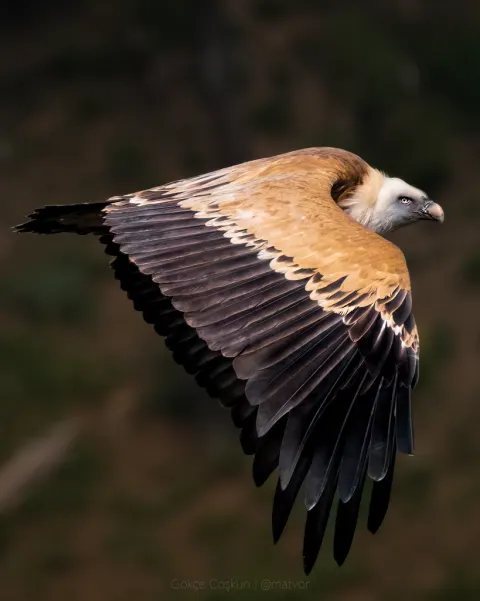
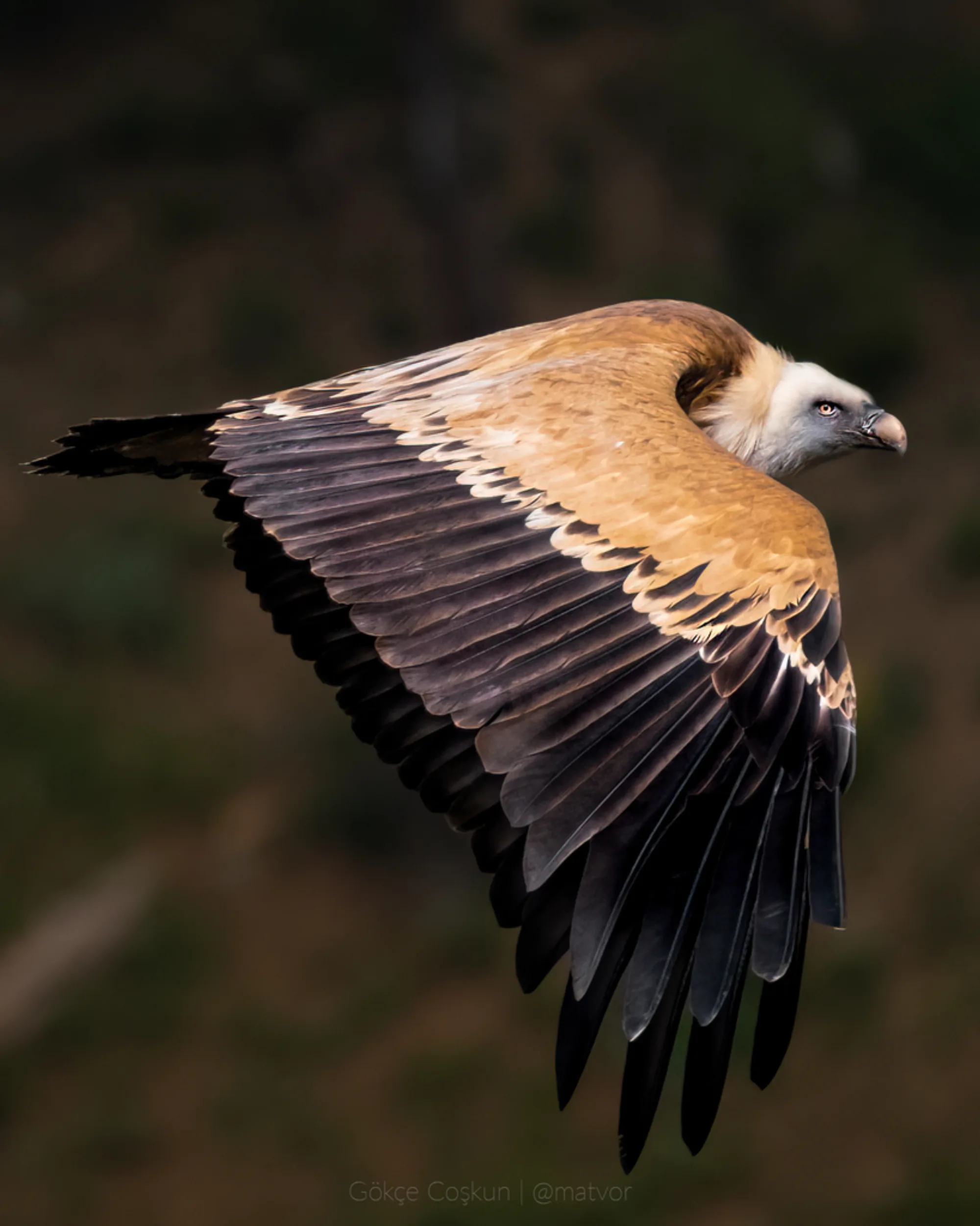
With broad wings, a short tail and a white head, the Griffon Vulture is a large bird of prey built for soaring. A white neck ruff and yellow bill add to its distinctive appearance, while its buff body and wing feathers contrast with darker flight feathers. It measures 93 to 122 cm in length, with a wingspan of 2.3 to 2.8 m.
This vulture lives year-round across parts of southern Europe, North Africa and Asia, from the Iberian Peninsula and eastern Atlas Mountains to the Tian Shan and Altai Mountains. Mountainous areas are important habitat: on Crete, birds inhabit the mountains and sometimes gather in groups of up to 20. They breed on mountain crags, sometimes in loose colonies, and lay one egg. Nests in caves, potholes and sheltered ledges are favoured over exposed sites and produce more fledglings. On the Croatian island of Cres, some birds nest as low as 10 m, bringing them into frequent contact with people.
Griffon Vultures are scavengers that use soaring to travel efficiently. They feed more rapidly when food is plentiful, and older adults have shown more aggression and dominance in studies connected with reintroduction. Poisoned baits set by people are the main cause of the species' rapid decline. In the Pyrenees, restrictions on leaving carcasses in fields have sharply reduced the food available to vultures. Although they do not normally attack larger living prey, Spanish birds have been reported killing weak, young or unhealthy animals when carrion is scarce.
Written from the English Wikipedia article Eurasian griffon vulture (CC BY-SA 4.0).
- Records
- 309,284
- Countries
- 69
- Atlas places
- 3
These are open occurrence records, so they show where people looked for and recorded the Griffon Vulture as much as where it lives. Cells are up to 25 km across, and every location is generalised to its cell.
Generalised encounter areas, not exact locations. Each shape is a grid cell coloured by how likely the species is there.
- Very likelySpain25 km zone · high confidence · 225931 records · updated 86 days ago
- Very likelyFrance25 km zone · high confidence · 48552 records · updated 86 days ago
- Very likelyPortugal25 km zone · high confidence · 13425 records · updated 86 days ago
- Very likelyIsrael25 km zone · high confidence · 3456 records · updated 86 days ago
- Very likelyIndia25 km zone · high confidence · 2379 records · updated 86 days ago
- Very likelyAndorra25 km zone · high confidence · 2262 records · updated 86 days ago
- Very likelyRussia25 km zone · high confidence · 1852 records · updated 86 days ago
- Very likelyBulgaria25 km zone · high confidence · 1630 records · updated 86 days ago
- Very likelyGreece25 km zone · high confidence · 1264 records · updated today
- Very likelyAzerbaijan25 km zone · high confidence · 1180 records · updated today
Conservation status not assessed here yet, so every location is generalised to its grid cell.