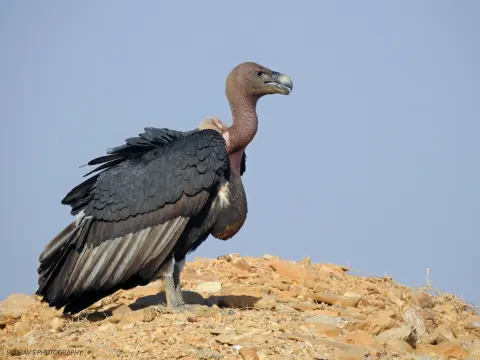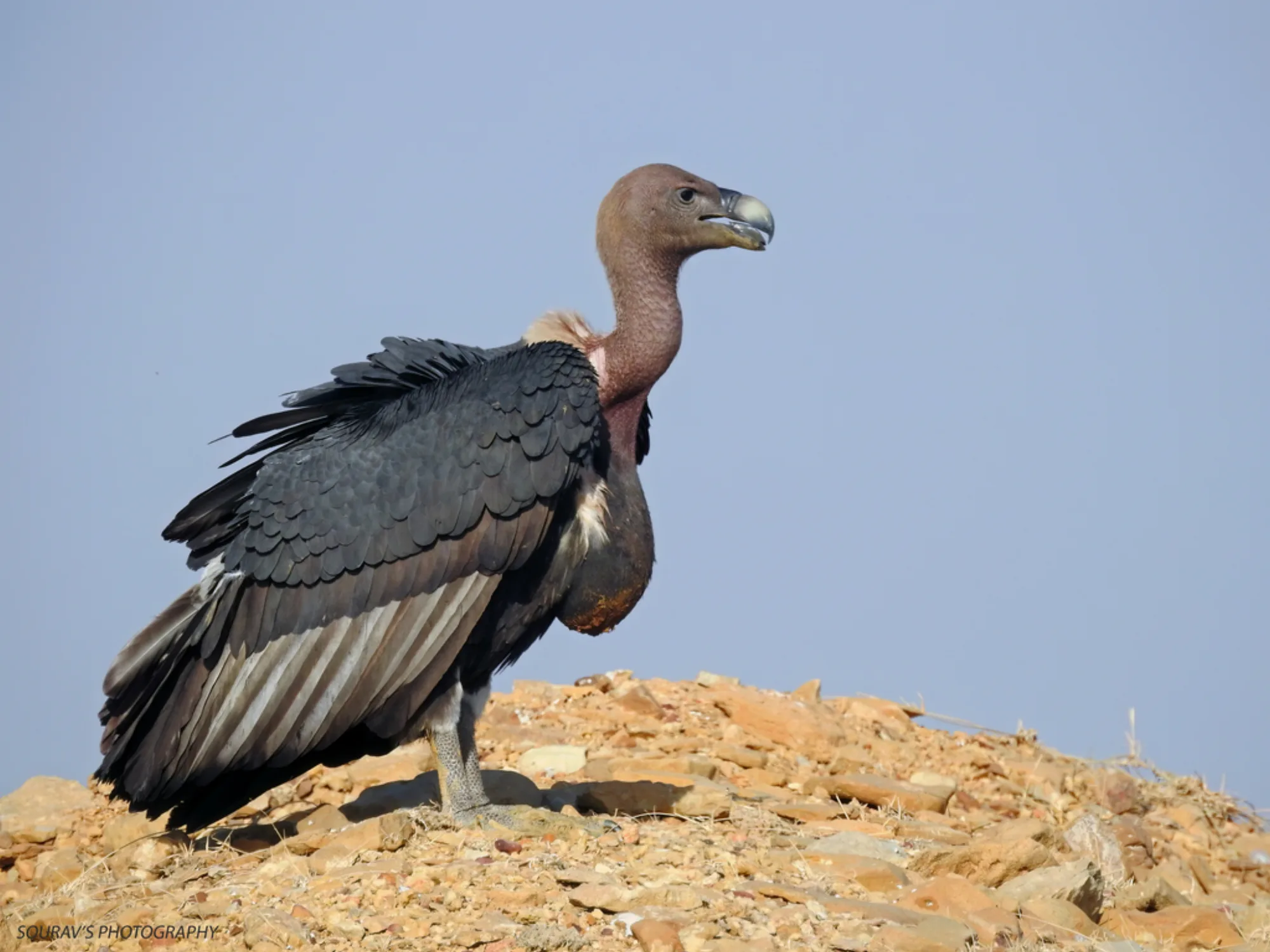
White-rumped Vulture
Gyps bengalensis
Broad wings and a short tail give the White-rumped Vulture a distinctive outline as it soars over South and Southeast Asia. Though the smallest of the Gyps vultures, it is still a very large bird, measuring 75 to 93 cm in length. Adults have dark bodies, a white neck ruff and a pale back and rump; from below, the white wing lining contrasts with the dark leading edge. Young birds are largely dark, taking about four or five years to gain adult plumage.
The species is mostly resident and often flies or perches in flocks. It nests in tall trees, often close to human settlements, and forms communal roosts. As the morning sun warms the air, the birds take to rising currents and search for carcasses, sometimes using the presence of other scavengers to locate food. They descend quickly to feed, and may also return to carcasses after dark. Where water is available, they drink and bathe regularly. Several pairs may nest close together, lining their nests with green leaves; the main nesting period runs from November to March. A female usually lays one egg, and the young remain in the nest for about three months, fed on pieces of meat by their parents.
Numbers have fallen sharply: in 2021, the global population was estimated at fewer than 6,000 mature birds. A major cause of decline is poisoning from the veterinary drug diclofenac, which can remain in cattle carcasses and cause kidney failure in vultures that feed on them. In Southeast Asia, the loss of large wild hoofed animals and changes in the disposal of dead livestock probably left vultures with fewer carcasses to eat.
Written from the English Wikipedia article White-rumped vulture (CC BY-SA 4.0).
- Records
- 13,808
- Countries
- 5
- Atlas places
- 15
- Bandipur National Park· India
- Jim Corbett National Park· India
- Nagarhole National Park· India
- Chitwan National Park· Nepal
- Annapurna Conservation Area· Nepal
- Kanha National Park· India
- Pench National Park· India
- Bandhavgarh National Park· India
- Kaziranga National Park· India
- Shuklaphanta National Park· Nepal
- Koshi Tappu Wildlife Reserve· Nepal
- Ranthambore National Park· India
- Bardiya National Park· Nepal
- Gir National Park· India
- Manas National Park· India
These are open occurrence records, so they show where people looked for and recorded the White-rumped Vulture as much as where it lives. Cells are up to 25 km across, and every location is generalised to its cell.
Generalised encounter areas, not exact locations. Each shape is a grid cell coloured by how likely the species is there.
- Very likelyIndia25 km zone · high confidence · 10914 records · updated 80 days ago
- Very likelyNepal25 km zone · high confidence · 2338 records · updated 80 days ago
- Very likelyCambodia25 km zone · high confidence · 496 records · updated 80 days ago
- LikelyMyanmar (Burma)25 km zone · medium confidence · 53 records · updated 80 days ago
- PossiblePakistan25 km zone · medium confidence · 7 records · updated 80 days ago
Conservation status not assessed here yet, so every location is generalised to its grid cell.