White-backed Vulture
Gyps africanus
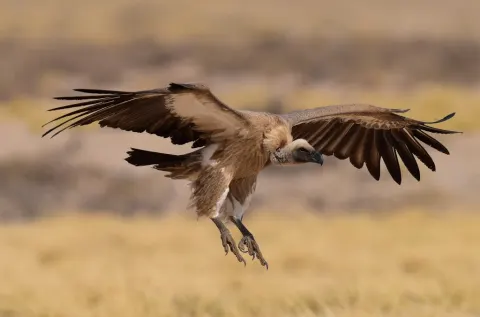
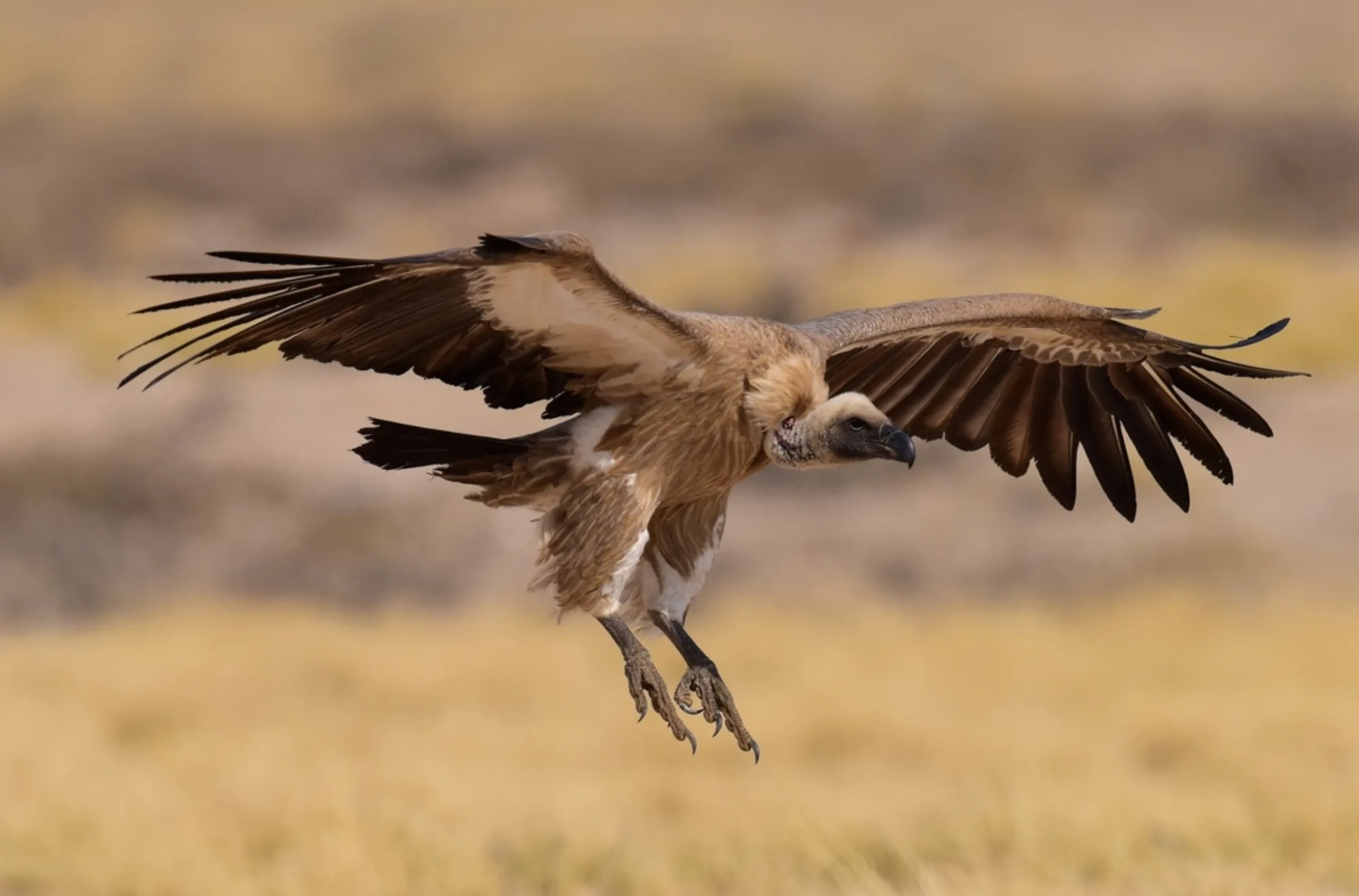
With broad wings, a short tail and a white ruff around its neck, the White-backed Vulture has a familiar vulture silhouette. Adults have a pale back that contrasts with their otherwise dark plumage, while young birds are largely dark. This medium-sized bird measures 78 to 98 cm in length, with a wingspan of 1.96 to 2.25 m. Its range stretches from Senegal, Gambia and Mali across the Sahel to Ethiopia and Somalia, then south through East Africa to South Africa. It lives in wooded savannah, where the carcasses of large grazing animals provide its main food.
White-backed Vultures circle overhead looking for freshly dead animals, sometimes following other scavenging birds and mammalian carnivores to find them. They feed together and are often among the first vultures at a carcass, eating soft tissues as well as bone fragments. Their food includes zebras, gazelles, warthogs, rhinoceroses, buffalo, ostriches and livestock. For nesting, they favour tall trees along waterways, especially Acacia, building large stick nests lined with leaves and grasses. Breeding takes time: incubation lasts around 8 weeks, followed by about 4 to 5 months in the nest.
The species has suffered a rapid decline, with a 2024 study reporting a population fall of 86%. Habitat degradation, poaching and the loss of nesting sites all threaten it, while expanding farming and ranching are associated with less nesting activity. Changes in vegetation, including woody plant encroachment, can reduce visibility and make finding food less efficient. Poisoning is another danger: in northern Botswana, hundreds of White-backed Vultures were suspected to have died after feeding on elephants poisoned by poachers. Veterinary diclofenac also poisoned vultures in studies.
Written from the English Wikipedia article White-backed vulture (CC BY-SA 4.0).
- Records
- 97,312
- Countries
- 33
- Atlas places
- 44
- Kruger National Park· South Africa
- Okavango Delta· Botswana
- Serengeti National Park· Tanzania
- Ngorongoro Conservation Area· Tanzania
- Chobe National Park· Botswana
- Etosha National Park· Namibia
- iSimangaliso Wetland Park· South Africa
- Kgalagadi Transfrontier Park· South Africa
- Maasai Mara National Reserve· Kenya
- Hluhluwe-iMfolozi Park· South Africa
- Lake Manyara National Park· Tanzania
- Queen Elizabeth National Park· Uganda
- Bwabwata National Park· Namibia
- Hwange National Park· Zimbabwe
- Akagera National Park· Rwanda
- Gonarezhou National Park· Zimbabwe
- Kidepo Valley National Park· Uganda
- Mapungubwe National Park· South Africa
- Nairobi National Park· Kenya
- Nkasa Rupara National Park· Namibia
- Samburu National Reserve· Kenya
- Tarangire National Park· Tanzania
- Zambezi National Park· Zimbabwe
- Mudumu National Park· Namibia
- Murchison Falls National Park· Uganda
- South Luangwa National Park· Zambia
- Aberdare National Park· Kenya
- Amboseli National Park· Kenya
- Arusha National Park· Tanzania
- Bwindi Impenetrable National Park· Uganda
- Hell's Gate National Park· Kenya
- Kafue National Park· Zambia
- Kasanka National Park· Zambia
- Lake Mburo National Park· Uganda
- Lake Nakuru National Park· Kenya
- Liuwa Plain National Park· Zambia
- Lower Zambezi National Park· Zambia
- Madikwe Game Reserve· South Africa
- Mana Pools National Park· Zimbabwe
- Mikumi National Park· Tanzania
- Namib-Naukluft· Namibia
- Nyerere National Park· Tanzania
- Udzungwa Mountains National Park· Tanzania
- Waterberg Plateau Park· Namibia
These are open occurrence records, so they show where people looked for and recorded the White-backed Vulture as much as where it lives. Cells are up to 25 km across, and every location is generalised to its cell.
Generalised encounter areas, not exact locations. Each shape is a grid cell coloured by how likely the species is there.
- Very likelySouth Africa25 km zone · high confidence · 48272 records · updated 86 days ago
- Very likelyKenya25 km zone · high confidence · 9991 records · updated 86 days ago
- Very likelyTanzania25 km zone · high confidence · 8885 records · updated 86 days ago
- Very likelyNamibia25 km zone · high confidence · 5717 records · updated 86 days ago
- Very likelyBotswana25 km zone · high confidence · 4477 records · updated 86 days ago
- Very likelyUganda25 km zone · high confidence · 4392 records · updated 86 days ago
- Very likelyZimbabwe25 km zone · high confidence · 4262 records · updated 86 days ago
- Very likelyMozambique25 km zone · high confidence · 3834 records · updated 86 days ago
- Very likelyZambia25 km zone · high confidence · 2498 records · updated 86 days ago
- Very likelyEthiopia25 km zone · high confidence · 1225 records · updated 86 days ago
Conservation status not assessed here yet, so every location is generalised to its grid cell.