Bearded Vulture
Gypaetus barbatus
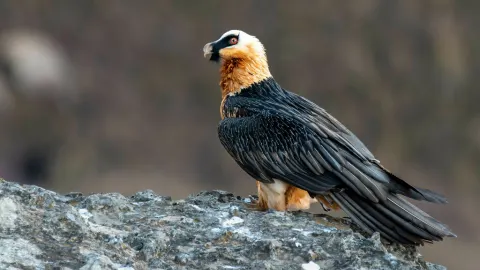
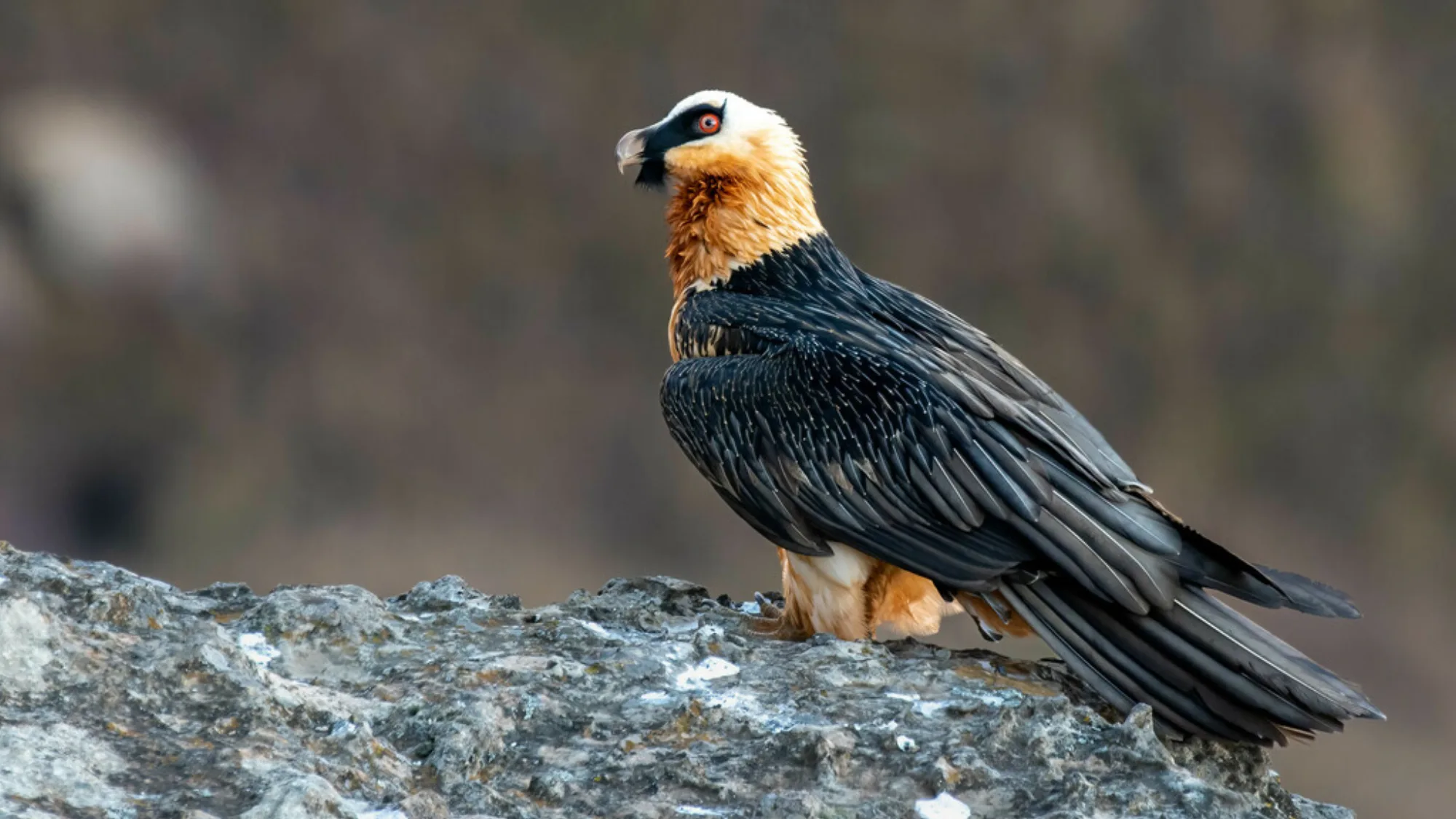
Long, narrow wings and a wedge-shaped tail give the Bearded Vulture a distinctive silhouette in flight. This very large bird of prey has a feathered head, with a dark band across the eyes and black bristles beneath the chin. Adults are largely grey, rusty and white, while young birds are mostly dark black-brown. The rusty colour can come from bathing in dust or rubbing iron-rich mud over the body.
Bearded Vultures live among high mountain crags across a broad but scattered range, from southern Europe and East Africa to the Himalayas and central China. They usually live around or above the tree line and are rarely found below 1,000 m, although they sometimes descend lower. In Ethiopia, they can also be seen at rubbish dumps outside villages and towns. Generally solitary, they search for food flying low over rocky ground.
These scavengers feed mostly on dead animals and specialise in eating bones. They carry bones too large to swallow into the air and drop them onto rocks, then glide or spiral down to inspect the pieces. Young birds need extensive practice to master this skill. Breeding pairs build large stick nests on steep rock walls, often in caves or on ledges, and both parents care for the young. Females usually lay one or two eggs, and chicks fledge after 100 to 130 days in the nest. Habitat loss, reduced food supplies, poisoning, hunting and collisions with energy infrastructure all contribute to population declines. Birds have been reintroduced to the Alps, where a population has become established again.
Written from the English Wikipedia article Bearded vulture (CC BY-SA 4.0).
- Records
- 50,755
- Countries
- 40
- Atlas places
- 12
- uKhahlamba-Drakensberg Park· South Africa
- Annapurna Conservation Area· Nepal
- Hemis National Park· India
- Golden Gate Highlands National Park· South Africa
- Kilimanjaro National Park· Tanzania
- Langtang National Park· Nepal
- Aberdare National Park· Kenya
- Amboseli National Park· Kenya
- Hell's Gate National Park· Kenya
- Lake Manyara National Park· Tanzania
- Ngorongoro Conservation Area· Tanzania
- Sagarmatha National Park· Nepal
These are open occurrence records, so they show where people looked for and recorded the Bearded Vulture as much as where it lives. Cells are up to 25 km across, and every location is generalised to its cell.
Generalised encounter areas, not exact locations. Each shape is a grid cell coloured by how likely the species is there.
- Very likelyFrance25 km zone · high confidence · 20585 records · updated 86 days ago
- Very likelySpain25 km zone · high confidence · 10204 records · updated 86 days ago
- Very likelyIndia25 km zone · high confidence · 5536 records · updated 86 days ago
- Very likelyItaly25 km zone · medium confidence · 2518 records · updated 86 days ago
- Very likelySouth Africa25 km zone · high confidence · 1829 records · updated 86 days ago
- Very likelyNepal25 km zone · high confidence · 1156 records · updated 86 days ago
- Very likelyChina25 km zone · high confidence · 1088 records · updated 86 days ago
- Very likelyGeorgia25 km zone · high confidence · 1047 records · updated 86 days ago
- Very likelyLesotho25 km zone · high confidence · 1015 records · updated 86 days ago
- Very likelySwitzerland25 km zone · high confidence · 969 records · updated 86 days ago
Conservation status not assessed here yet, so every location is generalised to its grid cell.