European Shag
Gulosus aristotelis
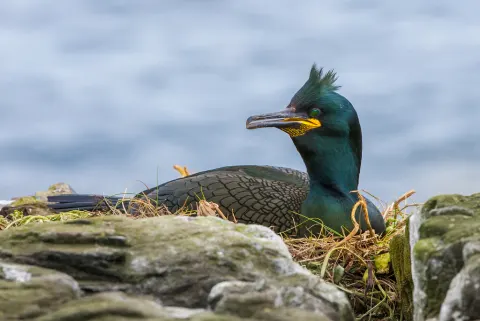
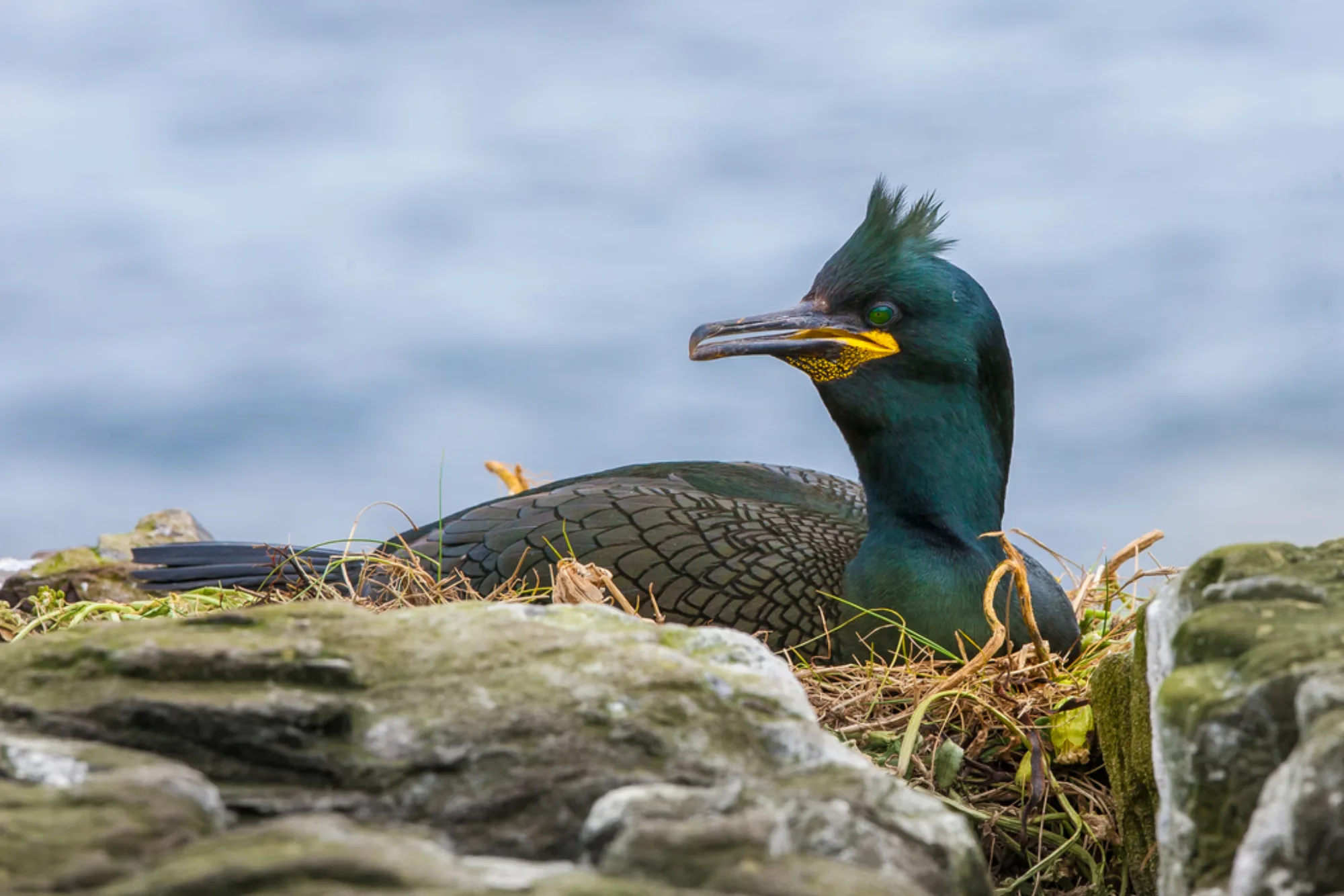
On a rocky coast, look for the European Shag, a black cormorant with a longish tail and a yellow patch at its throat. It measures 68 to 78 cm in length, with a wingspan of 95 to 110 cm. Breeding adults show a small crest and a metallic green sheen, while their smaller size, lighter build and thinner bill help distinguish them from great cormorants. Young shags have darker underparts than young great cormorants.
European Shags breed along rocky shores from western and southern Europe to southwest Asia and north Africa. Most spend the winter within their breeding range, though the northernmost birds are an exception; they can winter along any coast with a good supply of fish. They feed at sea and are rarely found inland, travelling many kilometres from their roosts to find food. Fish form a varied diet, with sand eels their most common prey, and they usually hunt near the seabed. Before diving, a shag jumps clear of the water; dives in UK coastal waters typically last around 20 to 45 seconds. Birds have been recorded diving as deep as 61 m.
Nests sit on rocky ledges, in crevices or in small caves, and are untidy heaps of seaweed or twigs held together with guano. Nesting can begin in late February, although some birds start in May or later, and three eggs are laid. The chicks hatch without down and depend on their parents for warmth, often for two months before they can fly. At Scotland's Isle of May, evidence suggests that chick diets have become more varied in response to ocean warming; shags there also eat fewer sand eels on windy days.
Written from the English Wikipedia article European shag (CC BY-SA 4.0).
- Records
- 244,828
- Countries
- 21
No atlas park has a record of the European Shag in or around it yet.
These are open occurrence records, so they show where people looked for and recorded the European Shag as much as where it lives. Cells are up to 25 km across, and every location is generalised to its cell.
Generalised encounter areas, not exact locations. Each shape is a grid cell coloured by how likely the species is there.
- Very likelyNorway25 km zone · high confidence · 92628 records · updated 80 days ago
- Very likelyUnited Kingdom25 km zone · high confidence · 73257 records · updated 80 days ago
- Very likelySpain25 km zone · high confidence · 31259 records · updated 80 days ago
- Very likelyIreland25 km zone · high confidence · 10620 records · updated 80 days ago
- Very likelyPortugal25 km zone · high confidence · 10540 records · updated 80 days ago
- Very likelyIsle of Man25 km zone · high confidence · 7359 records · updated 80 days ago
- Very likelyFrance25 km zone · high confidence · 5459 records · updated 80 days ago
- Very likelyIceland25 km zone · high confidence · 3561 records · updated 80 days ago
- Very likelyTürkiye25 km zone · high confidence · 3554 records · updated 80 days ago
- Very likelySlovenia25 km zone · high confidence · 1192 records · updated 80 days ago
Conservation status not assessed here yet, so every location is generalised to its grid cell.