Black-necked Crane
Grus nigricollis
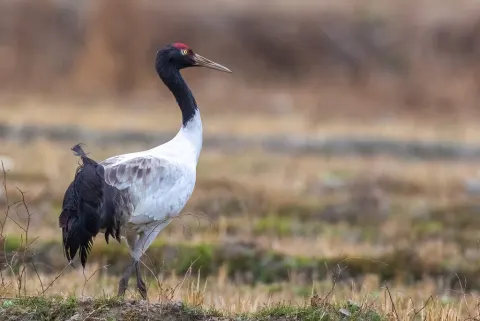
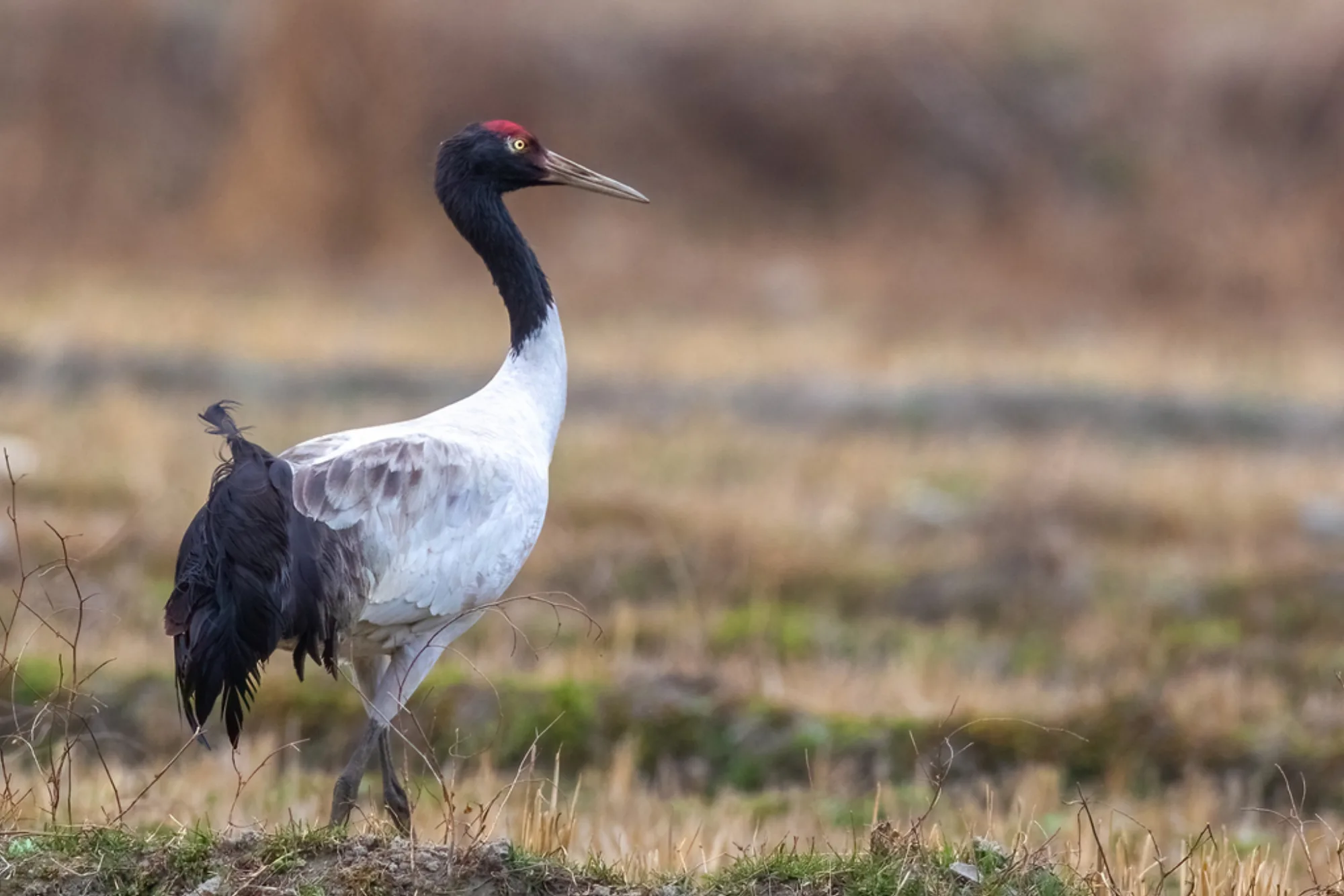
Across the high Tibetan Plateau, the Black-necked Crane spends the summer among alpine meadows, marshes and river valleys. This mostly grey bird has a black head and upper neck, a red crown patch, black legs and a small white patch behind the eye. Its black tail helps distinguish it at a distance from the similar common crane, and its calls are loud and trumpeting. It measures 139 cm long, with a 235 cm wingspan. Most live in China, while smaller populations occur in Vietnam, Bhutan and India. Some populations move seasonally, spending winter in sheltered valleys or at lower altitudes.
Wary of people, the cranes nevertheless grow accustomed to undisturbing local residents in some places. They feed on the ground in small parties, with one bird often standing guard, and eat plant roots, sedge tubers, earthworms, insects, frogs and other small animals. Fallen grain and crops such as potatoes also feature in their diet. Breeding pairs defend territories, perform dances and usually nest on an existing mud island in a large, shallow wetland. They lay one or two eggs, mainly in May and June, and the young continue to accompany their parents when foraging.
The greatest threats are the loss and damage of habitat, especially in wintering wetlands affected by irrigation, dams, drainage and grazing. Drying wetlands can expose nests to predators, while rising water can submerge them. Herders' dogs threaten young birds, hunting persists in parts of China and India, and power lines have killed cranes in some areas of Bhutan.
Written from the English Wikipedia article Black-necked crane (CC BY-SA 4.0).
- Records
- 4,704
- Countries
- 6
- Atlas places
- 2
These are open occurrence records, so they show where people looked for and recorded the Black-necked Crane as much as where it lives. Cells are up to 25 km across, and every location is generalised to its cell.
Generalised encounter areas, not exact locations. Each shape is a grid cell coloured by how likely the species is there.
- Very likelyIndia25 km zone · high confidence · 2393 records · updated 80 days ago
- Very likelyChina25 km zone · high confidence · 1738 records · updated 80 days ago
- Very likelyBhutan25 km zone · high confidence · 558 records · updated 80 days ago
- UncommonMongolia25 km zone · medium confidence · 7 records · updated 80 days ago
- UncommonTajikistan25 km zone · medium confidence · 4 records · updated 80 days ago
- UncommonUnited States25 km zone · medium confidence · 4 records · updated 80 days ago
Conservation status not assessed here yet, so every location is generalised to its grid cell.