Red-crowned Crane
Grus japonensis
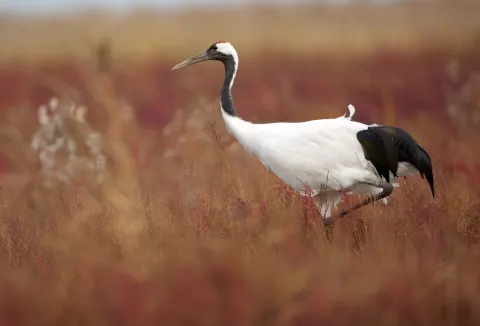
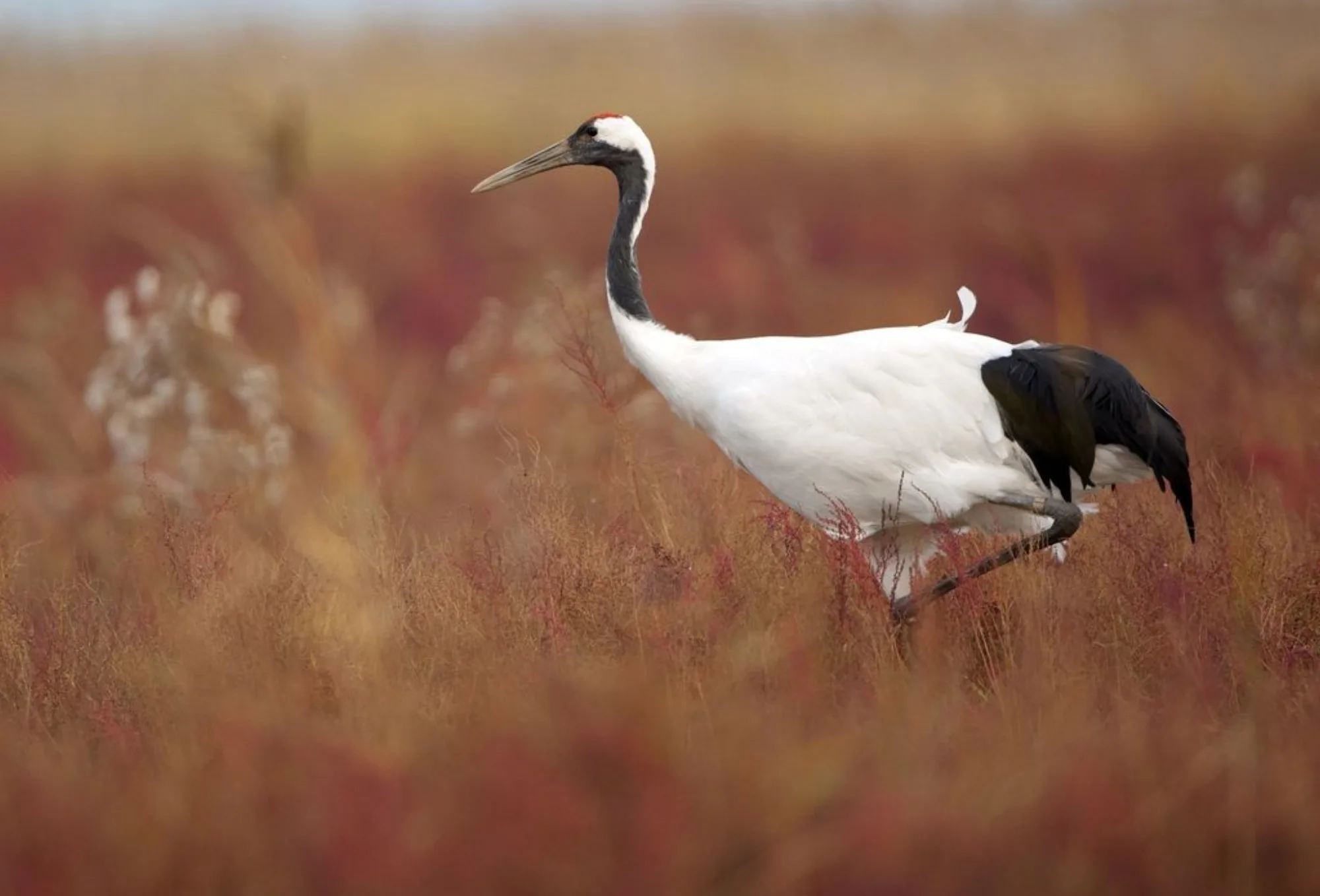
Standing up to 158 cm tall, the Red-crowned Crane is a large Northeast Asian bird with a patch of bare red skin on its crown. Adults are mostly white, with black wing feathers that can look like a black tail when the bird is standing. Males have black cheeks, throats and necks, while these areas are pearly grey in females. Young birds have a mix of white, tawny, brown and rusty or greyish feathers.
Migratory cranes breed in wetlands, marshes and rivers in far eastern Russia and Northeast China, and occasionally in northeastern Mongolia. They travel in flocks to winter on the Korean Peninsula and in east-central China, while a resident population lives in eastern Hokkaidō, Japan. Winter habitats include rice fields, grassy tidal flats and mudflats, where the birds eat aquatic invertebrates. In cold, snowy weather they turn mainly to rice left in the fields. Their varied diet also includes fish, amphibians, insects and water plants; they usually forage with their heads near the ground, probing the mud with their bills.
In winter, cranes may feed alone, in pairs or as families, but roost in larger groups. Pairs give fluting calls together and dance, and defend territories during the breeding season. Both parents build the nest, incubate the eggs and feed the young, which follow them through marshes at around 3 months old. Loss and fragmentation of habitat are the main threats, with few pristine wetlands remaining for nesting. Disturbance near nests, poisoning and poaching also threaten the cranes.
Written from the English Wikipedia article Red-crowned crane (CC BY-SA 4.0).
- Records
- 4,971
- Countries
- 12
No atlas park has a record of the Red-crowned Crane in or around it yet.
These are open occurrence records, so they show where people looked for and recorded the Red-crowned Crane as much as where it lives. Cells are up to 25 km across, and every location is generalised to its cell.
Generalised encounter areas, not exact locations. Each shape is a grid cell coloured by how likely the species is there.
- Very likelyJapan25 km zone · high confidence · 2615 records · updated 80 days ago
- Very likelySouth Korea25 km zone · high confidence · 806 records · updated 80 days ago
- Very likelyChina25 km zone · high confidence · 573 records · updated 80 days ago
- Very likelyRussia25 km zone · high confidence · 379 records · updated 80 days ago
- Very likelyTaiwan25 km zone · medium confidence · 220 records · updated 80 days ago
- Very likelyUnited States25 km zone · high confidence · 204 records · updated 80 days ago
- Very likelySpain25 km zone · high confidence · 120 records · updated 80 days ago
- LikelyMongolia25 km zone · medium confidence · 38 records · updated 80 days ago
- PossibleNorth Korea25 km zone · medium confidence · 10 records · updated 80 days ago
- UncommonDenmark25 km zone · medium confidence · 3 records · updated 80 days ago
Conservation status not assessed here yet, so every location is generalised to its grid cell.