Common Crane
Grus grus
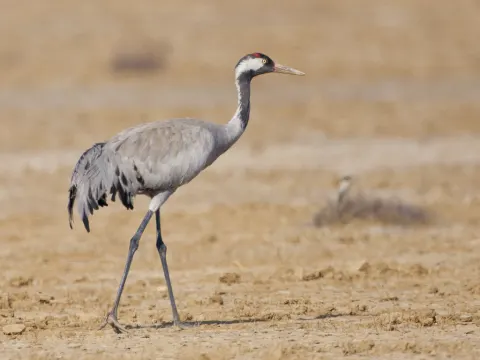
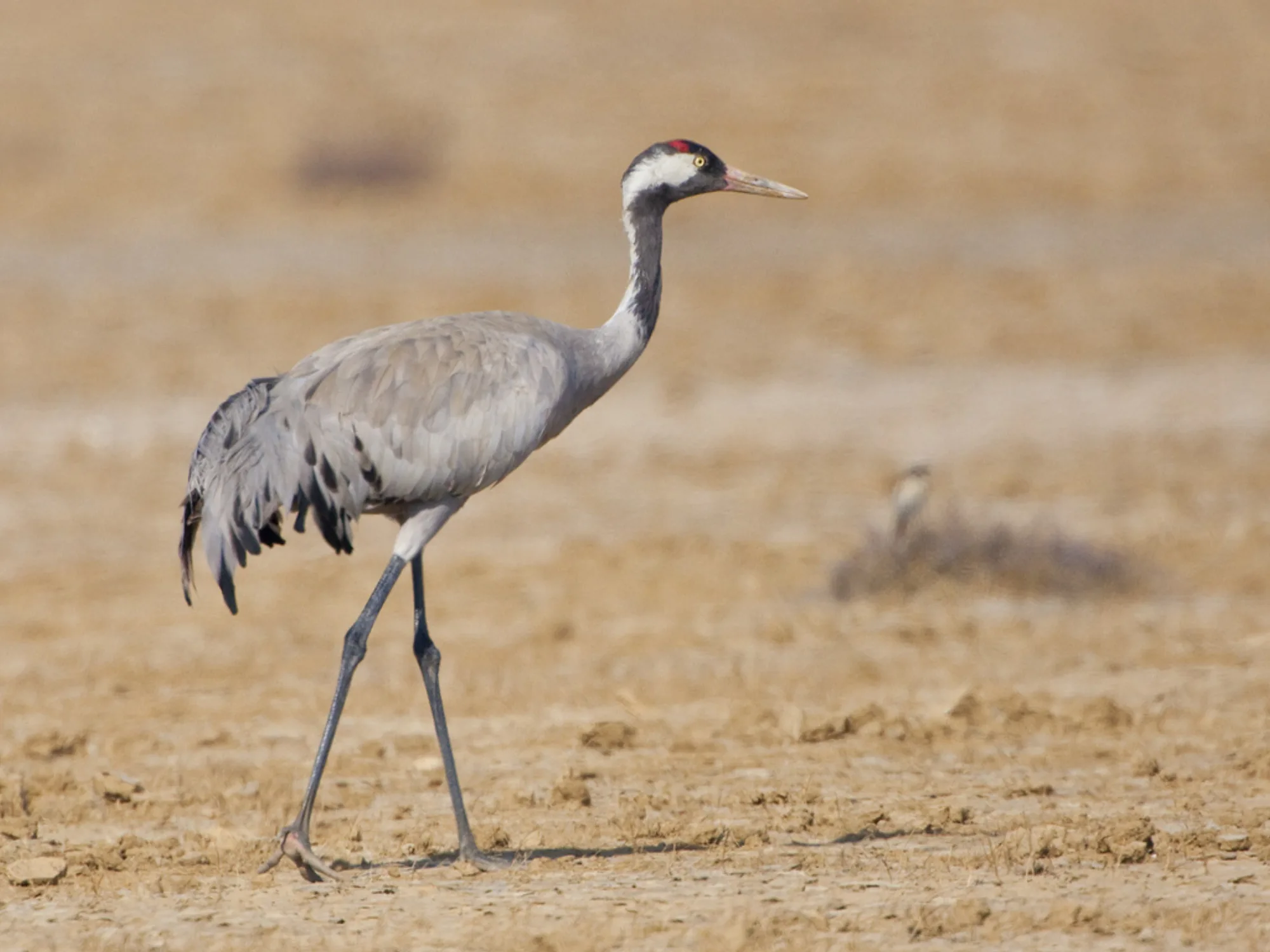
A slate-grey bird with a piercing trumpet call, the Common Crane can be heard from a considerable distance. Adults have a bare red crown, a blackish forehead and a white streak running from behind the eyes towards the upper back. Drooping feathers form plumes over the tail, while young birds lack those plumes and the adult's bright neck pattern. In flight, migrating flocks form a V.
Common Cranes breed across Europe and eastwards to Siberia, with their largest breeding populations in Russia, Finland and Sweden. They favour quiet wooded swamps, bogs and wetlands, though breeding habitats also include forest openings, marshes and treeless moors. European breeders mainly spend winter in Portugal, Spain and northern Africa, while others winter farther east, including in the Indian subcontinent and eastern China. At migration stopovers, thousands can gather to rest and feed.
Cranes forage in small groups on land or in shallow water, probing with their bills. Their varied diet is mostly plant material, from roots and seeds to berries, but insects and other animals become more important during summer breeding. Pairs repeat their courtship displays each spring, and their social dances can include bows, leaps and turns at almost any time of year. Nests lie in or close to shallow water and usually hold two eggs; both parents defend them against ground predators. Habitat loss and degradation are the main threats, driven by wetland drainage, dams, urbanisation and expanding agriculture. Nest disturbance, collisions with utility lines, hunting and pesticide poisoning also pose risks, while outbreaks of highly pathogenic avian influenza have caused mass deaths.
Written from the English Wikipedia article Common crane (CC BY-SA 4.0).
- Records
- 276,158
- Countries
- 82
- Atlas places
- 3
These are open occurrence records, so they show where people looked for and recorded the Common Crane as much as where it lives. Cells are up to 25 km across, and every location is generalised to its cell.
Generalised encounter areas, not exact locations. Each shape is a grid cell coloured by how likely the species is there.
- Very likelyNorway25 km zone · high confidence · 92876 records · updated 86 days ago
- Very likelyFrance25 km zone · high confidence · 53413 records · updated 86 days ago
- Very likelySpain25 km zone · high confidence · 37049 records · updated 86 days ago
- Very likelyFinland25 km zone · high confidence · 18674 records · updated 86 days ago
- Very likelyIndia25 km zone · high confidence · 8919 records · updated 86 days ago
- Very likelyPoland25 km zone · high confidence · 8075 records · updated 86 days ago
- Very likelyIsrael25 km zone · high confidence · 5361 records · updated 86 days ago
- Very likelyBelgium25 km zone · high confidence · 5177 records · updated 86 days ago
- Very likelyUnited Kingdom25 km zone · high confidence · 4995 records · updated 86 days ago
- Very likelySweden25 km zone · high confidence · 4939 records · updated 86 days ago
Conservation status not assessed here yet, so every location is generalised to its grid cell.