Whooping Crane
Grus americana
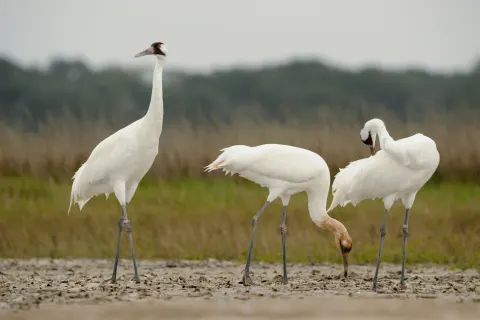
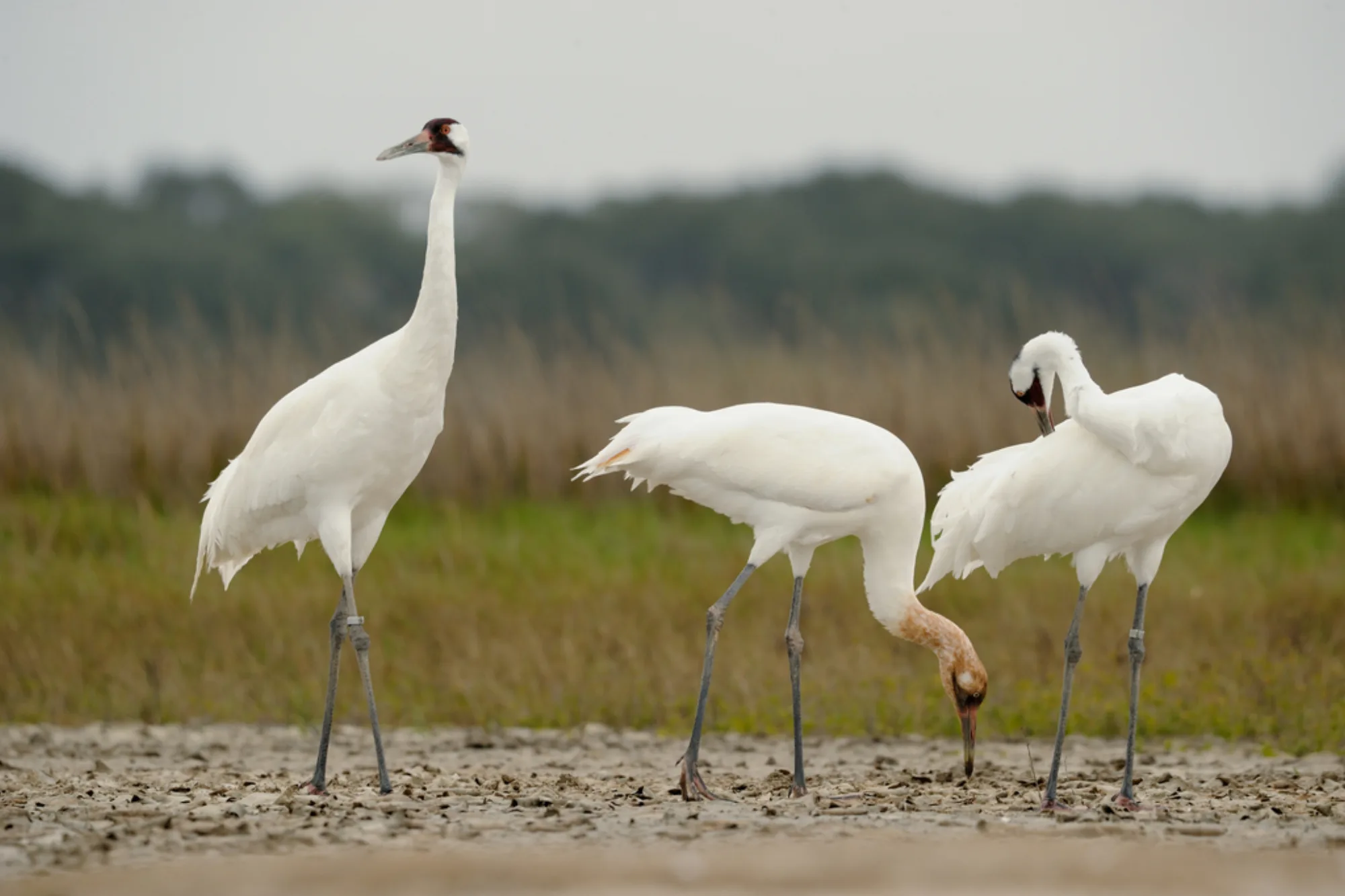
Standing up to 1.6 m tall, the Whooping Crane is the tallest bird native to North America. Adults have white plumage, a red crown and a pointed dark bill; young birds are cinnamon brown. In flight, look for black wing tips, a straight outstretched neck and long dark legs trailing behind. Its loud calls can carry for several kilometres, and pairs call together after waking and when defending their territory.
The surviving migratory population travels between breeding grounds in Canada's Wood Buffalo National Park and wintering marshes on the Gulf coast of Texas, around Aransas National Wildlife Refuge. In Oklahoma, the cranes make a major migratory stop at Salt Plains National Wildlife Refuge. Reintroduced birds also breed in Wisconsin and Louisiana. Walking through shallow water or fields, the cranes search for food and sometimes probe with their bills. Their varied diet includes crustaceans, fish, small rodents, aquatic plants and fruit; waste grain is important during migration. At Aransas, blue crabs have been a significant food source in winter.
For nesting, Whooping Cranes generally choose raised ground within a marsh. Females usually lay 1 or 2 eggs between late April and mid-May, and both parents tend the young. Usually no more than one chick survives in a season, and parents often feed it for 6 to 8 months. Habitat destruction and overhunting caused severe declines, and illegal shooting continues to kill birds in reintroduced populations. Habitat loss, predators and low breeding success have also hampered the Florida reintroduction, while changes in wetland protection have raised concerns about further habitat loss and fragmentation.
Written from the English Wikipedia article Whooping crane (CC BY-SA 4.0).
- Records
- 62,540
- Countries
- 2
- Atlas places
- 1
These are open occurrence records, so they show where people looked for and recorded the Whooping Crane as much as where it lives. Cells are up to 25 km across, and every location is generalised to its cell.
Generalised encounter areas, not exact locations. Each shape is a grid cell coloured by how likely the species is there.
- Very likelyUnited States25 km zone · high confidence · 60799 records · updated 80 days ago
- Very likelyCanada25 km zone · high confidence · 1741 records · updated 80 days ago
Conservation status not assessed here yet, so every location is generalised to its grid cell.