Fairy Basslet
Gramma loreto
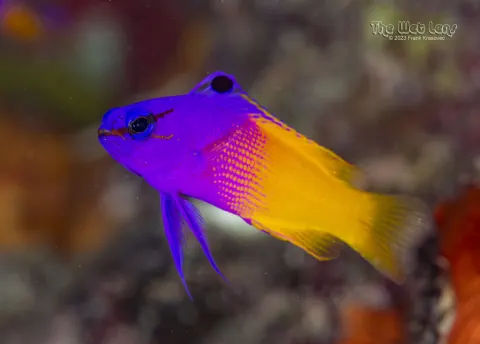
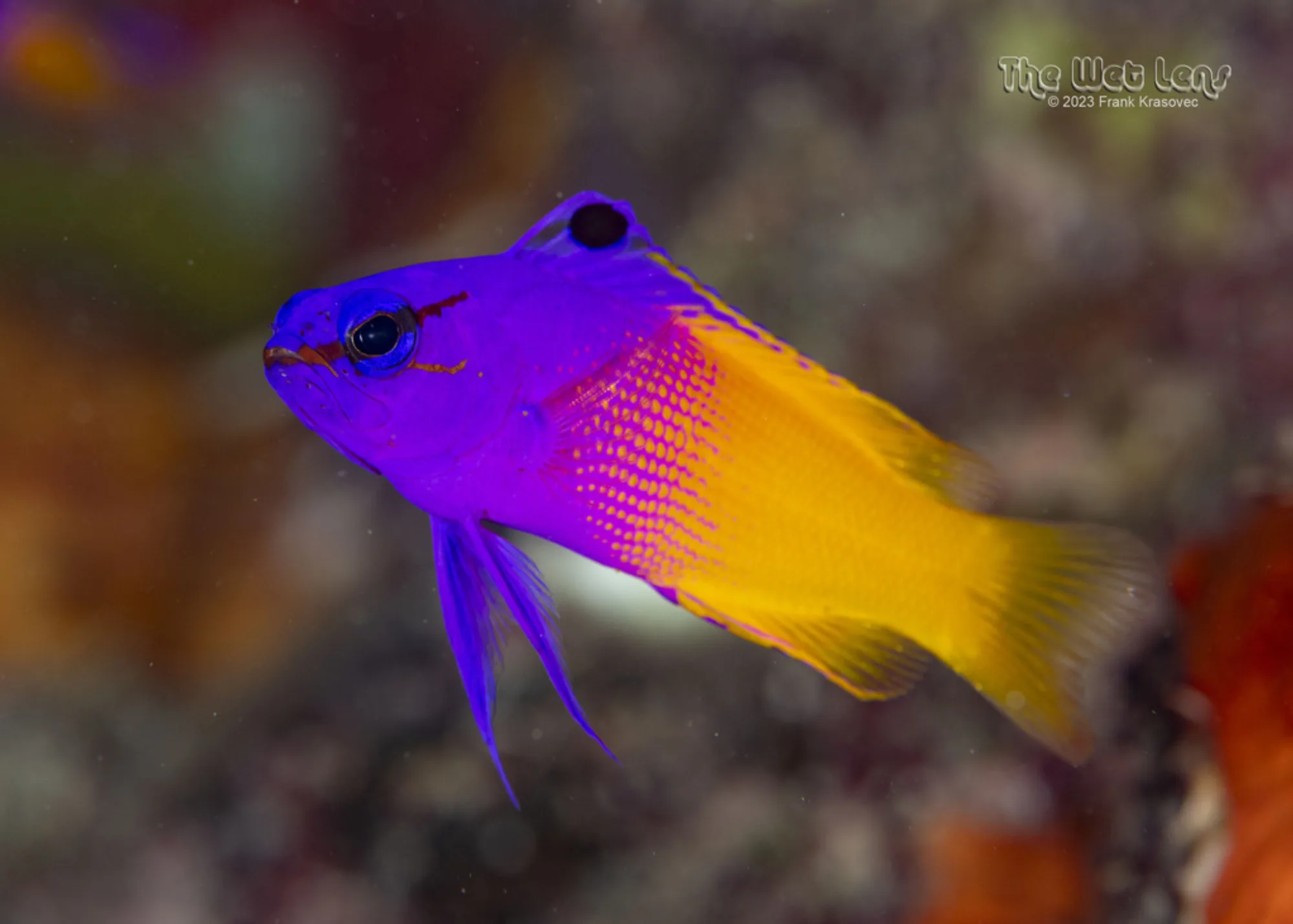
A wash of purple fading into golden yellow makes the Fairy Basslet a striking fish of tropical western Atlantic reefs. Its colour starts light purple to deep violet at the head, then changes gradually towards the yellow tail. A small black spot marks its dorsal fin near the front, and a dark stripe crosses its eye. The similar false gramma has clear fins and an abrupt change of colour instead of a gradual fade. The Fairy Basslet averages slightly over 8 cm in length.
Its range includes the Bahamas, Bermuda, the Antilles and Venezuela, as well as waters around Central America and northern South America. It tends to swim towards the bottom, at depths between 1 and 20 m. Around rocks and crevices, it claims a territory and selects favourite hiding places. It may swim vertically or upside down beneath a ledge, keeping its body parallel to the nearest surface. Generally peaceful, it nevertheless guards its territory, chasing away small fish and opening its mouth wide when threatened. It feeds mainly on zooplankton and crustaceans, favouring prey picked from midwater, and removes parasites from other fish.
For breeding, the male builds a nest among rocks from pieces of algae and guards the eggs. He also maintains the nest and removes debris, with breeding behaviour repeated almost daily for a month or longer. After five to seven days, the eggs usually hatch during the evening. Larger, aggressive fish can eat Fairy Basslets, while cramped aquarium conditions can make them aggressive towards their tank-mates.
Written from the English Wikipedia article Royal gramma (CC BY-SA 4.0).
- Records
- 2,616
- Countries
- 23
- Atlas places
- 1
These are open occurrence records, so they show where people looked for and recorded the Fairy Basslet as much as where it lives. Cells are up to 25 km across, and every location is generalised to its cell.
Generalised encounter areas, not exact locations. Each shape is a grid cell coloured by how likely the species is there.
- Very likelyU.S. Virgin Islands25 km zone · medium confidence · 1108 records · updated 80 days ago
- Very likelyPuerto Rico25 km zone · high confidence · 884 records · updated 80 days ago
- Very likelyGuadeloupe25 km zone · high confidence · 150 records · updated 80 days ago
- Very likelyCaribbean Netherlands25 km zone · high confidence · 117 records · updated 80 days ago
- LikelyUnited States25 km zone · medium confidence · 101 records · updated 80 days ago
- LikelyBelize25 km zone · medium confidence · 63 records · updated 80 days ago
- LikelyHonduras25 km zone · medium confidence · 61 records · updated 80 days ago
- LikelyCayman Islands25 km zone · medium confidence · 26 records · updated 80 days ago
- LikelyMartinique25 km zone · medium confidence · 25 records · updated 80 days ago
- LikelyBahamas25 km zone · medium confidence · 24 records · updated 80 days ago
Conservation status not assessed here yet, so every location is generalised to its grid cell.