Magpie-lark
Grallina cyanoleuca
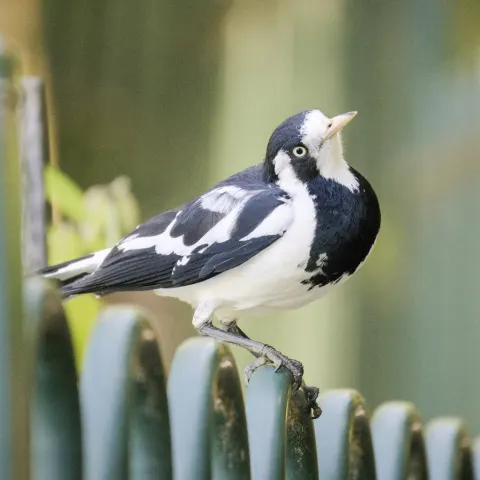
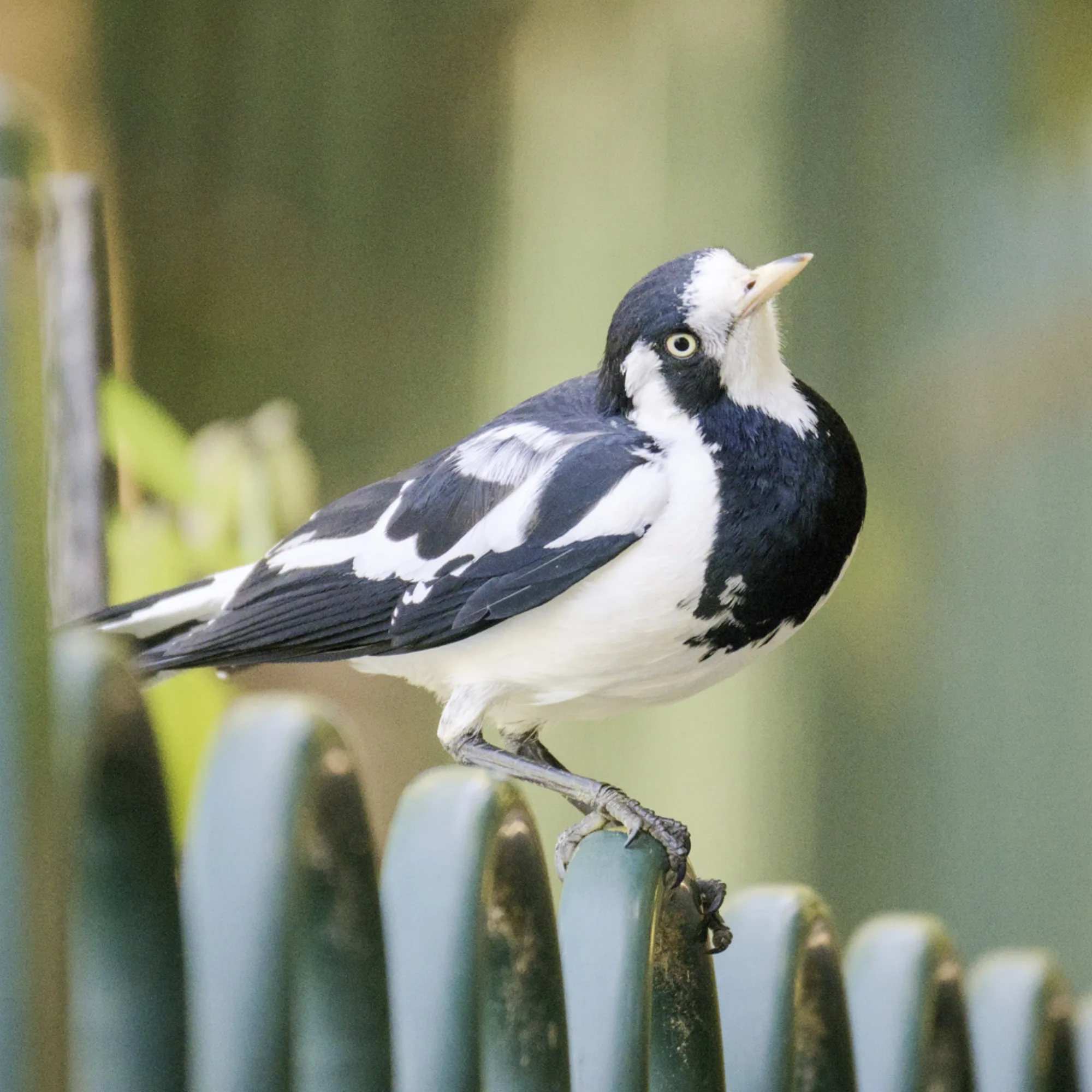
Bold black and white markings make the Magpie-lark easy to notice, whether it is perched on a telephone wire or walking over bare ground. This small to medium-sized bird reaches 25 to 30 cm in length. Males and females look similar from a distance, but females have a white throat, while males have a black throat and a white eyebrow. Young birds have a white throat, a black stripe through the eye and a white belly. Around Australia, the bird is known by several names, including peewee, mudlark and Murray magpie.
Common across much of Australia, it occurs in both towns and the countryside, but is absent from Tasmania and parts of the far north-western inland desert. It also lives in southern New Guinea and Timor, and is widespread on Lord Howe Island, where it was introduced. Look for it alone or in pairs near foreshores and swamps, or listen for its high-pitched shrieks around houses and fences. It eats small creatures and can use many habitats, provided there is soft, bare ground for feeding, mud for nesting and a tree in which to build.
Pairs generally stay together for life and defend their territory, sometimes confronting much larger birds or attacking people near a nest. They also sing cooperative duets to defend their territory. Their round nests are made from grass and other plant material plastered with mud, then lined with grass, feathers and fur. Both parents incubate the eggs, and several broods are common when conditions allow. Some chicks do not survive: a nest can become crowded enough for one chick to push another out.
Written from the English Wikipedia article Magpie-lark (CC BY-SA 4.0).
- Records
- 978,995
- Countries
- 2
- Atlas places
- 6
These are open occurrence records, so they show where people looked for and recorded the Magpie-lark as much as where it lives. Cells are up to 25 km across, and every location is generalised to its cell.
Generalised encounter areas, not exact locations. Each shape is a grid cell coloured by how likely the species is there.
- Very likelyAustralia25 km zone · high confidence · 978972 records · updated 86 days ago
- UncommonPapua New Guinea25 km zone · medium confidence · 23 records · updated today
Conservation status not assessed here yet, so every location is generalised to its grid cell.