Common Hill Myna
Gracula religiosa
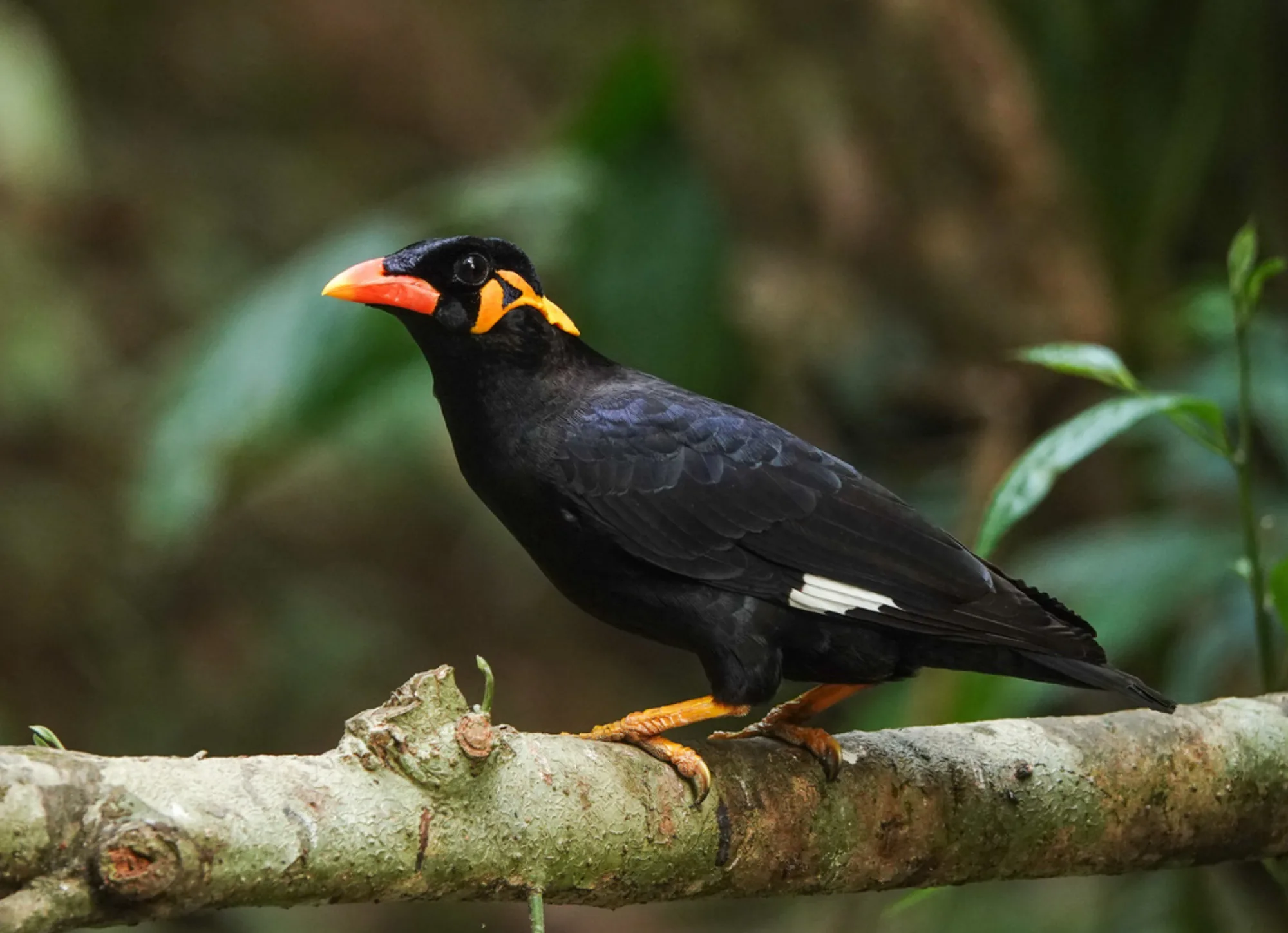
A loud, descending whistle from the forest canopy may be the first sign of a Common Hill Myna. This stocky starling is about 29 cm long, with black plumage that shines green and takes on a purple tint around the head and neck. Bright yellow skin and fleshy wattles run from the eye to the back of the head, where they meet. Its bill and strong legs are yellow, while large white patches show on the wings in flight. Males and females look alike, but young birds have a duller bill.
Look for it from northern India through the Himalayan foothills and Southeast Asia to southern China, northern Indonesia and Palawan in the Philippines. It breeds at elevations up to 2,000 m and spends almost all its time in trees. At dawn and dusk, small groups call from high in the canopy around forest clearings. Its repertoire includes whistles, wails, screeches and gurgles, some with a human-like sound. In the wild it does not imitate other birds, although captive birds can reproduce human voices and other sounds. Hill mynas move noisily through treetops at forest edges and hop sideways along branches. They eat fruit, nectar and insects, and nest in tree holes, usually laying two or three eggs.
Capture for the pet trade and habitat destruction have taken a toll. The bird is virtually extinct in Bangladesh, and populations have declined markedly in the central part of its range, especially Thailand. It is also becoming rarer in northeastern India, where fledged birds are captured for the illegal pet trade.
Written from the English Wikipedia article Common hill myna (CC BY-SA 4.0).
- Records
- 42,923
- Countries
- 16
- Atlas places
- 5
These are open occurrence records, so they show where people looked for and recorded the Common Hill Myna as much as where it lives. Cells are up to 25 km across, and every location is generalised to its cell.
Generalised encounter areas, not exact locations. Each shape is a grid cell coloured by how likely the species is there.
- Very likelyIndia25 km zone · high confidence · 21282 records · updated 80 days ago
- Very likelySingapore25 km zone · high confidence · 9113 records · updated 80 days ago
- Very likelyCambodia25 km zone · high confidence · 2941 records · updated 80 days ago
- Very likelyNepal25 km zone · high confidence · 2800 records · updated 80 days ago
- Very likelyUnited States25 km zone · high confidence · 2272 records · updated 80 days ago
- Very likelyMalaysia25 km zone · high confidence · 1277 records · updated 80 days ago
- Very likelyBhutan25 km zone · high confidence · 1155 records · updated 80 days ago
- Very likelyPhilippines25 km zone · high confidence · 1095 records · updated 80 days ago
- Very likelyBangladesh25 km zone · high confidence · 299 records · updated 80 days ago
- Very likelyChina25 km zone · high confidence · 204 records · updated 80 days ago
Conservation status not assessed here yet, so every location is generalised to its grid cell.