Victoria Crowned Pigeon
Goura victoria
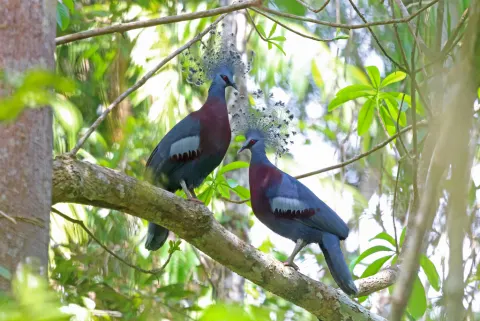
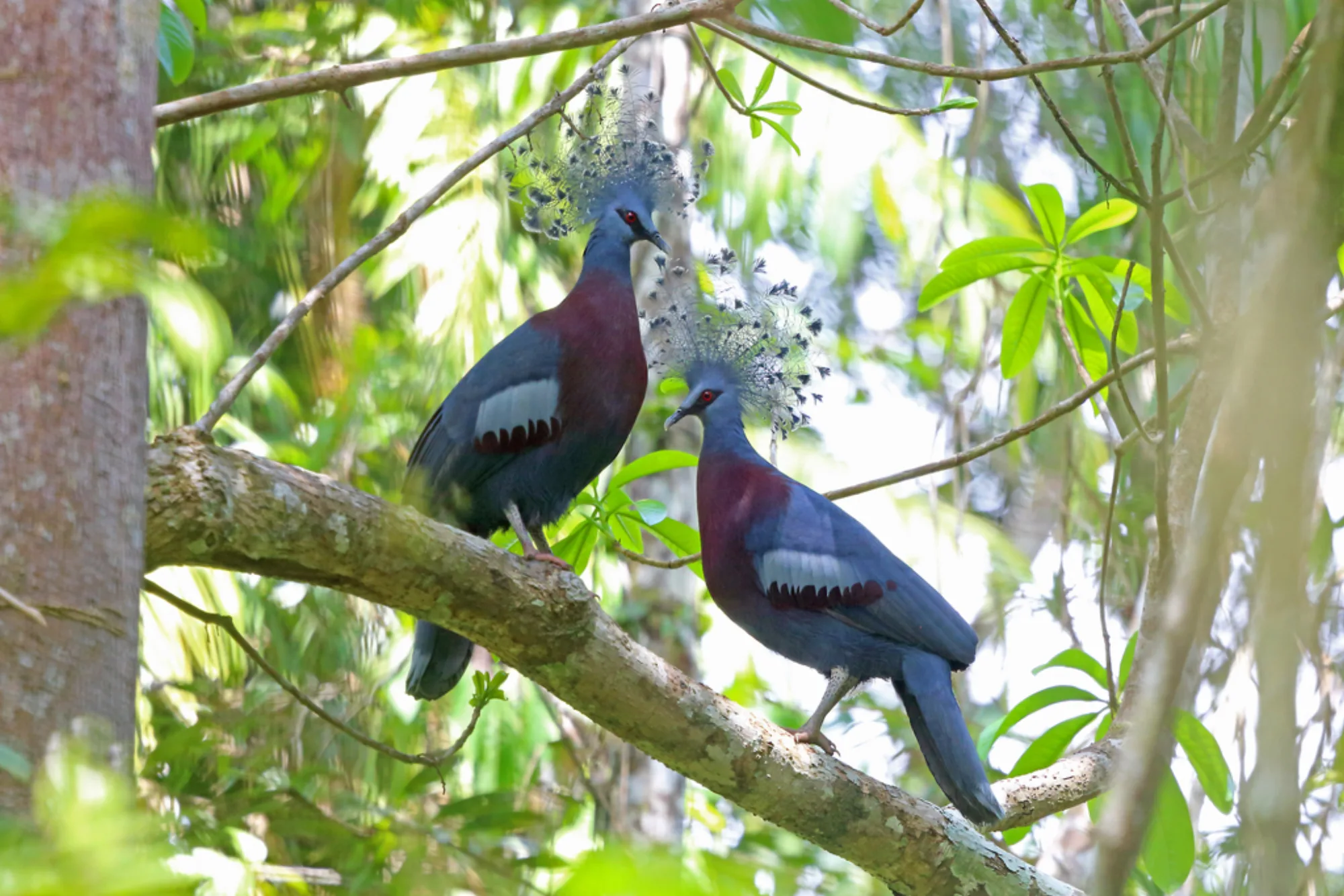
A deep blue-grey pigeon with a lacy, white-tipped crest, the Victoria Crowned Pigeon is the largest surviving pigeon species. A small black mask, red eyes and a purple-maroon chest add to its distinctive appearance. A paler blue wing bar has maroon tips, and both sexes look alike. Typically 73 to 75 cm long, it walks on the ground and can announce itself with a deep whooping call. Its wings make a loud clap as it takes flight.
In northern New Guinea and nearby islands, it inhabits lowland and swamp forests, often on former alluvial plains, including sago forest. It is usually found at or near sea level, although it sometimes ventures into the hills. Pairs or small groups walk slowly over the forest floor in search of food, mainly fallen fruit, with seeds and invertebrates occasionally added. When disturbed, the birds fly up into the canopy or onto a large branch, where they may stay calling and flicking their tails. Wild birds tend to be shy, though a quiet approach is sometimes possible.
Most breeding takes place towards the end of the wet season or in the dry season. The female usually lays one white egg in a tree nest built from stems, sticks and palm leaves. Both parents help raise the young, which leave the nest while still much smaller than the adults and receive care for 13 weeks in total. Logging continues to remove habitat, while hunting for feathers and meat has made the bird uncommon near human settlements. Trapping for captive collections is illegal, but likely still occurs.
Written from the English Wikipedia article Victoria crowned pigeon (CC BY-SA 4.0).
- Records
- 50
- Countries
- 2
No atlas park has a record of the Victoria Crowned Pigeon in or around it yet.
These are open occurrence records, so they show where people looked for and recorded the Victoria Crowned Pigeon as much as where it lives. Cells are up to 25 km across, and every location is generalised to its cell.
Generalised encounter areas, not exact locations. Each shape is a grid cell coloured by how likely the species is there.
- Very likelyPapua New Guinea25 km zone · medium confidence · 49 records · updated 80 days ago
- UncommonIndonesia25 km zone · medium confidence · 1 record · updated 80 days ago
Conservation status not assessed here yet, so every location is generalised to its grid cell.