Eastern Gorilla
Gorilla beringei
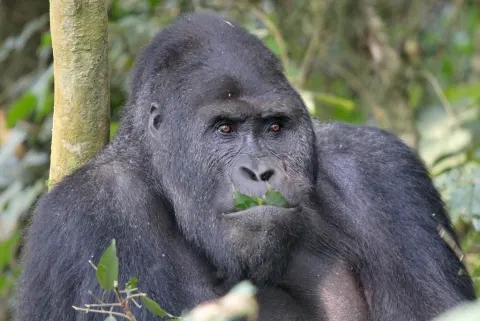
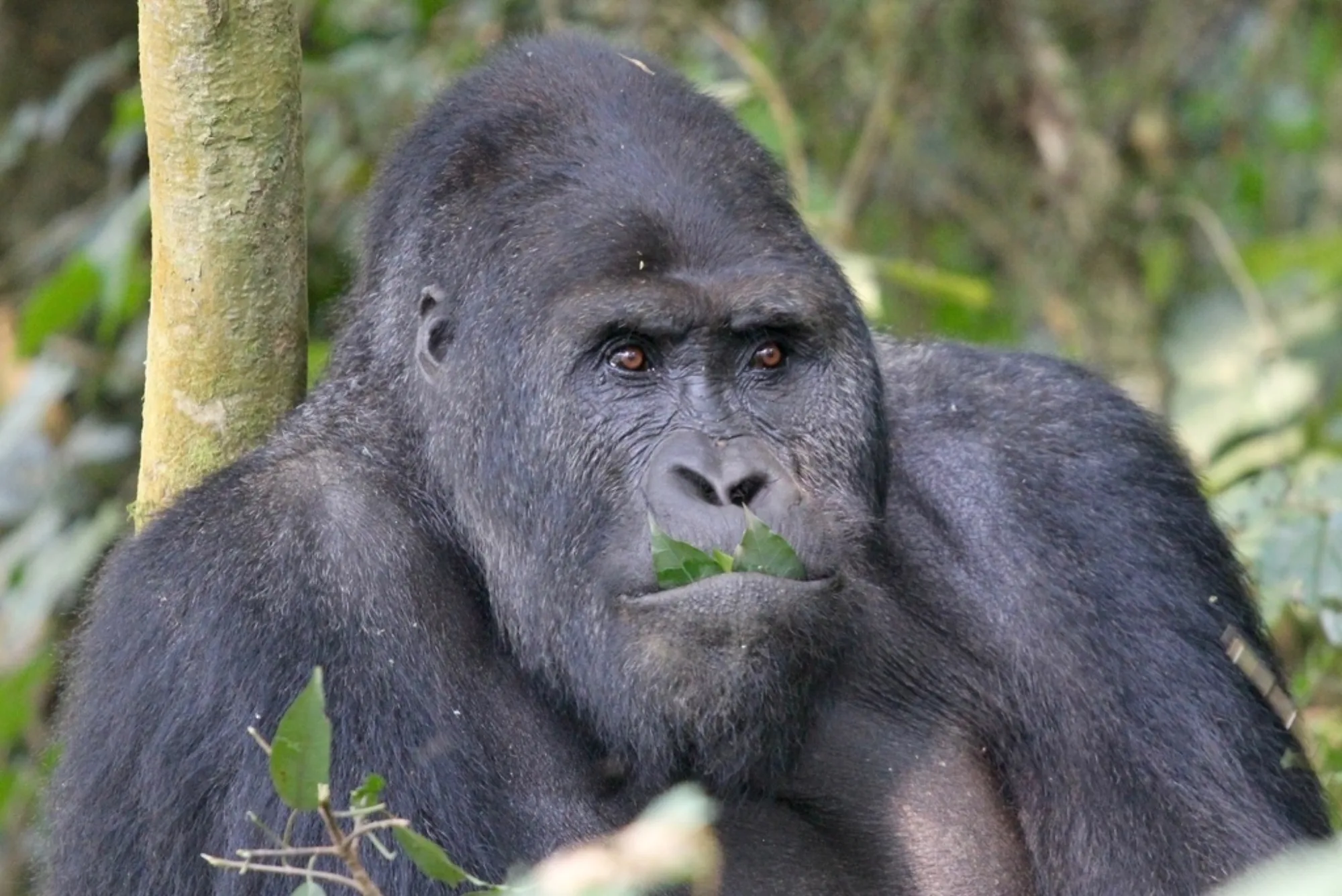
Standing as the largest living primate, the Eastern Gorilla is a heavy-set hominid with a broad chest and a flat nose. Most of its body is covered in black fur, though adult males develop a white, silvery saddle across their backs as they age. These older males, known as silverbacks, can weigh up to 205.5 kg and stand 1.7 m tall. While Grauer's gorillas possess thick, deep black coats, the mountain subspecies has a more bluish tint. Travelers may find mountain gorillas on volcanic slopes and in subalpine forests, while Grauer's gorillas inhabit the forests of the Albertine Rift.
These primates live in stable family groups of up to 35 individuals, each led by a dominant silverback. They spend their days foraging for foliage, which makes up the bulk of their herbivorous diet. Because they rely on abundant greenery rather than fruit, they maintain smaller home ranges than their western relatives. Most feeding happens in the morning and late afternoon, and when night falls, the group builds nests on the ground by folding over vegetation. Mothers provide long periods of parental care, meaning they only give birth every 3 to 4 years.
The species faces significant pressure from illegal hunting and the destruction of habitat for farming and commercial use. Roads and resource extraction further break up their living space. While the mountain gorilla population has grown to approximately 1,004 individuals, the overall species saw a population loss of more than 70 percent between 1996 and 2016. In popular viewing areas, there is also a risk of gorillas contracting diseases from humans or livestock.
Written from the English Wikipedia article Eastern gorilla (CC BY-SA 4.0).
- Atlas places
- 0
These are open occurrence records, so they show where people looked for and recorded the Eastern Gorilla as much as where it lives. Cells are up to 25 km across, and every location is generalised to its cell.
No encounter zones yet
Where and when you can expect to see Eastern Gorilla is calculated from observation density. No zones have been computed for this species yet.