Florida Gopher Tortoise
Gopherus polyphemus
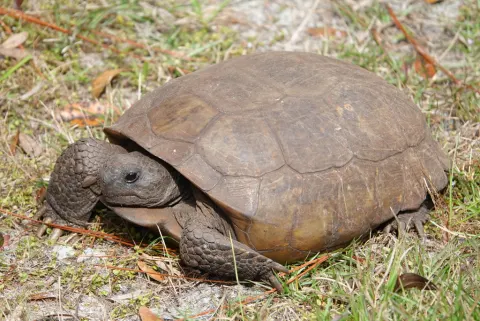
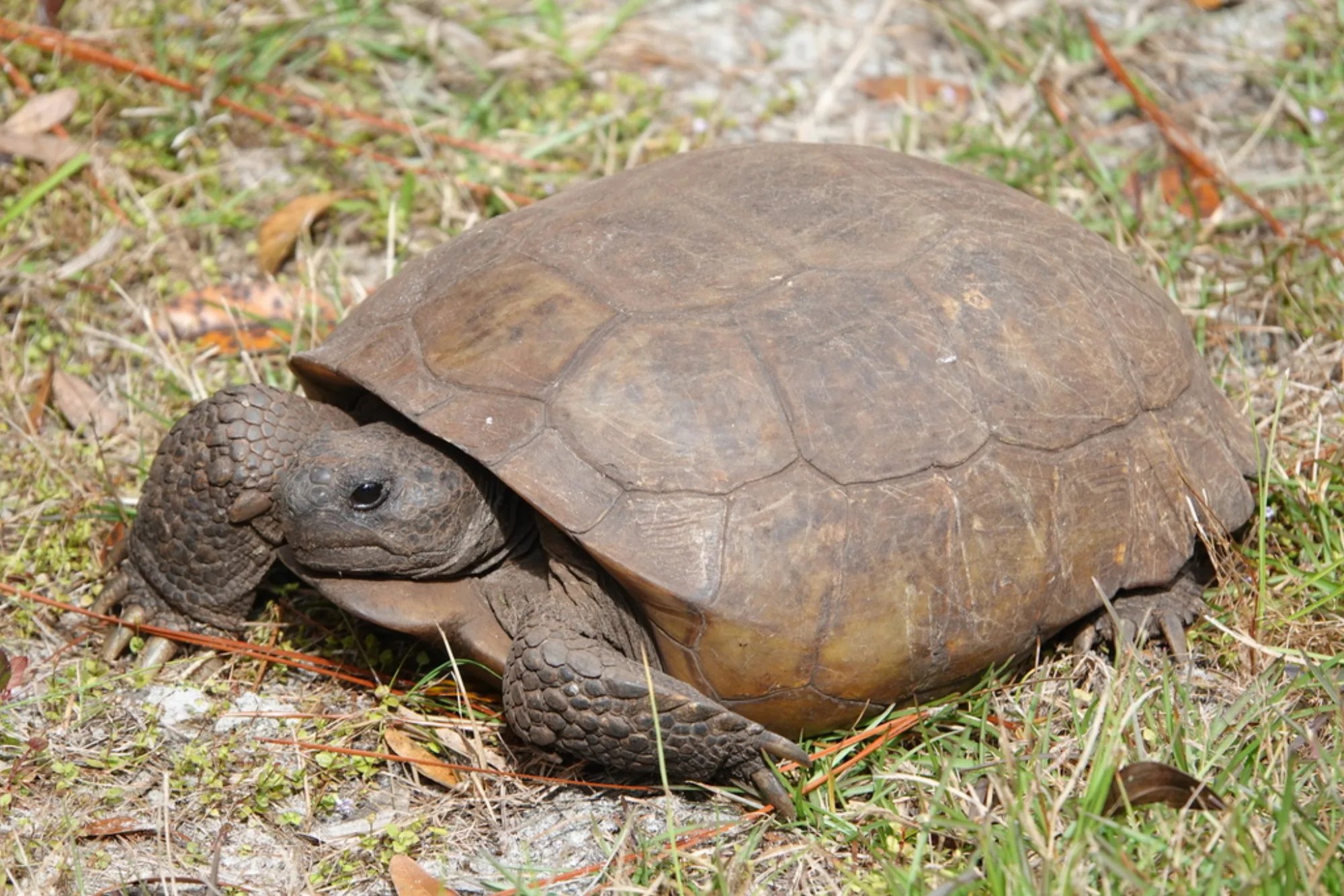
Built for digging, the Florida Gopher Tortoise (Gopherus polyphemus) has scaled front legs and a shell that ranges from dark brown to grey-black, with yellow underneath. Adults usually have shells 15 to 28 cm long. Native to the southeastern United States, it lives in habitats including longleaf pine savannas and coastal sand dunes. Longleaf pine habitat offers sandy, well-drained soil, low-growing plants and open space where eggs can incubate.
The tortoise spends much of its time in burrows, which shelter it from heat, cold, fire and predators. It digs several within a small home range and is mostly solitary outside the breeding season. Other animals also use the burrows, including gopher frogs, eastern indigo snakes and Florida mice. Tortoises graze on grasses and legumes, as well as shoots, leaves, mushrooms and fruit; they usually get their water from food. They become more active in the warmth of spring and summer. Females typically lay 3 to 14 eggs in a sandy mound close to the burrow entrance. Raccoons, foxes, armadillos and other predators may destroy about 90% of clutches before they hatch.
Development, conversion of land to farming and poor forest management have reduced the tortoise's habitat, while roads bring the danger of vehicle strikes. People have also taken tortoises for food or as pets, and relocation can disrupt populations and spread disease. On the coast, rising seas and intense storms threaten sand dune habitat, leaving tortoises to move towards higher ground.
Written from the English Wikipedia article Gopher tortoise (CC BY-SA 4.0).
- Records
- 1,794
- Countries
- 1
- Atlas places
- 1
These are open occurrence records, so they show where people looked for and recorded the Florida Gopher Tortoise as much as where it lives. Cells are up to 25 km across, and every location is generalised to its cell.
Generalised encounter areas, not exact locations. Each shape is a grid cell coloured by how likely the species is there.
- Very likelyUnited States25 km zone · medium confidence · 1794 records · updated 80 days ago
Conservation status not assessed here yet, so every location is generalised to its grid cell.