Mojave Desert Tortoise
Gopherus agassizii
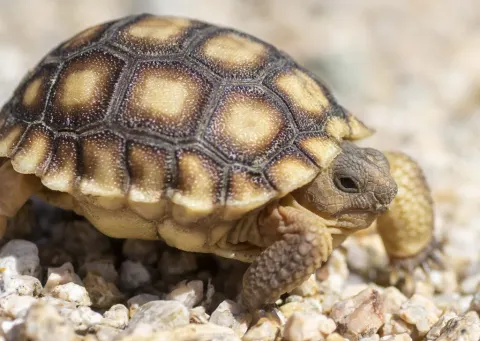
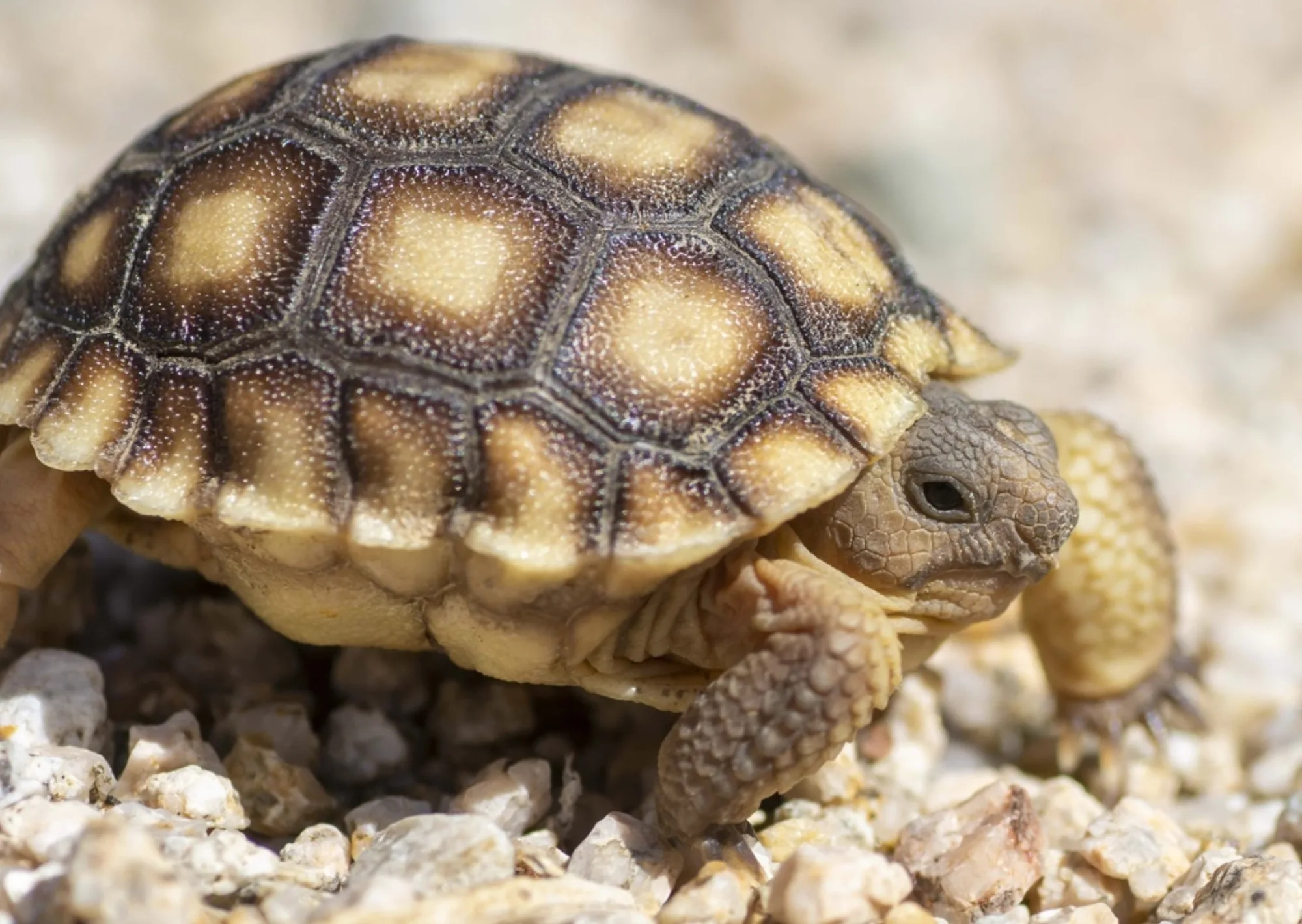
A high-domed shell, coloured greenish-tan to dark brown, helps distinguish the Mojave Desert Tortoise (Gopherus agassizii). It can reach 25 to 36 cm in length, with flattened front limbs adapted for digging. Its range extends across parts of California, Nevada, Utah and Arizona, including an isolated population in Arizona's Black Mountains. In the Mojave Desert, it favours alluvial fans, washes and canyons, as well as habitats ranging from sandy flats to rocky foothills. Suitable soil matters: it must be easy enough to excavate yet firm enough to hold a burrow open.
The tortoise spends most of its life underground, sheltering from heat, cold and water loss. Seasonal rain brings a rise in activity, which peaks in late spring in the Mojave. In summer, it may emerge in the early morning or late evening. Grasses make up much of its diet, supplemented by herbs, wildflowers and the fresh growth, fruit and flowers of cacti. Much of its water comes from the plants it eats, though it also drinks from pools after adequate rainfall. Females generally lay four to eight eggs in June or July, often in nests near burrow entrances or beneath shrubs; the eggs usually hatch in August or September.
Habitat destruction and fragmentation, urbanisation, disease, illegal collection and vandalism all threaten desert tortoises. Off-road vehicles can crush tortoises and damage eggs and burrows, while ravens prey on young animals, especially in some areas near urban development. If you see one in the wild, leave it undisturbed: handling may prompt it to empty its stored water, a serious loss in dry country.
Written from the English Wikipedia article Desert tortoise (CC BY-SA 4.0).
- Records
- 788
- Countries
- 2
- Atlas places
- 3
These are open occurrence records, so they show where people looked for and recorded the Mojave Desert Tortoise as much as where it lives. Cells are up to 25 km across, and every location is generalised to its cell.
Generalised encounter areas, not exact locations. Each shape is a grid cell coloured by how likely the species is there.
- Very likelyUnited States25 km zone · medium confidence · 784 records · updated 80 days ago
- LikelyMexico25 km zone · medium confidence · 4 records · updated 80 days ago
Conservation status not assessed here yet, so every location is generalised to its grid cell.