Ganges Shark
Glyphis gangeticus
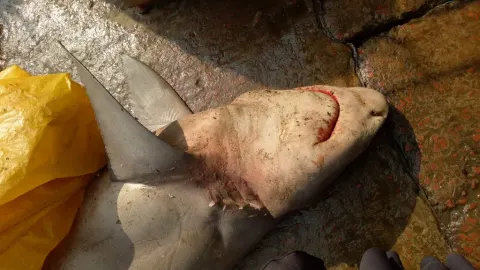
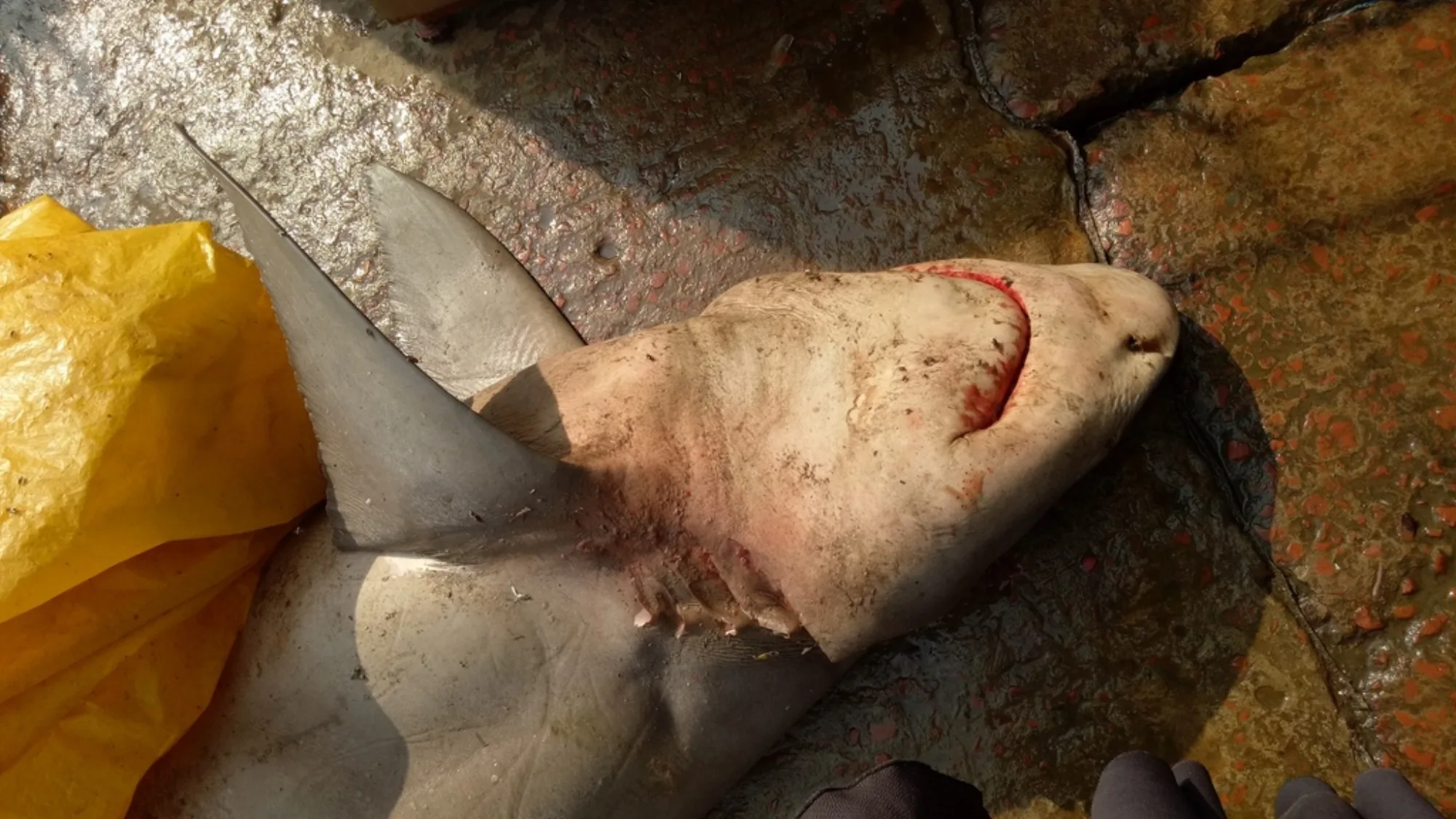
This rare requiem shark is a stocky fish with a broadly rounded snout and two spineless dorsal fins. It is uniform grey or brownish, lacking any obvious markings. To identify the Ganges Shark, look for its unusually small eyes, which are tilted toward its back rather than its sides. This adaptation likely helps it scan for prey in the silt-laden, turbid waters it inhabits. Its mouth contains long, broad rows of teeth, with the front lower teeth featuring a distinct claw-like shape.
While primarily found in the middle and lower reaches of the Ganges, Brahmaputra, and Hooghly rivers, its range may extend to Pakistan, Myanmar, Borneo, and Java. These sharks inhabit freshwater, estuarine, and inshore marine systems. Though their diet is largely unknown, their slender teeth suggest they are fish-eaters. In the Bay of Bengal, they are known to eat stingrays found on the bottom. They are likely born in fresh water at a size of 56 to 61 cm, eventually growing to about 204 cm.
Human activity in its narrow habitat poses the greatest risk to this species. It faces pressure from overfishing, pollution, and the construction of dams. The shark is caught in gill nets for its meat and for oil used as a fish attractant, and it is also part of the shark fin trade. Because these sharks grow slowly and have small litters, they are highly sensitive to even low levels of exploitation. Only about 250 individuals are thought to remain.
Written from the English Wikipedia article Ganges shark (CC BY-SA 4.0).
- Records
- 0
- Countries
- 1
- Atlas places
- 0
These are open occurrence records, so they show where people looked for and recorded the Ganges Shark as much as where it lives. Cells are up to 25 km across, and every location is generalised to its cell.
Generalised encounter areas, not exact locations. Each shape is a grid cell coloured by how likely the species is there.
- Very likelyBangladesh50 km zone · low confidence · 0 records · updated 1 day ago