Mamushi
Gloydius blomhoffii
Across Japan, the Mamushi inhabits a wide range of landscapes, from wetlands and meadows to open woodland and rocky hillsides. This venomous pit viper also lives among rock outcrops in the mountains and occurs near farmland, where rodent populations provide a source of food. Its colours help it disappear into vegetation or leaf litter, where it typically waits in ambush for prey. Rodents make up the main part of its diet, though it also eats small birds, lizards and insects.
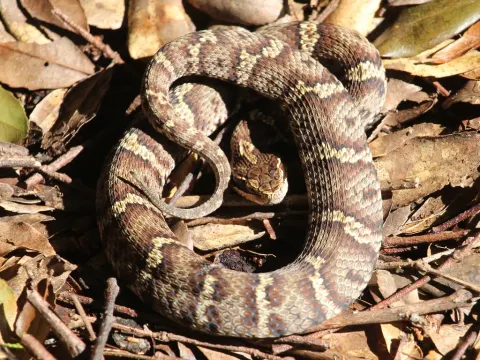
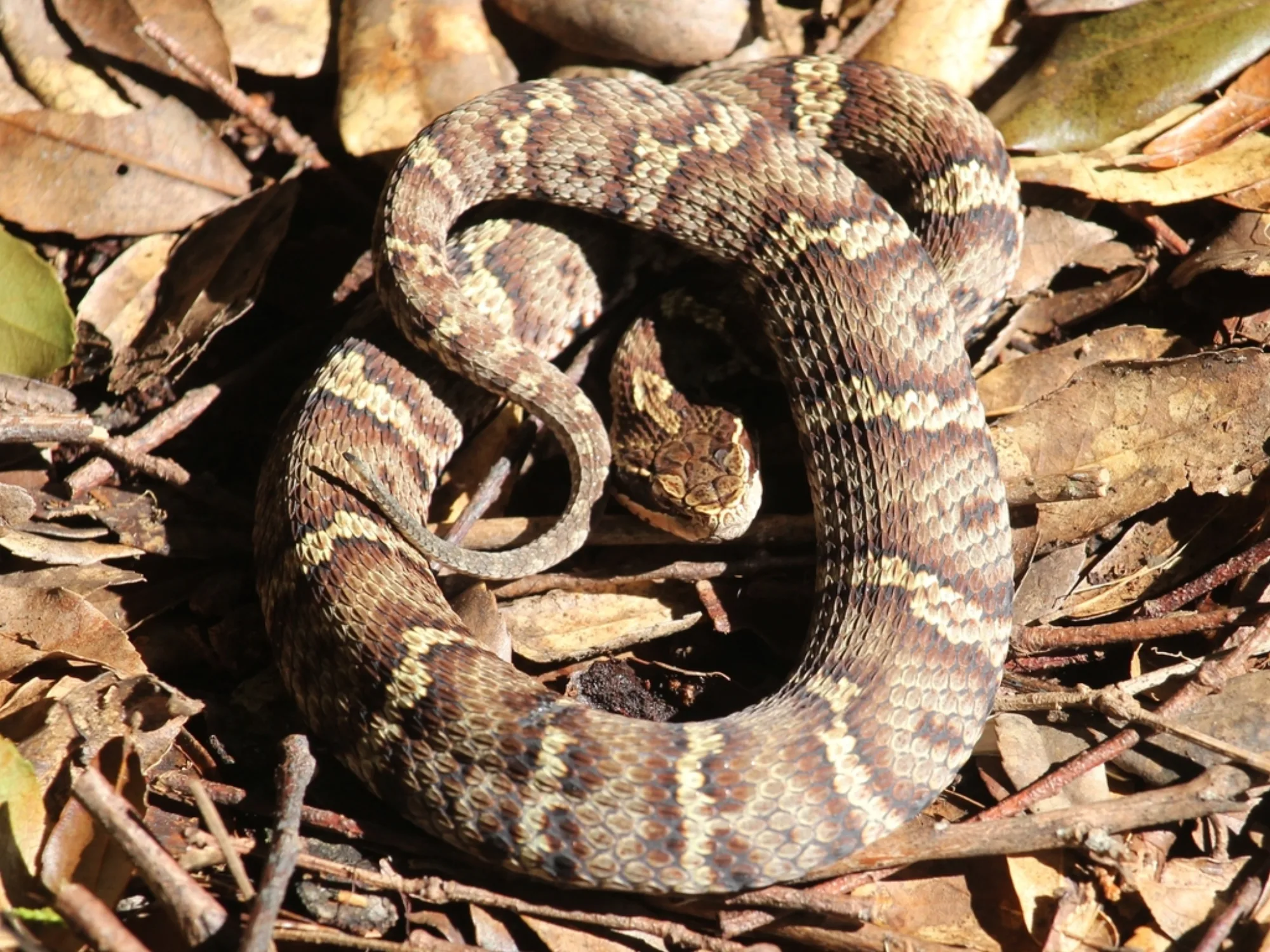
Mature Mamushi average 45 to 81 cm in length, with the longest recorded specimen reaching 91 cm. The background colour can be pale grey, reddish-brown or yellow-brown, marked along the sides by a series of irregular blotches. These markings have black borders and often lighter centres, while the dark brown or black head has beige or pale-grey sides. The species is among Japan's most venomous snakes, alongside the yamakagashi and the Okinawan habu. Each year, 2000 to 3000 people in Japan are bitten by Mamushi, and around 10 victims die. Severe bites require intensive care, while bitten people typically need a week of hospital treatment. There is an effective antivenom made in Japan and China. One study found that full recovery could take several months, even after hospital and outpatient treatment. Reported effects of bites have included kidney failure, visual disturbances and palsy, as well as miscarriage in pregnant women.
Written from the English Wikipedia article Mamushi (CC BY-SA 4.0).
- Records
- 12
- Countries
- 1
No atlas park has a record of the Mamushi in or around it yet.
These are open occurrence records, so they show where people looked for and recorded the Mamushi as much as where it lives. Cells are up to 25 km across, and every location is generalised to its cell.
Generalised encounter areas, not exact locations. Each shape is a grid cell coloured by how likely the species is there.
- Very likelyJapan25 km zone · medium confidence · 12 records · updated 80 days ago
Conservation status not assessed here yet, so every location is generalised to its grid cell.