Short-finned Pilot Whale
Globicephala macrorhynchus
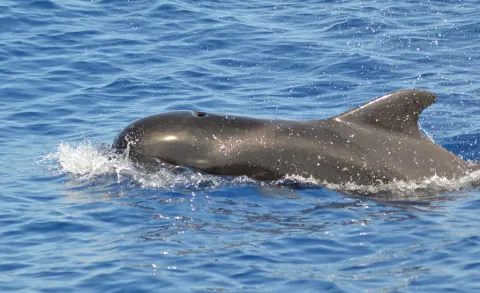
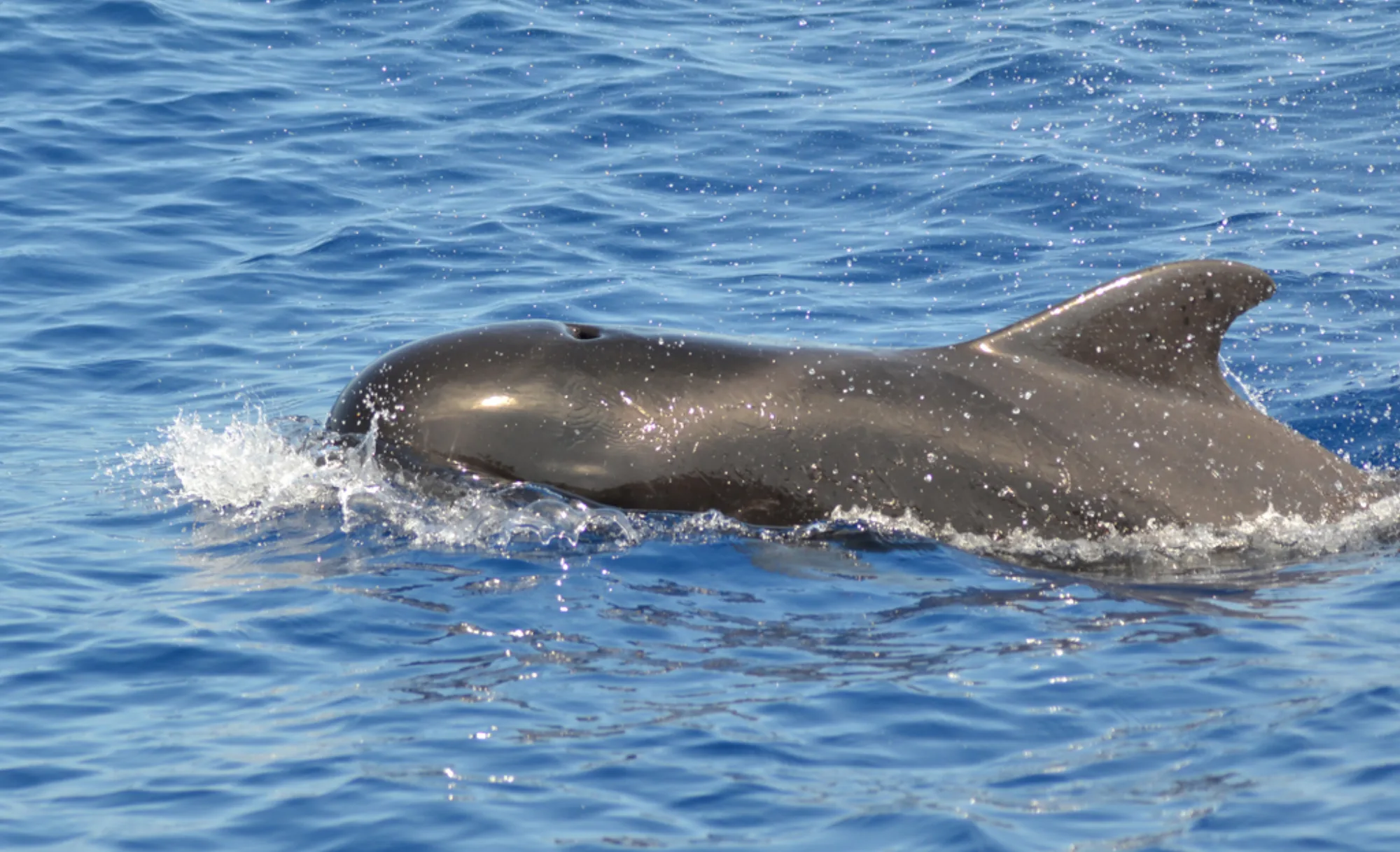
With its rounded head and stocky, dark body, the Short-finned Pilot Whale belongs to the oceanic dolphin family. Its broad, curved dorsal fin and pointed tail tips add to its distinctive profile, while a pale patch behind the fin and a light marking beneath the chin may help identify it. These markings vary between populations, and it can be difficult to distinguish from the long-finned pilot whale. Short-finned pilot whales inhabit coastal waters and the open ocean across temperate and tropical parts of the Atlantic, Indian and Pacific Oceans. Some remain year-round around places including Hawaii and Madeira, while other populations move as temperature and productivity change.
These social whales usually travel in pods of 10 to 30, although gatherings of several hundred have been reported. At the surface they may slap their tails on the water or raise their heads above it, and adults have been seen caring for young that are not their own. They hunt mainly squid, as well as fish and octopus, using echolocation during deep dives and fast pursuits. Females begin breeding at about 7 to 12 years of age and have calves every five to eight years; a calf suckles for at least two years.
Hunting continues in parts of Japan and the Lesser Antilles, while fishing gear can entangle or hook pilot whales, causing injury, exhaustion or death. Vessel strikes and contaminants pose further risks, and noise from whale-watching boats may disrupt communication at close range. Mass strandings also occur across their range, though their causes remain uncertain. Warming may alter where the whales and their prey are found.
Written from the English Wikipedia article Short-finned pilot whale (CC BY-SA 4.0).
- Records
- 3,339
- Countries
- 34
- Atlas places
- 3
These are open occurrence records, so they show where people looked for and recorded the Short-finned Pilot Whale as much as where it lives. Cells are up to 25 km across, and every location is generalised to its cell.
Generalised encounter areas, not exact locations. Each shape is a grid cell coloured by how likely the species is there.
- Very likelyPortugal25 km zone · high confidence · 2461 records · updated 80 days ago
- Very likelyUnited States25 km zone · medium confidence · 342 records · updated 80 days ago
- Very likelySpain25 km zone · medium confidence · 115 records · updated 80 days ago
- Very likelyMexico25 km zone · medium confidence · 96 records · updated 80 days ago
- Very likelyGuadeloupe25 km zone · high confidence · 62 records · updated 80 days ago
- Very likelyAustralia25 km zone · medium confidence · 59 records · updated 80 days ago
- Very likelyMadagascar25 km zone · medium confidence · 32 records · updated 80 days ago
- Very likelyNew Caledonia25 km zone · medium confidence · 29 records · updated 80 days ago
- Very likelyFrench Polynesia25 km zone · medium confidence · 28 records · updated 80 days ago
- Very likelyTaiwan25 km zone · medium confidence · 24 records · updated 80 days ago
Conservation status not assessed here yet, so every location is generalised to its grid cell.