Southern Flying Squirrel
Glaucomys volans
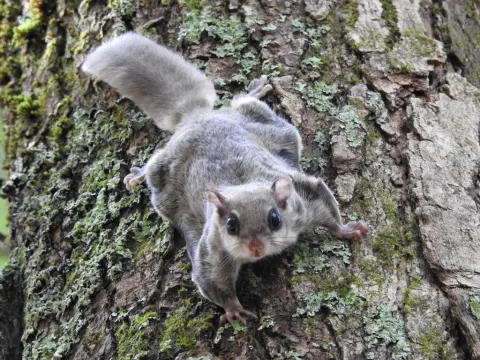
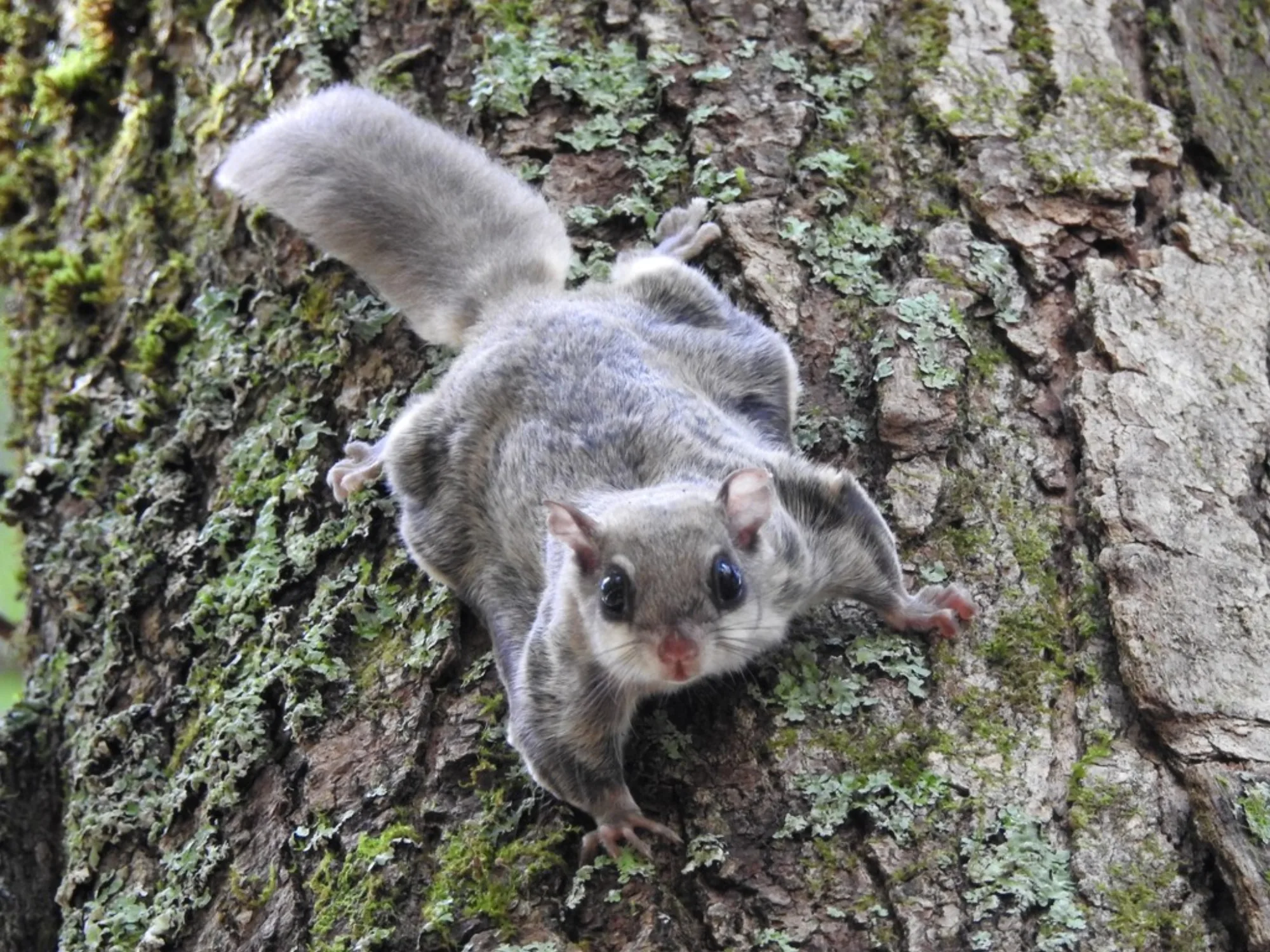
Large dark eyes and a flattened tail help distinguish the Southern Flying Squirrel, a small squirrel with grey-brown fur above, darker sides and a cream-coloured underside. Including the tail, it measures 21 to 26 cm long. A furry membrane stretches between its front and hind legs, allowing it to glide between trees rather than fly. It can turn around obstacles in the air, then lift its tail before landing and quickly move around the trunk or towards the top of the tree.
Its range extends from southeastern Canada south to Florida across eastern North America, with isolated populations in upland areas of Mexico, Guatemala and Honduras. It lives in deciduous and mixed woods, including areas with hickory, beech, maple, poplar and oak. It also occurs in heavily wooded suburbs, though never in large numbers there. Nocturnal and social, these squirrels have been seen gliding and foraging together, and often share dens when temperatures fall. They shelter in natural cavities and woodpecker holes, or make leaf and twig nests, using cavities for breeding and more heavily in winter.
Their varied diet includes tree fruits and nuts, insects, buds, mushrooms, fungi, carrion, bird eggs, nestlings and flowers. They store food for winter, particularly acorns, while in summer they tend to forage and hide food alone. Females can produce two litters a year, each with 2 to 7 young, which become independent at around 120 days old. Snakes, owls, hawks and raccoons prey on them, and domestic cats are potential predators. Forest disturbance also matters: when crossing plantations and logged areas, the squirrels favour corridors of mature forest over younger ones.
Written from the English Wikipedia article Southern flying squirrel (CC BY-SA 4.0).
- Records
- 529
- Countries
- 2
- Atlas places
- 3
These are open occurrence records, so they show where people looked for and recorded the Southern Flying Squirrel as much as where it lives. Cells are up to 25 km across, and every location is generalised to its cell.
Generalised encounter areas, not exact locations. Each shape is a grid cell coloured by how likely the species is there.
- Very likelyUnited States25 km zone · medium confidence · 516 records · updated 80 days ago
- Very likelyCanada25 km zone · medium confidence · 13 records · updated 80 days ago
Conservation status not assessed here yet, so every location is generalised to its grid cell.