Northern Flying Squirrel
Glaucomys sabrinus
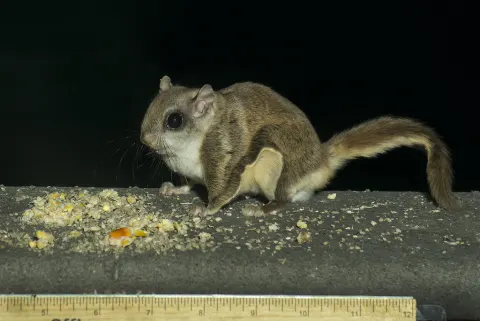
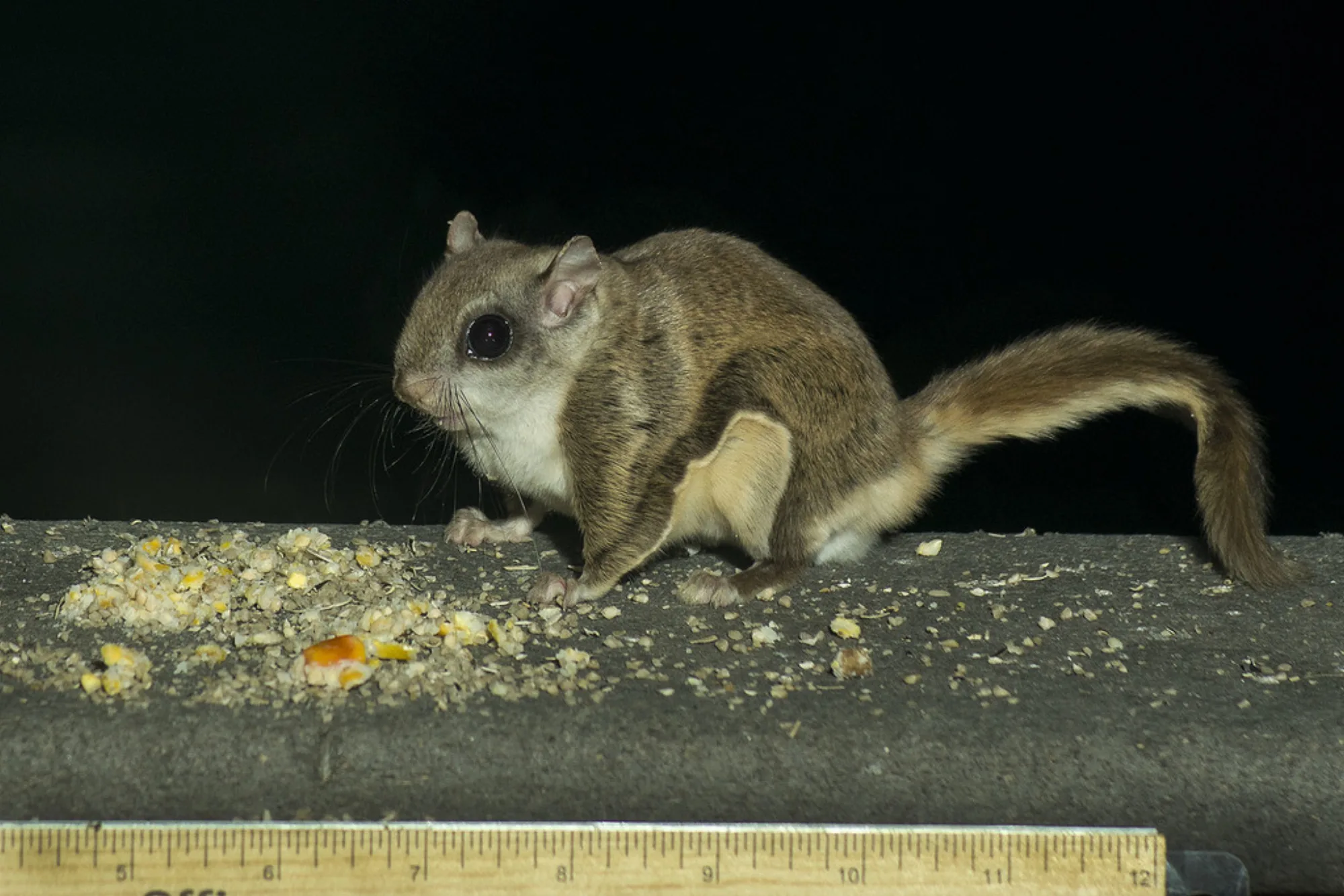
After dark, the Northern Flying Squirrel moves through forests of conifers and mixed trees in much of Canada and parts of the United States. Its range extends across northern North America between Alaska and Nova Scotia, reaching Utah in the west and the North Carolina and Tennessee mountains in the south. Look for thick light brown or cinnamon fur above, greyish sides, a whitish underside, large eyes, long whiskers and a flat tail. Adults measure 25 to 37 cm long and weigh 110 to 230 grams. Despite its name, it glides rather than flies, using a fold of skin to travel between trees. It can turn around obstacles in the air, but is clumsy on the ground and may hide if danger approaches.
Fungi are a major part of its diet, alongside lichens, nuts, sap, insects, bird eggs and nestlings, among other foods. It finds truffles by smell and stores food, including lichens and seeds, in tree cavities or its nest. Tree holes are favoured nesting places, particularly in large trunks and dead trees, although it also nests among leaves, underground and sometimes in buildings. Except when raising young, it changes nests frequently. In winter, squirrels often share a nest to maintain body temperature, with 4 to 10 individuals usually gathering together. They mostly breed once a year, although two litters have been recorded in southern Ontario and New Brunswick.
Owls, hawks, martens, lynxes and foxes prey on northern flying squirrels. Forest clearing and development can destroy or fragment their habitat, forcing animals into smaller areas and potentially across dangerous roads. The Center for Biological Diversity argues that changing temperatures are reducing both the forest available to the San Bernardino flying squirrel and the truffles it eats.
Written from the English Wikipedia article Northern flying squirrel (CC BY-SA 4.0).
- Records
- 501
- Countries
- 2
- Atlas places
- 3
These are open occurrence records, so they show where people looked for and recorded the Northern Flying Squirrel as much as where it lives. Cells are up to 25 km across, and every location is generalised to its cell.
Generalised encounter areas, not exact locations. Each shape is a grid cell coloured by how likely the species is there.
- Very likelyUnited States25 km zone · medium confidence · 430 records · updated 80 days ago
- Very likelyCanada25 km zone · medium confidence · 71 records · updated 80 days ago
Conservation status not assessed here yet, so every location is generalised to its grid cell.