Masai Giraffe
Giraffa tippelskirchi
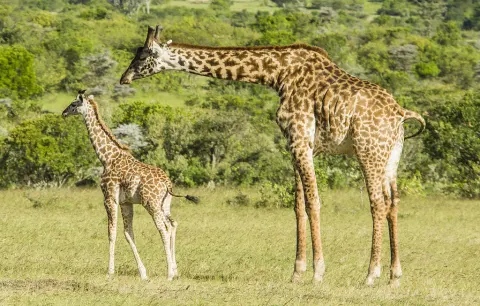
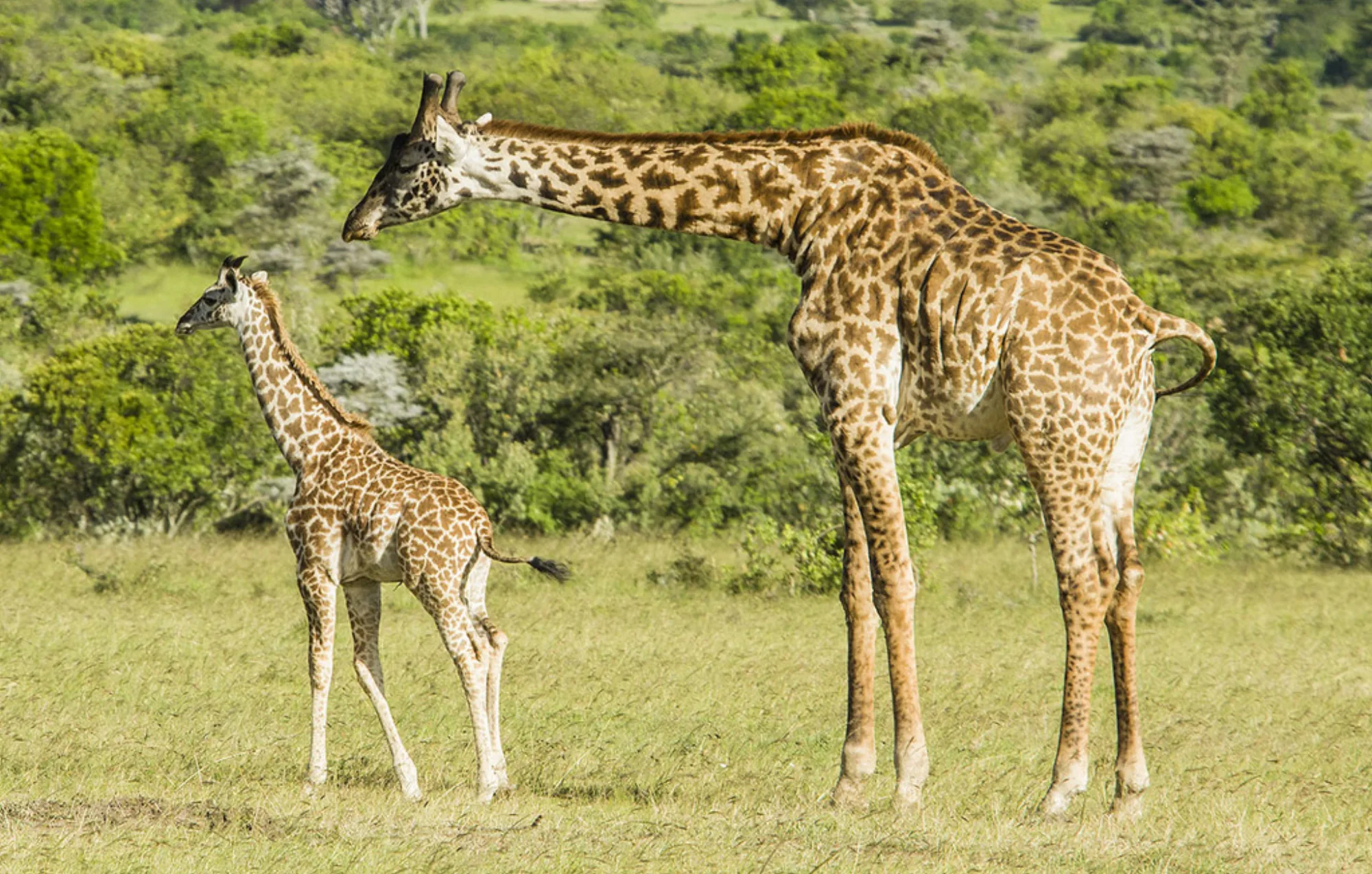
Jagged, irregular markings give the Masai Giraffe (Giraffa tippelskirchi) a distinctive appearance, with leaf-like blotches extending from its hooves to its head. No land animal stands taller, and it has the largest body of any giraffe species. Males tend to be bigger than females, reaching up to 5.8 m in height and weighing close to 1.3 tonnes. Its long neck accounts for roughly a third of its height, while a long tongue helps it reach leaves in tall trees that other animals cannot access. When galloping, it has been recorded at almost 64 kilometers per hour.
Native to East Africa, this giraffe occurs in Tanzania, Uganda, the central and southern parts of Kenya, and Zambia's Luangwa Valley region. Wild individuals can live for around 30 years, and in most cases live longer in captivity. Calf survival is affected by the season of birth and by whether migrating herds of wildebeest and zebra are present locally. At several zoos, cows have become pregnant and given birth successfully.
Poaching and habitat loss have driven a 52% population decline in recent decades, and the wild population amounts to 32,550. Studies suggest that poaching contributes to low adult survival outside protected areas, while predation contributes to low calf survival inside them. Both patterns influence population growth, and protected areas have been found important for keeping giraffes across the wider landscape. Community-based wildlife conservation areas have also helped protect them. Some Masai giraffes develop a skin disease that causes lesions on their forelimbs; its cause is unknown, and the disorder is being investigated further.
Written from the English Wikipedia article Masai giraffe (CC BY-SA 4.0).
- Records
- 7
- Countries
- 3
- Atlas places
- 12
- Maasai Mara National Reserve· Kenya
- Serengeti National Park· Tanzania
- Tarangire National Park· Tanzania
- Ngorongoro Conservation Area· Tanzania
- Amboseli National Park· Kenya
- Nairobi National Park· Kenya
- South Luangwa National Park· Zambia
- Arusha National Park· Tanzania
- Kilimanjaro National Park· Tanzania
- Lake Manyara National Park· Tanzania
- Tsavo East National Park· Kenya
- Tsavo West National Park· Kenya
These are open occurrence records, so they show where people looked for and recorded the Masai Giraffe as much as where it lives. Cells are up to 25 km across, and every location is generalised to its cell.
Generalised encounter areas, not exact locations. Each shape is a grid cell coloured by how likely the species is there.
- Very likelyKenya25 km zone · medium confidence · 4 records · updated 80 days ago
- Very likelyTanzania25 km zone · medium confidence · 2 records · updated 80 days ago
- Very likelyZambia25 km zone · medium confidence · 1 record · updated 80 days ago
Conservation status not assessed here yet, so every location is generalised to its grid cell.