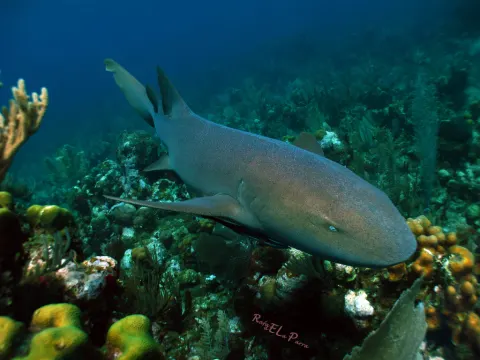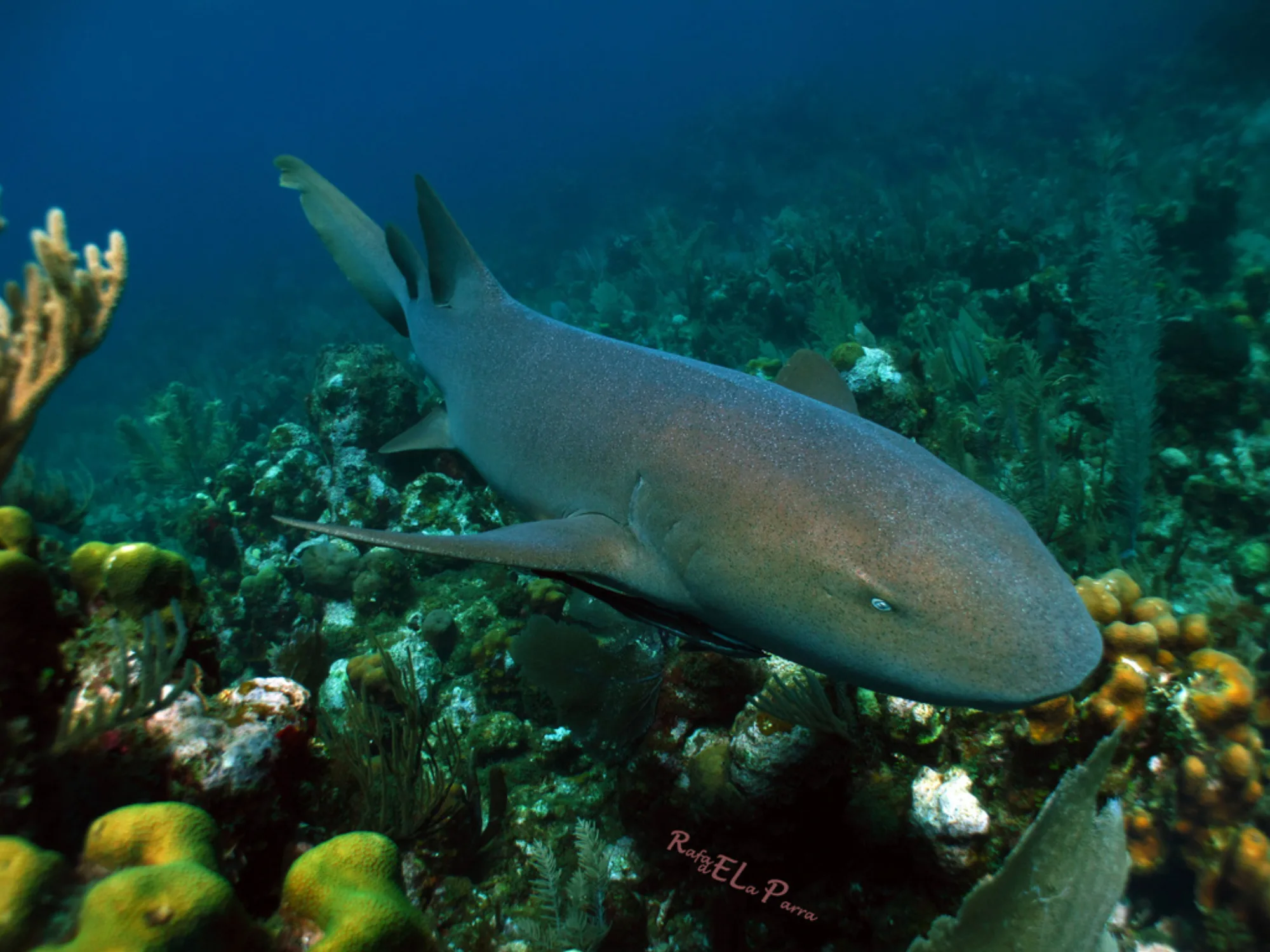
Nurse Shark
Ginglymostoma cirratum
A broad head, rounded fins and a long tail give the Nurse Shark its distinctive outline. Adults are brownish, while newborns have spots that fade as they grow. The largest documented adult measured 3.08 m, although larger historical reports are thought to have been exaggerated.
This bottom-dwelling shark has a wide but patchy range, inhabiting warm coastal waters in the eastern and western Atlantic and the eastern Pacific. In the western Atlantic, it occurs from Rhode Island to southern Brazil, including the Caribbean. Young sharks tend to stay on shallow coral reefs and seagrass flats or around mangrove islands. Older sharks favour deeper reefs and rocky places, sheltering in crevices and under ledges by day before moving into shallower water to feed at night.
Nurse sharks often gather in large, resting groups during daylight, but usually forage alone after dark. They search the seabed for small fish and invertebrates, including crustaceans, molluscs and sea urchins, and also eat algae. Powerful suction helps them take food, and they can shake their heads or suck and spit to break larger items down. They tend to remain in the same areas and return repeatedly to the same breeding grounds. Females give birth to fully developed young after a six-month gestation, typically producing 21 to 29 pups. Fishing poses a threat: nurse sharks are targeted in some fisheries and caught incidentally in others. In some coastal habitats, American alligators and American crocodiles may also prey on them.
Written from the English Wikipedia article Nurse shark (CC BY-SA 4.0).
- Records
- 920
- Countries
- 28
- Atlas places
- 3
These are open occurrence records, so they show where people looked for and recorded the Nurse Shark as much as where it lives. Cells are up to 25 km across, and every location is generalised to its cell.
Generalised encounter areas, not exact locations. Each shape is a grid cell coloured by how likely the species is there.
- Very likelyUnited States25 km zone · medium confidence · 502 records · updated 81 days ago
- Very likelyBelize25 km zone · medium confidence · 122 records · updated 81 days ago
- Very likelyPuerto Rico25 km zone · medium confidence · 78 records · updated 81 days ago
- Very likelyMexico25 km zone · medium confidence · 40 records · updated 81 days ago
- Very likelyBrazil25 km zone · medium confidence · 36 records · updated 81 days ago
- Very likelyBahamas25 km zone · medium confidence · 35 records · updated 81 days ago
- Very likelyCayman Islands25 km zone · medium confidence · 25 records · updated 81 days ago
- Very likelyU.S. Virgin Islands25 km zone · medium confidence · 19 records · updated 81 days ago
- LikelyCaribbean Netherlands25 km zone · medium confidence · 14 records · updated 81 days ago
- LikelyGuadeloupe25 km zone · medium confidence · 11 records · updated 81 days ago
Conservation status not assessed here yet, so every location is generalised to its grid cell.