Northern Bald Ibis
Geronticus eremita
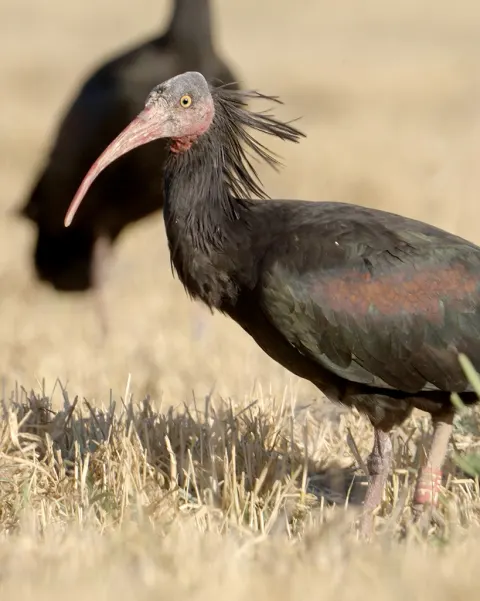
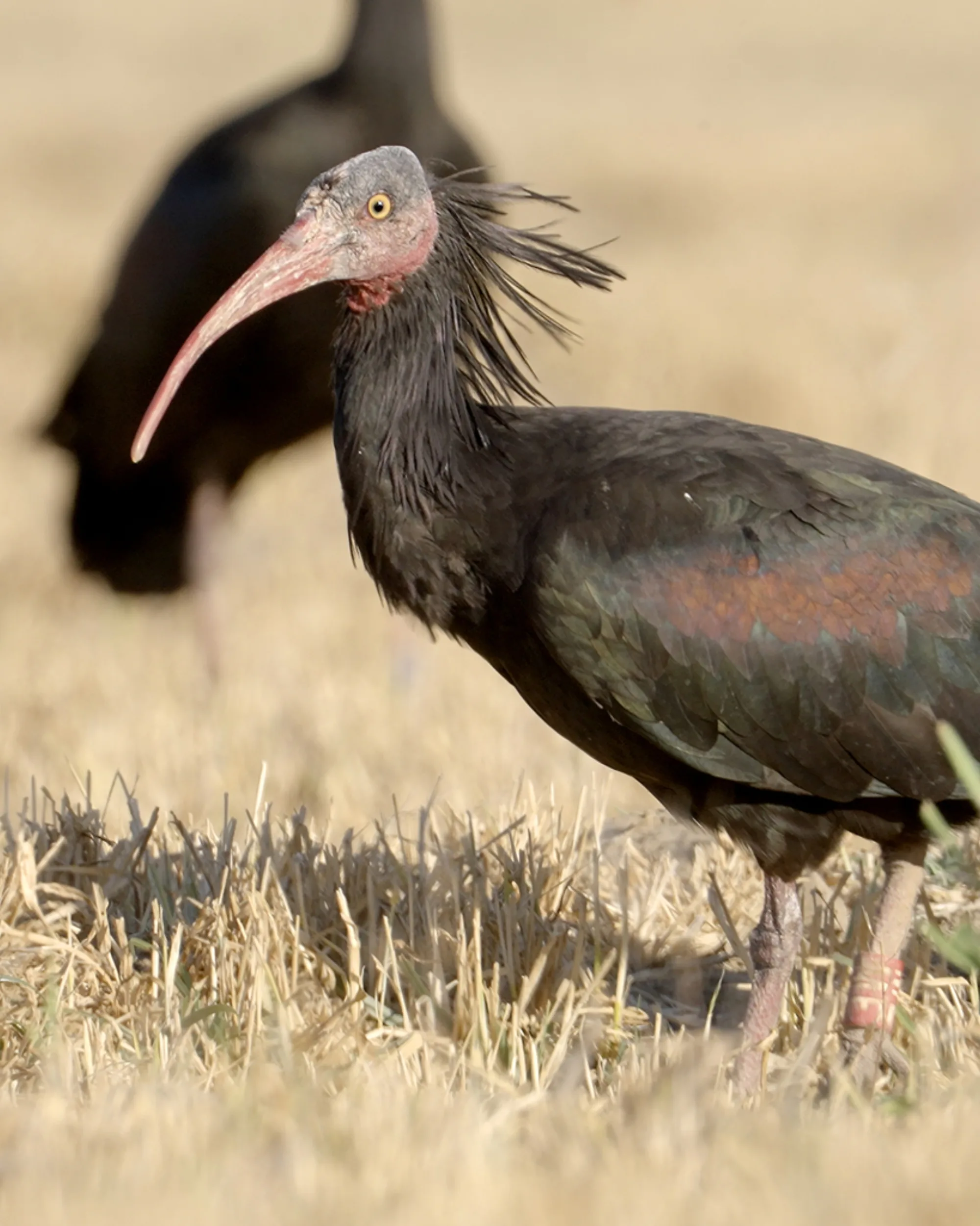
With its bare red head, long curved bill and glossy dark plumage, the Northern Bald Ibis is a distinctive sight on dry ground. Its black feathers catch bronze-green and violet tones, while a wispy ruff trails down the back of its neck. It measures 70 to 80 cm in length and, unlike many ibises, does not wade. At breeding colonies its calls include low, guttural sounds and high, hoarse notes, but elsewhere it is usually silent.
The species favours open country, including grasslands, rocky mountains and semi-deserts, often near running water. In Morocco, wild breeding birds use cliffs at Souss-Massa National Park and around the Oued Tamri river mouth, north of Agadir. They remain in the region year-round, spreading along the coast after nesting. A managed, semi-wild flock at Birecik in Turkey flies freely around the area during the breeding season, foraging in fields, forest nurseries and along the Euphrates. Reintroduction projects have also established birds in parts of Europe, including Spain and Austria.
Social birds, the ibises fly between roosts or breeding cliffs and feeding grounds in V-shaped flocks. They probe loose, sandy soil with their bills, finding lizards, beetles and other small animals. Pairs nest in loose colonies on cliff ledges or among boulders on steep slopes, building twig nests lined with grass or straw. Both parents incubate the eggs and feed their chicks. Hunting, pesticide poisoning, disturbance and the loss of feeding habitat have all contributed to the species' decline. Electricity pylons and hunting have also threatened migrating birds, while predators can take eggs from nests.
Written from the English Wikipedia article Northern bald ibis (CC BY-SA 4.0).
- Records
- 7,315
- Countries
- 19
No atlas park has a record of the Northern Bald Ibis in or around it yet.
These are open occurrence records, so they show where people looked for and recorded the Northern Bald Ibis as much as where it lives. Cells are up to 25 km across, and every location is generalised to its cell.
Generalised encounter areas, not exact locations. Each shape is a grid cell coloured by how likely the species is there.
- Very likelySpain25 km zone · high confidence · 3785 records · updated 80 days ago
- Very likelyMorocco25 km zone · high confidence · 1854 records · updated 80 days ago
- Very likelyTürkiye25 km zone · high confidence · 777 records · updated 80 days ago
- Very likelyItaly25 km zone · high confidence · 240 records · updated 80 days ago
- Very likelyGermany25 km zone · medium confidence · 135 records · updated 80 days ago
- Very likelySwitzerland25 km zone · medium confidence · 134 records · updated 80 days ago
- Very likelyAustria25 km zone · high confidence · 128 records · updated 80 days ago
- Very likelyIsrael25 km zone · medium confidence · 85 records · updated 80 days ago
- LikelyFrance25 km zone · medium confidence · 48 records · updated 80 days ago
- LikelySlovenia25 km zone · medium confidence · 35 records · updated 80 days ago
Conservation status not assessed here yet, so every location is generalised to its grid cell.