Zebra Dove
Geopelia striata
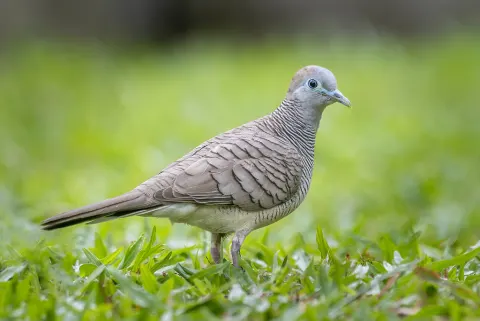
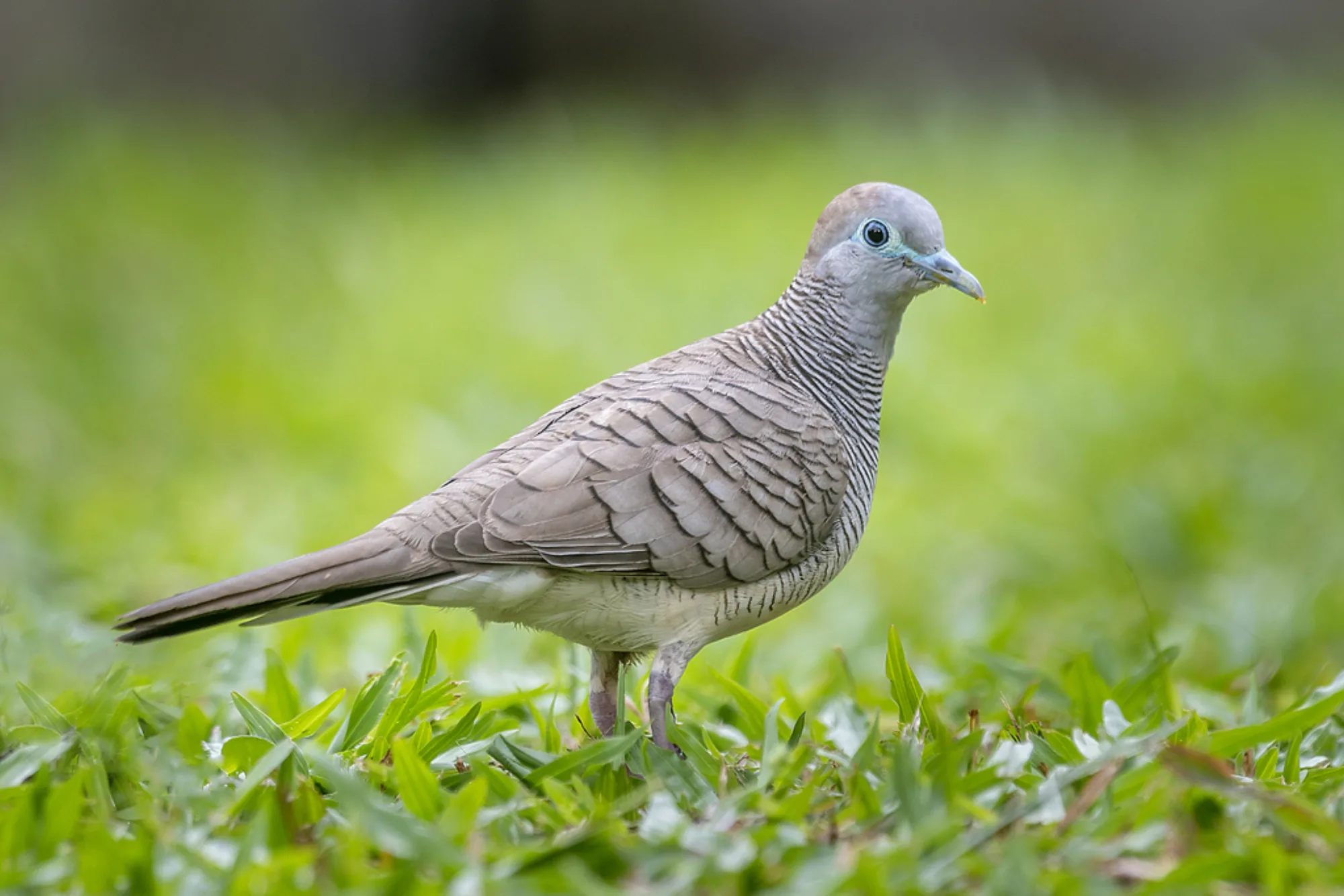
Small and slender, the Zebra Dove has a long, narrow tail and brownish-grey upperparts crossed by black-and-white bars. Its underparts are pinkish, with black bars across the breast and belly and down either side of the neck. Look for a blue-grey face, blue skin around the eyes and white tips on the tail feathers. Young birds are duller and paler than adults, and may have brown feathers. A series of soft, staccato coos gives the bird a distinctive voice.
Its native range includes southern Thailand, Tenasserim, Peninsular Malaysia, Singapore, Sumatra and Java, and it may also be native to several other islands. Escaped and deliberately released birds have established populations beyond that range, including in Hawaii, the Seychelles and Mauritius. In lowland areas, look for it in scrub, farmland and open country, as well as parks and gardens. It favours bare ground, short grass and roads for foraging, where it scurries with a rodent-like movement. Its colours provide camouflage on the ground, and it forages alone or in pairs. Small grass and weed seeds make up its diet, along with insects and other small invertebrates.
Within its native range, the breeding season runs from September to June. A simple platform made from grass blades and leaves serves as a nest, placed in a bush or tree, sometimes on the ground or a window ledge. One or two white eggs are incubated by both parents over 13 to 18 days. Within two weeks, the young depart the nest, and after three weeks they can fly well. Trapping for the cagebird trade has made the species rare in parts of Indonesia, although it remains common across most of its range.
Written from the English Wikipedia article Zebra dove (CC BY-SA 4.0).
- Records
- 320,829
- Countries
- 26
- Atlas places
- 5
These are open occurrence records, so they show where people looked for and recorded the Zebra Dove as much as where it lives. Cells are up to 25 km across, and every location is generalised to its cell.
Generalised encounter areas, not exact locations. Each shape is a grid cell coloured by how likely the species is there.
- Very likelyUnited States25 km zone · high confidence · 140329 records · updated 86 days ago
- Very likelyThailand25 km zone · high confidence · 81041 records · updated 86 days ago
- Very likelyMalaysia25 km zone · high confidence · 26564 records · updated 86 days ago
- Very likelyPhilippines25 km zone · high confidence · 18006 records · updated 86 days ago
- Very likelySingapore25 km zone · high confidence · 16944 records · updated 86 days ago
- Very likelyCambodia25 km zone · high confidence · 16558 records · updated 86 days ago
- Very likelyIndonesia25 km zone · high confidence · 7132 records · updated 86 days ago
- Very likelyVietnam25 km zone · high confidence · 2762 records · updated 86 days ago
- Very likelySeychelles25 km zone · high confidence · 2245 records · updated 86 days ago
- Very likelyFrench Polynesia25 km zone · high confidence · 2203 records · updated 86 days ago
Conservation status not assessed here yet, so every location is generalised to its grid cell.