Common Genet
Genetta genetta
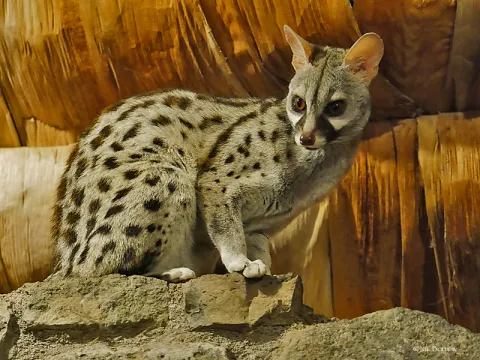
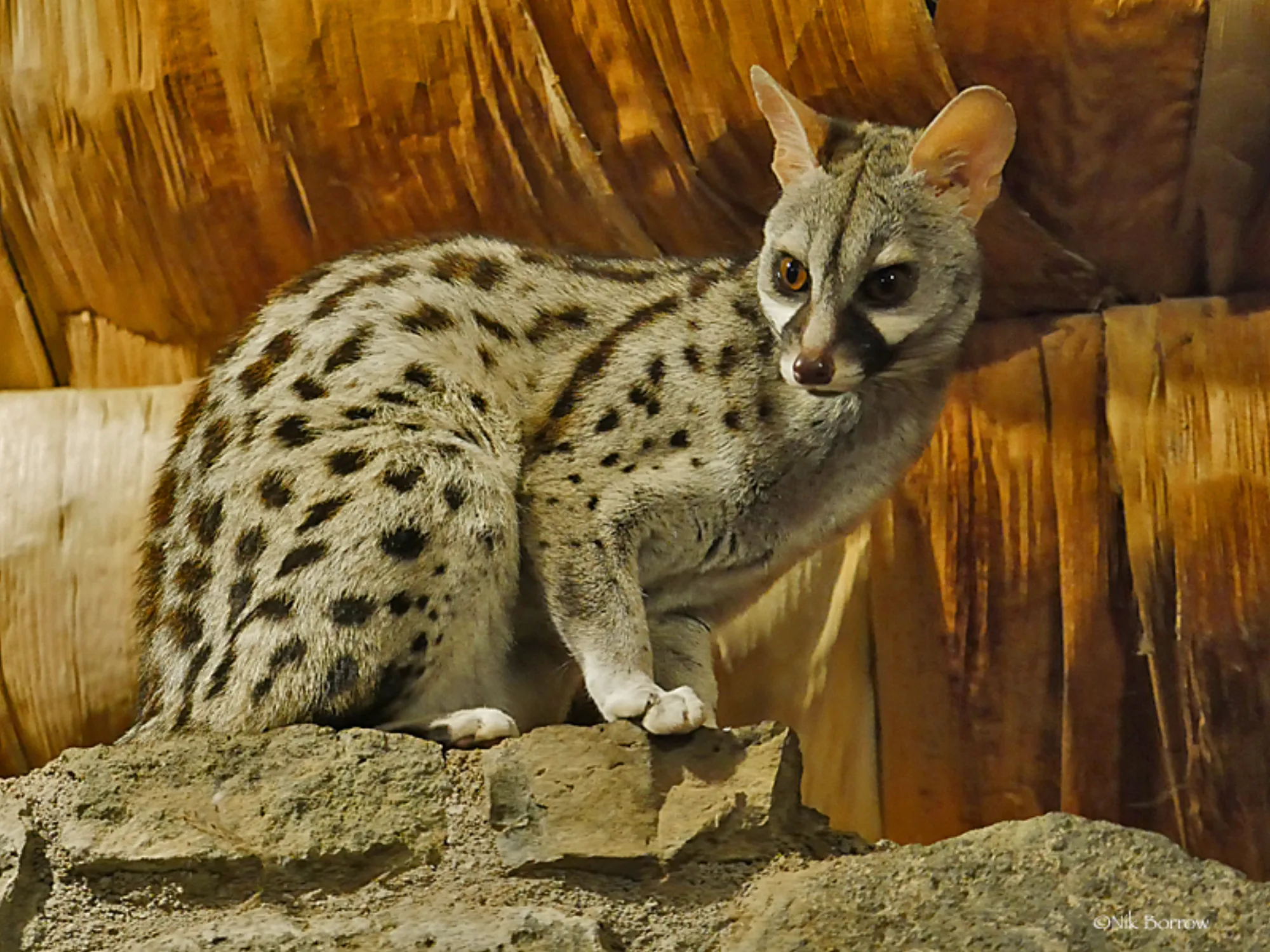
Slender and cat-like, the Common Genet has a pointed muzzle, large eyes and ears, and a soft, pale grey coat patterned with black spots. A black stripe runs along its back, while its long tail has eight to thirteen rings and a white tip. Its body measures 43 to 55 cm, with a tail of 33 to 52 cm.
Native to Africa and introduced to southwestern Europe, it also occurs along the Arabian coast. Its African range includes the western Mediterranean coast, savannah south of the Sahara and parts of southern Africa. It favours dense vegetation and sheltered places, including thickets, evergreen oak forest and rocky ground with caves. In southwestern Europe, it also lives in pine forests, olive groves and shrublands, sometimes close to settlements.
A solitary animal, the genet is most active after sunset and just before sunrise, although young animals may venture out during the day. It rests in hollow trees or thickets, often returning to the same sites. Its varied diet includes small mammals, birds, lizards, insects and fruit, with wood mice among its favoured prey. Genets find prey mainly by scent, and both sexes leave scent marks within their home ranges. In Spain, breeding takes place between January and September, with peaks in February and March and again in summer. After 10 to 11 weeks of gestation, a female can give birth to up to four young. No major threats are known, but genets are hunted for fur in parts of Africa and killed in predator traps in Portugal. On Ibiza, urbanisation and infrastructure development break up and reduce their habitat.
Written from the English Wikipedia article Common genet (CC BY-SA 4.0).
- Records
- 9,809
- Countries
- 5
No atlas park has a record of the Common Genet in or around it yet.
These are open occurrence records, so they show where people looked for and recorded the Common Genet as much as where it lives. Cells are up to 25 km across, and every location is generalised to its cell.
Generalised encounter areas, not exact locations. Each shape is a grid cell coloured by how likely the species is there.
- Very likelyFrance25 km zone · medium confidence · 9134 records · updated 80 days ago
- Very likelySpain25 km zone · medium confidence · 457 records · updated 80 days ago
- Very likelyBenin25 km zone · high confidence · 200 records · updated 80 days ago
- LikelyPortugal25 km zone · medium confidence · 18 records · updated 80 days ago
Conservation status not assessed here yet, so every location is generalised to its grid cell.