Dorcas Gazelle
Gazella dorcas
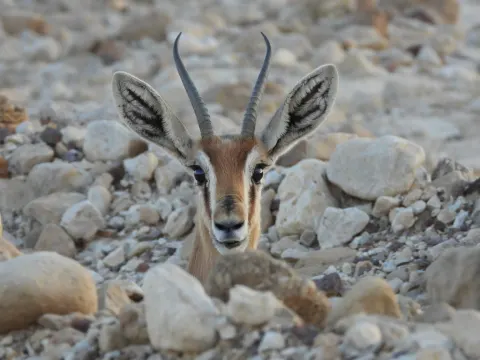
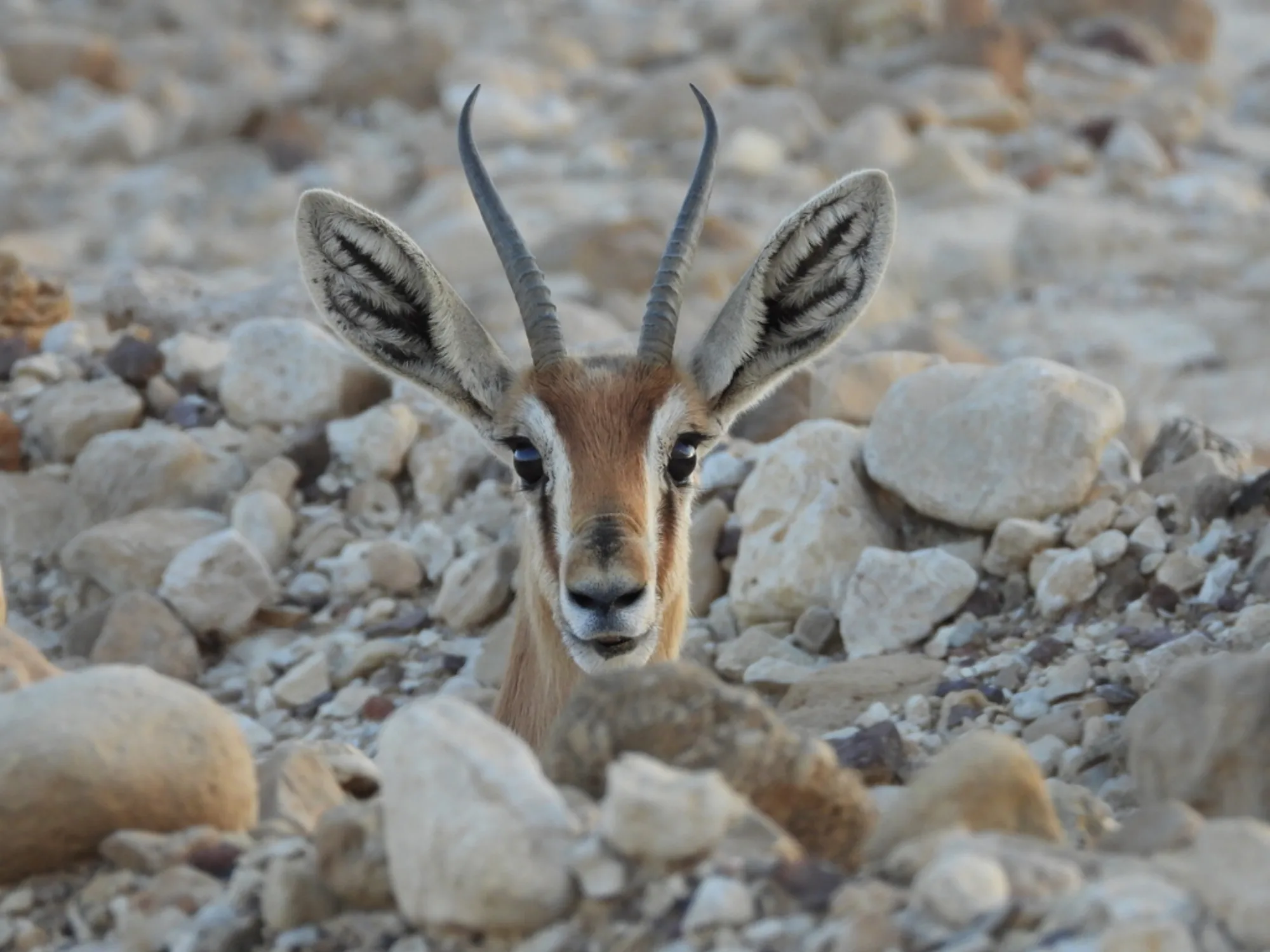
Small and desert-adapted, the Dorcas Gazelle stands about 55 to 65 cm at the shoulder and weighs 15 to 20 kg. Its long ears and curved horns, which sweep outwards before turning inwards and forwards at the tips, help distinguish it from the larger mountain gazelle. Coat colour varies across its range: Saharan animals are pale fawn with a white underside and brown and sandy stripes, while populations near the Red Sea and in Israel have darker, more reddish coats.
The gazelle lives in Africa and Arabia, using grassland, steppe, wadis, mountain desert and semidesert. Large populations occur in the Negev and Arava, Sudan and the southern Eastern Desert of Egypt. It feeds on acacia leaves, flowers and pods, as well as the leaves, twigs and fruits of desert bushes. It sometimes rises on its hind legs to browse trees and has been seen digging up bulbs after rain. Succulent plants provide most of its water, but it also seeks out water sources and drinks when it finds them. Activity is mainly from dusk to dawn, although gazelles exposed to hunting tend to be active only at night.
In harsh conditions, Dorcas Gazelles live in pairs; when conditions improve, they form family herds with an adult male, several females and young. Most mating takes place from September to November, and a single fawn is usual after a six-month gestation. For its first two weeks, the fawn rests curled up in a shallow hollow or under bushes while its mother grazes nearby. Expanding human settlement threatens the gazelle as land is converted to farmland and domestic sheep and goats compete for grassland. Hunting and the trade in pelts and horns also affect the species, while predators include cheetahs, leopards, Arabian wolves and lions.
Written from the English Wikipedia article Dorcas gazelle (CC BY-SA 4.0).
- Records
- 362
- Countries
- 5
No atlas park has a record of the Dorcas Gazelle in or around it yet.
These are open occurrence records, so they show where people looked for and recorded the Dorcas Gazelle as much as where it lives. Cells are up to 25 km across, and every location is generalised to its cell.
Generalised encounter areas, not exact locations. Each shape is a grid cell coloured by how likely the species is there.
- Very likelySpain25 km zone · high confidence · 322 records · updated 80 days ago
- Very likelyIsrael25 km zone · medium confidence · 34 records · updated 80 days ago
- Very likelyMorocco25 km zone · medium confidence · 6 records · updated 80 days ago
- PossibleNiger25 km zone · low confidence · 0 records · updated 80 days ago
- PossiblePalestinian Territories25 km zone · low confidence · 0 records · updated 80 days ago
Conservation status not assessed here yet, so every location is generalised to its grid cell.