Indian Gazelle
Gazella bennettii
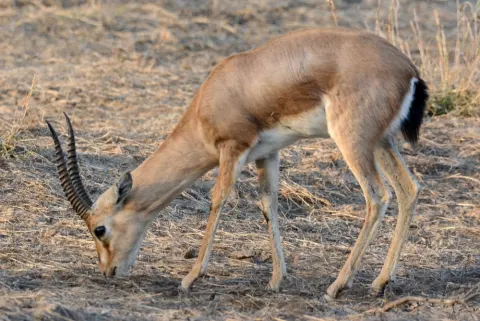
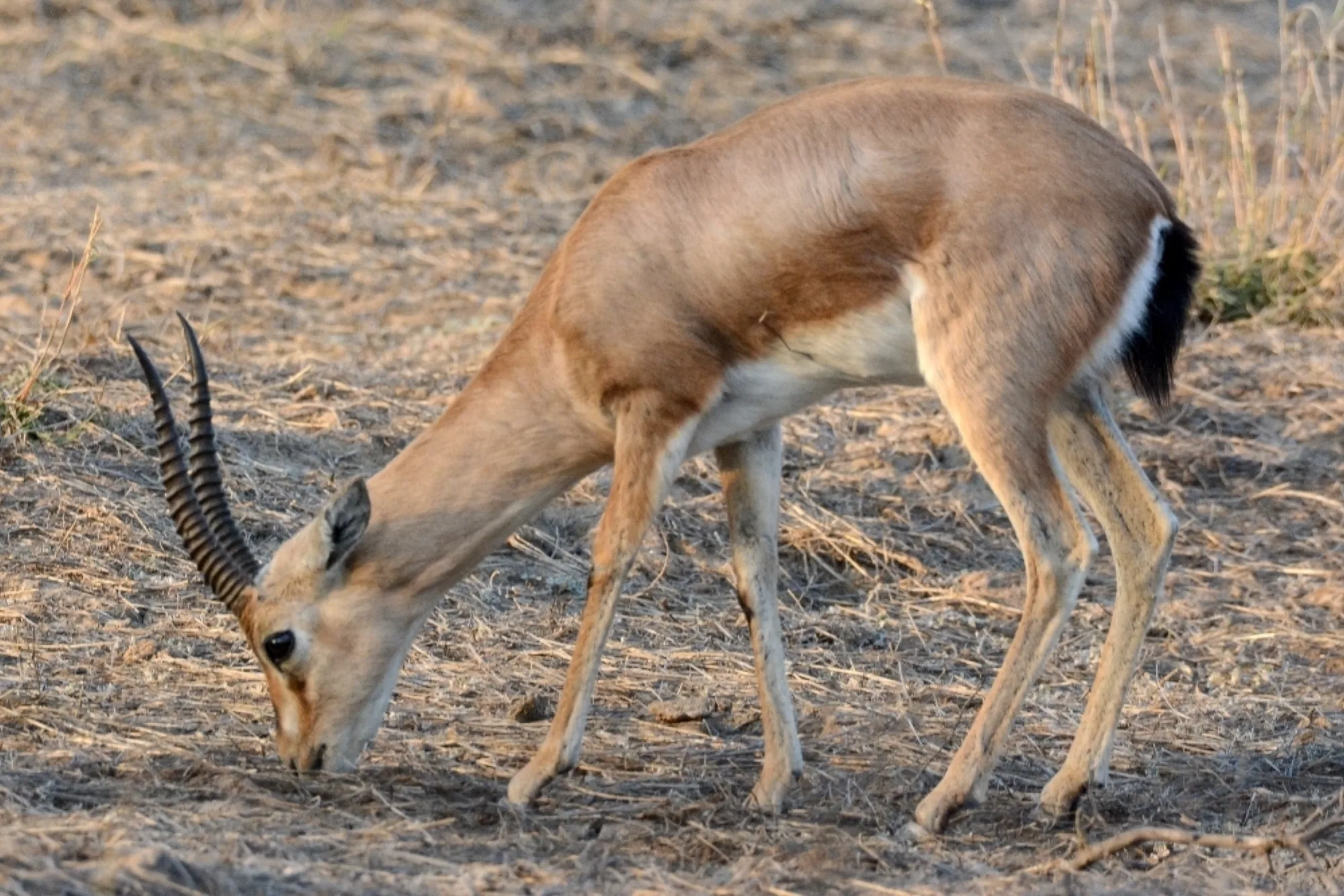
Known also as the chinkara, the Indian Gazelle is a swift, agile gazelle native to India, Iran, Afghanistan and Pakistan. It stands 65 cm tall and weighs about 23 kg, with a reddish-buff coat and glossy fur in summer. In winter, its white belly and throat stand out more strongly. Dark chestnut stripes run down the sides of its face, edged in white, while straight, ringed horns rise from its head. Both sexes have horns, though those of females are shorter.
Look for chinkara on arid plains and in hills, deserts, dry scrub and open or light forests. In India, they are most common in Gujarat, Madhya Pradesh, Maharashtra and Rajasthan, and occur in more than 80 protected areas. Pakistan's population is scattered, while in Afghanistan the gazelle is very rare and likely to be seen only seldom in the south. Iran's largest population lives in Kavir National Park, south of Tehran.
Chinkara are active at night and around dawn and dusk, with most feeding taking place in the evening. They browse on leaves and grasses, usually alone, in pairs or in small groups, although several may occasionally gather in a herd. Males defend territories, and females give birth after a pregnancy of 5 to 5.5 months, usually to one young, sometimes twins. A calf can remain alongside its mother for as long as 12 months. Hunting for meat and trophies threatens chinkara in Afghanistan, Iran and Pakistan, while expanding agriculture and industry take away habitat. Leopards, wolves, jackals and packs of dhole also prey on them, and dogs may pursue them outside protected areas.
Written from the English Wikipedia article Chinkara (CC BY-SA 4.0).
- Records
- 133
- Countries
- 2
- Atlas places
- 1
These are open occurrence records, so they show where people looked for and recorded the Indian Gazelle as much as where it lives. Cells are up to 25 km across, and every location is generalised to its cell.
Generalised encounter areas, not exact locations. Each shape is a grid cell coloured by how likely the species is there.
- Very likelyIndia25 km zone · medium confidence · 127 records · updated 80 days ago
- Very likelyIran25 km zone · medium confidence · 6 records · updated 80 days ago
Conservation status not assessed here yet, so every location is generalised to its grid cell.