Gharial
Gavialis gangeticus
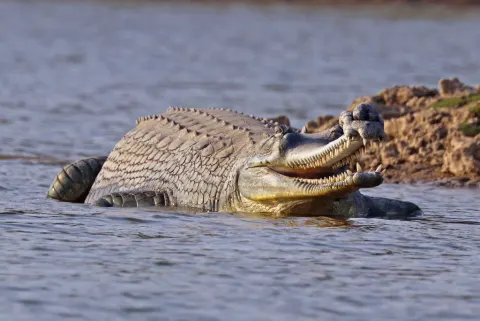
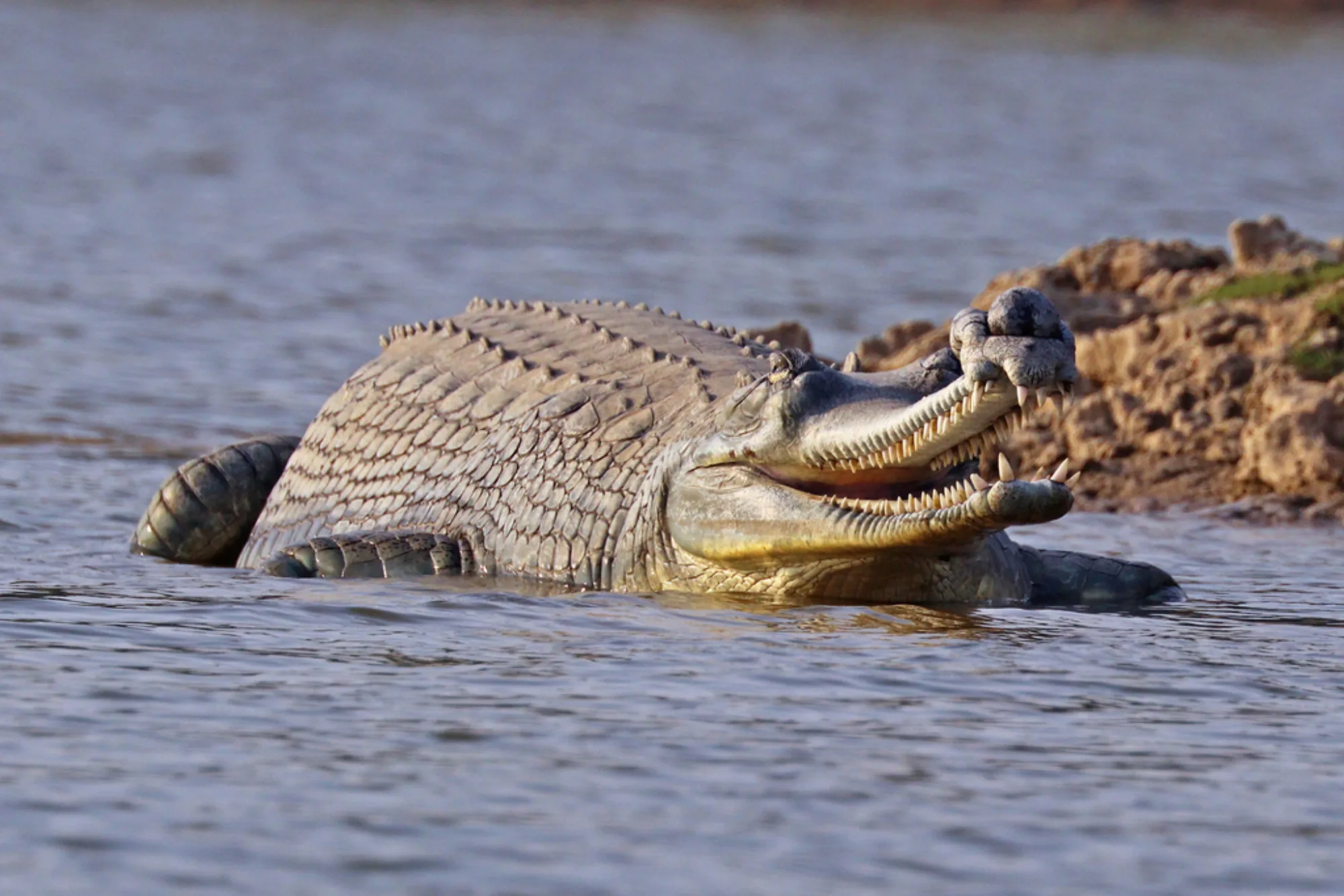
With its long, narrow snout and sharp interlocking teeth, the Gharial is a fish-catching crocodilian built for life in rivers. It is among the longest living crocodilians: mature females measure 2.6 to 4.5 m, while males reach 3 to 6 m. Adults are olive-coloured and darker than the young, which have brown bands and speckles. A mature male can be recognised by the pot-shaped swelling at the tip of his snout.
Gharials live in rivers across the plains of the northern Indian subcontinent, including the Chambal in India and the Narayani, Rapti system in Nepal. They spend most of their lives in water, coming ashore to bask and nest on sandy banks. In the cold season they bask daily, often in the morning, and groups of different ages may gather together. As the day grows hotter, they return to the river before coming back to the beach later. Their slender snouts help them catch fish underwater, which they swallow whole; young gharials also eat insects, tadpoles and frogs. In spring, females gather to dig nests and lay 20 to 95 eggs. They guard the nests and young, which hatch before the monsoon. During their first year, the hatchlings hide and feed in shallow water, moving to deeper sites as they grow.
The wild population has fallen sharply and is now confined to a small fraction of its former range. Sand mining, agriculture and structures such as dams and irrigation canals have reduced or altered river habitat. Depleted fish stocks and fishing methods, including gill nets, also threaten gharials. Captive-bred animals have been released into rivers in India and Nepal to support wild populations.
Written from the English Wikipedia article Gharial (CC BY-SA 4.0).
- Records
- 166
- Countries
- 2
- Atlas places
- 4
These are open occurrence records, so they show where people looked for and recorded the Gharial as much as where it lives. Cells are up to 25 km across, and every location is generalised to its cell.
Generalised encounter areas, not exact locations. Each shape is a grid cell coloured by how likely the species is there.
- Very likelyIndia25 km zone · medium confidence · 131 records · updated 80 days ago
- Very likelyNepal25 km zone · medium confidence · 35 records · updated 80 days ago
Conservation status not assessed here yet, so every location is generalised to its grid cell.