Red-throated Loon
Gavia stellata
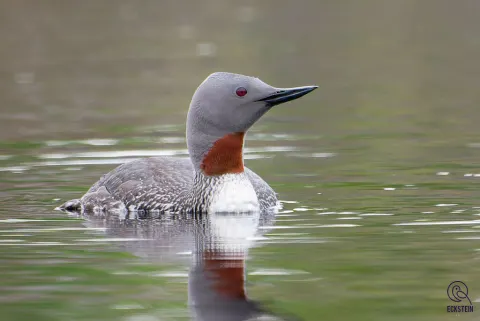
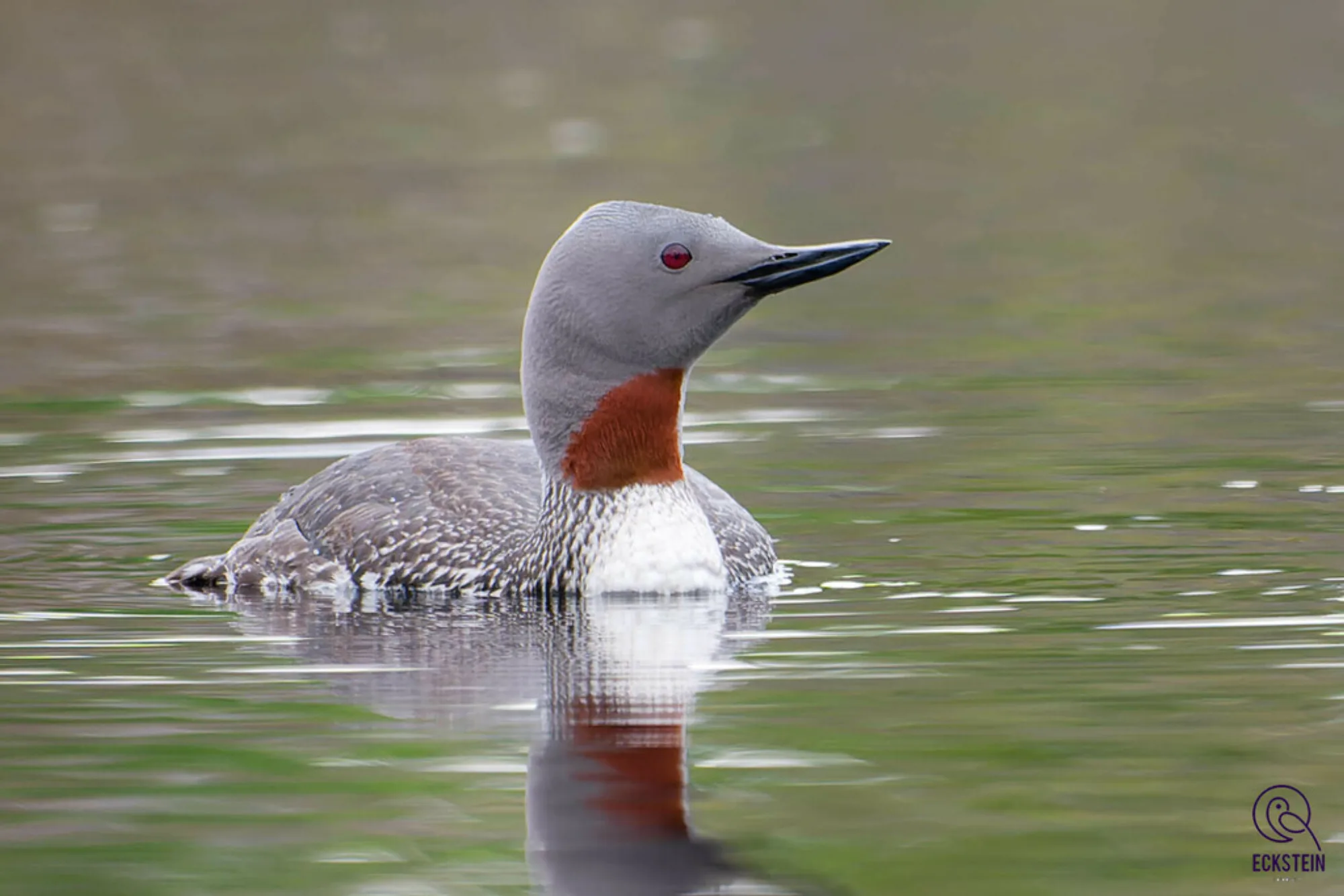
Small, sleek and often seen on water, the Red-throated Loon is a migratory bird of the Northern Hemisphere. It is the smallest of the loons, with a long body, short neck and a thin, pointed bill that often tilts upwards. In the breeding season, look for its dark grey head and triangular red throat patch. Winter birds are less colourful, with a white face and neck, a grey crown and white speckles across the dark back. In flight, its head and neck hang below its body line, giving it a hunched profile, while its narrow wings angle backwards.
The species breeds mainly in Arctic regions of North America and northern Eurasia, often on very small freshwater lakes. It also breeds in places including Iceland, northern Scotland and Scandinavia. It spends winter in northern coastal waters, sometimes gathering in sizeable groups. In North America its winter range reaches the Baja California Peninsula, while in Asia it extends south along the Pacific coast to China, Japan and Taiwan. Although it nests beside small ponds, it usually fishes on larger lakes or at sea. It catches most of its food underwater, taking mainly fish but also animals such as molluscs, crustaceans and frogs.
Pairs form long-term bonds and share the work of building a nest and feeding their young. The nest is usually a shallow scrape near the water, and a clutch generally contains two eggs. If danger approaches, parents may try to draw predators away from their nest and young. Oil spills, degraded habitat and fishing nets threaten the birds, while foxes and several kinds of seabird take eggs or chicks. Mercury pollution has caused breeding failures in some areas, and lake acidification can affect the fish on which the loons feed.
Written from the English Wikipedia article Red-throated loon (CC BY-SA 4.0).
- Records
- 561,718
- Countries
- 11
- Atlas places
- 3
These are open occurrence records, so they show where people looked for and recorded the Red-throated Loon as much as where it lives. Cells are up to 25 km across, and every location is generalised to its cell.
Generalised encounter areas, not exact locations. Each shape is a grid cell coloured by how likely the species is there.
- Very likelyUnited States25 km zone · high confidence · 416481 records · updated 81 days ago
- Very likelyNorway25 km zone · high confidence · 68788 records · updated 81 days ago
- Very likelyCanada25 km zone · high confidence · 35045 records · updated 81 days ago
- Very likelyUnited Kingdom25 km zone · high confidence · 28373 records · updated 81 days ago
- Very likelyFinland25 km zone · high confidence · 3622 records · updated 81 days ago
- Very likelyBelgium25 km zone · high confidence · 2749 records · updated 81 days ago
- Very likelySvalbard & Jan Mayen25 km zone · high confidence · 1666 records · updated 81 days ago
- Very likelySpain25 km zone · high confidence · 1620 records · updated 81 days ago
- Very likelyIceland25 km zone · high confidence · 1343 records · updated 81 days ago
- Very likelyIreland25 km zone · high confidence · 1062 records · updated 81 days ago
Conservation status not assessed here yet, so every location is generalised to its grid cell.