Three-spined Stickleback
Gasterosteus aculeatus
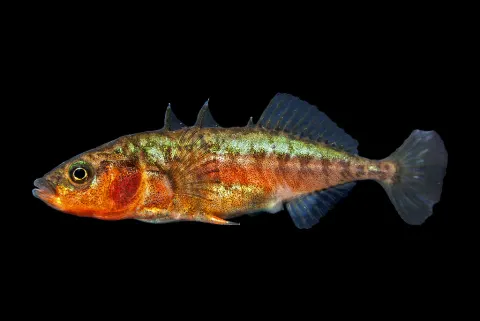
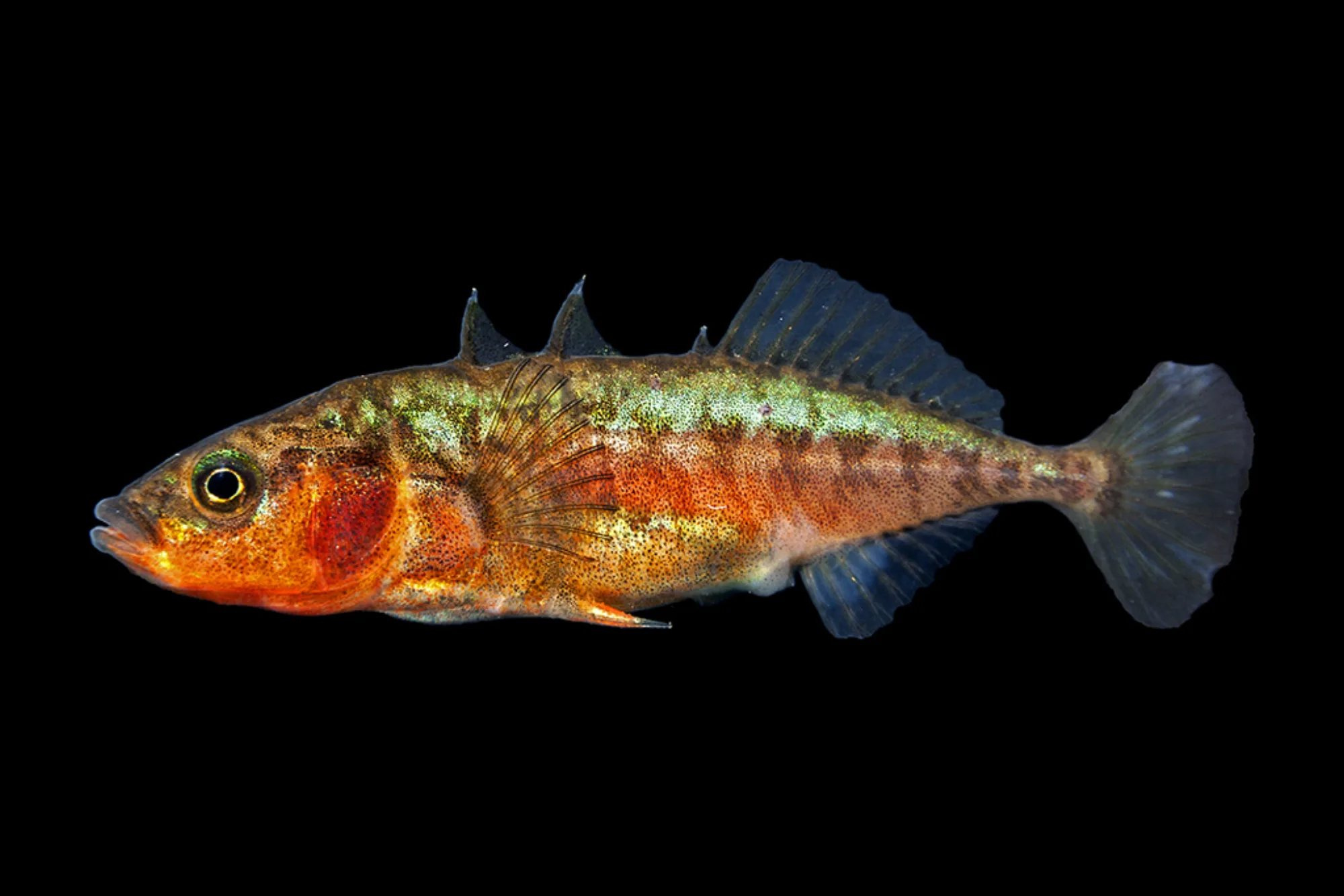
Small and often silvery, the Three-spined Stickleback usually reaches 3 to 4 centimetres at maturity, although some grow to 8 cm. Its narrow body has a slender tail and bony plates instead of scales. Typically, three spines stand in front of the dorsal fin, though some fish have two or four. The back is often olive or silvery green, sometimes mottled with brown, while the sides and belly are silvery. Breeding males can develop blue eyes and a bright red throat and belly, although males in a few populations are black or white instead.
Across the Northern Hemisphere, this fish lives in fresh, brackish and salt water. Look for it in slow-flowing water with emerging vegetation, including ponds, ditches, quiet rivers, marshes and sheltered bays. Its range includes much of Europe and both coasts of North America; in Asia, it extends between the Bering Straits, Japan and the Korean peninsula. Some populations spend much of their adult lives at sea and return to fresh water to breed, while others live in fresh water throughout their lives. Outside the breeding season, sticklebacks may gather in shoals. Depending on where they live, they eat plankton, fish, bottom-dwelling larvae and amphipods, as well as land animals that fall onto the water.
From late April, fish move into shallower water, where males defend territories and build nests on the bottom. A male tends the eggs and tries to keep the newly hatched young together for a few days. Introduced predators can threaten local populations: a predatory catfish destroyed a pair of distinct stickleback forms in Hadley Lake, while introduced northern pike in a nearby lake put the Bear Paw Lake population at risk.
Written from the English Wikipedia article Three-spined stickleback (CC BY-SA 4.0).
- Records
- 29,008
- Countries
- 14
- Atlas places
- 1
These are open occurrence records, so they show where people looked for and recorded the Three-spined Stickleback as much as where it lives. Cells are up to 25 km across, and every location is generalised to its cell.
Generalised encounter areas, not exact locations. Each shape is a grid cell coloured by how likely the species is there.
- Very likelyGermany25 km zone · high confidence · 6618 records · updated 80 days ago
- Very likelyCanada25 km zone · high confidence · 5242 records · updated 80 days ago
- Very likelySweden25 km zone · high confidence · 5043 records · updated 80 days ago
- Very likelyUnited Kingdom25 km zone · high confidence · 4924 records · updated 80 days ago
- Very likelyUnited States25 km zone · high confidence · 2041 records · updated 80 days ago
- Very likelyBelgium25 km zone · high confidence · 1560 records · updated 80 days ago
- Very likelyNorway25 km zone · high confidence · 1343 records · updated 80 days ago
- Very likelyFrance25 km zone · high confidence · 1018 records · updated 80 days ago
- Very likelyFinland25 km zone · high confidence · 435 records · updated 80 days ago
- Very likelyNetherlands25 km zone · high confidence · 391 records · updated 80 days ago
Conservation status not assessed here yet, so every location is generalised to its grid cell.