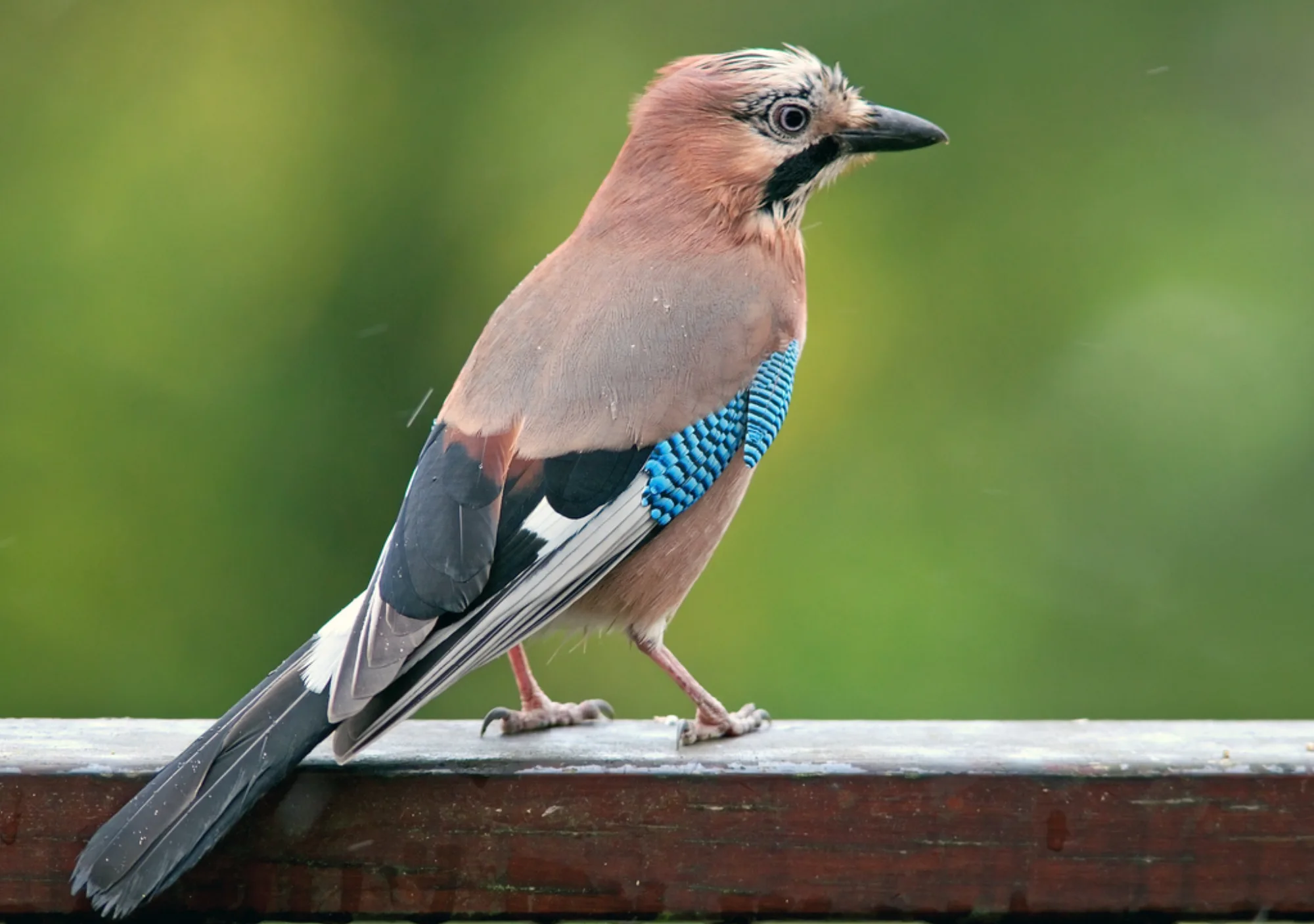
Eurasian Jay
Garrulus glandarius
A flash of blue on the upper wing can help pick out a Eurasian Jay among the trees. This relatively small member of the crow family has pinkish brown plumage, a whitish throat edged with black stripes and a mainly black tail. Its colouring varies across its extensive range, particularly between birds at opposite ends. Listen, too, for a harsh, rasping screech, though a jay can also mimic other birds so convincingly that seeing it may be the best way to identify the caller.
The species ranges from western Europe and north-west Africa across to the Indian subcontinent, the eastern coast of Asia and south-east Asia. It favours mixed woodland, especially where oaks grow, and has begun moving into urban areas. Woodland loss may be one reason for that shift. Jays feed in trees and on the ground, taking insects and other invertebrates, seeds, fruit, eggs, young birds and small mammals. They bury acorns for winter and store food throughout the year, with the busiest caching period in autumn. By carrying and burying acorns, they also help oaks spread.
Both parents build a nest, usually on a branch or in a fork close to a tree trunk. A clutch normally contains 3 to 6 speckled eggs, and the female incubates them for 16 to 19 days while the male brings her food. Both parents care for the chicks, which leave the nest after 19 to 23 days, and continue feeding them until they are 6 to 8 weeks old. The birds raise a single brood each year.
Written from the English Wikipedia article Eurasian jay (CC BY-SA 4.0).
- Records
- 769,307
- Countries
- 73
- Atlas places
- 1
These are open occurrence records, so they show where people looked for and recorded the Eurasian Jay as much as where it lives. Cells are up to 25 km across, and every location is generalised to its cell.
Generalised encounter areas, not exact locations. Each shape is a grid cell coloured by how likely the species is there.
- Very likelyUnited Kingdom25 km zone · high confidence · 170346 records · updated 86 days ago
- Very likelyBelgium25 km zone · high confidence · 104731 records · updated 86 days ago
- Very likelyFrance25 km zone · high confidence · 99624 records · updated 86 days ago
- Very likelyNorway25 km zone · high confidence · 54461 records · updated 86 days ago
- Very likelyPortugal25 km zone · high confidence · 41262 records · updated 86 days ago
- Very likelyIsrael25 km zone · high confidence · 35111 records · updated 86 days ago
- Very likelySpain25 km zone · high confidence · 31547 records · updated 86 days ago
- Very likelyPalestinian Territories25 km zone · high confidence · 23789 records · updated 86 days ago
- Very likelyCzechia25 km zone · high confidence · 21887 records · updated 86 days ago
- Very likelyGermany25 km zone · high confidence · 18698 records · updated 86 days ago
Conservation status not assessed here yet, so every location is generalised to its grid cell.