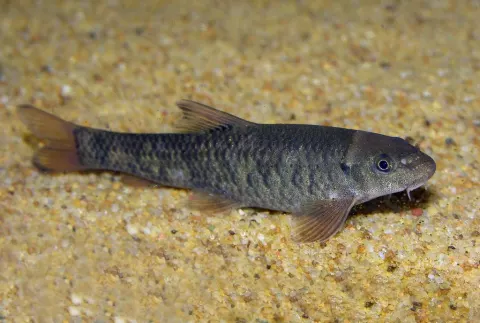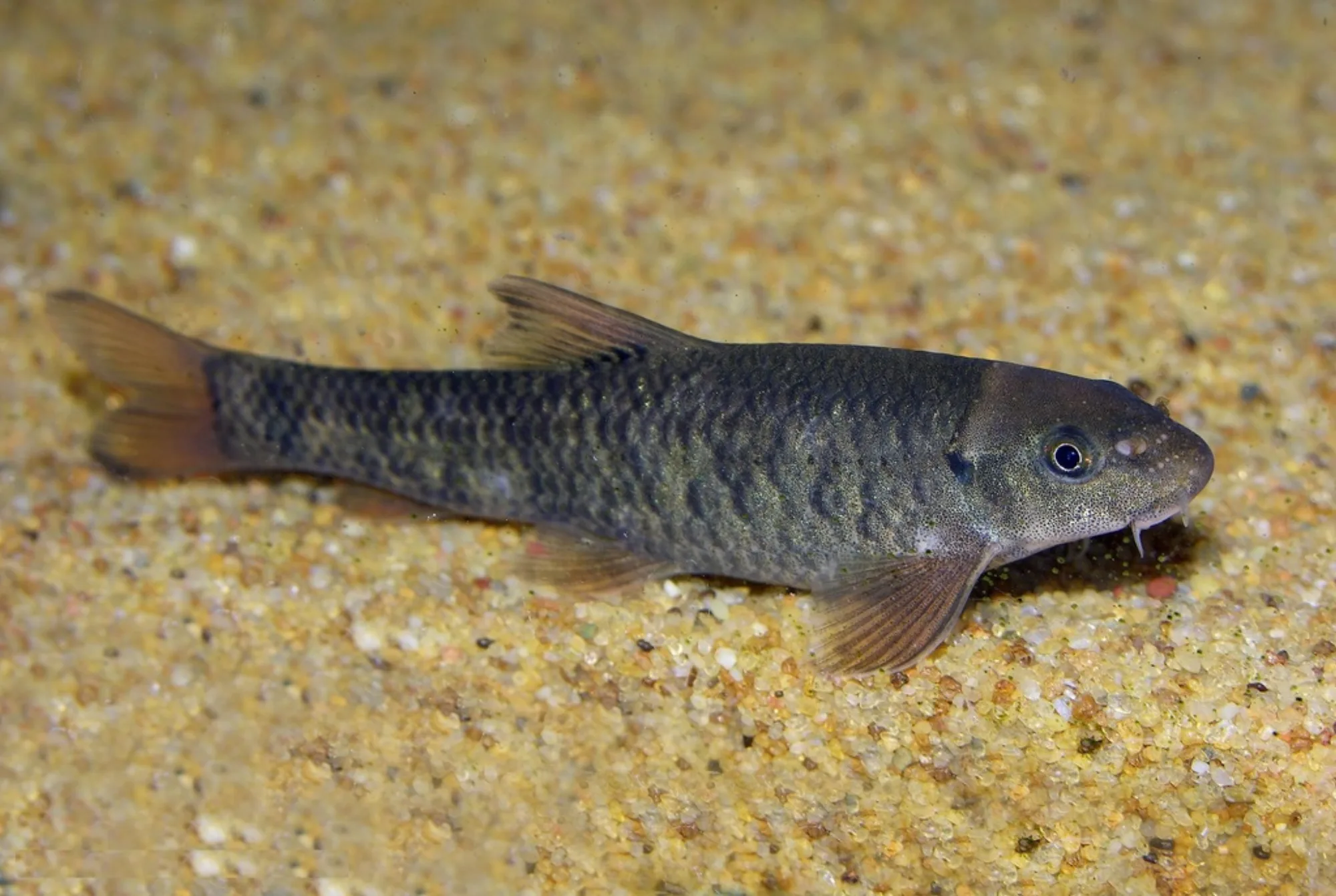
Red Garra
Garra rufa
Known also as the doctor fish or nibble fish, the Red Garra (Garra rufa) is a small freshwater fish from subtropical Western Asia. It typically grows to about 14 cm in total length, though some individuals reach 24 cm. Size is one clue for a visitor, although fish at the upper end of that range can be considerably longer than usual.
Its traditionally described range includes Iran and Iraq, as well as Turkey, Syria, Jordan and Israel-Palestine. It has been recorded in major river basins including the Tigris-Euphrates, as well as in coastal basins of the Levant and Iran and the Lake Maharlu system. Look for the fish in rivers and streams, but also in canals, reservoirs, ponds and lakes. It tends to avoid stagnant water, yet can be common or abundant in places heavily affected by people, including polluted canals. Its presence in such waterways shows that it can survive pollution, although in an aquarium it needs clean, moving water with plenty of oxygen to thrive.
In the wild, Red Garra feed on detritus, algae and tiny animals, including arthropods and other zooplankton. Fish sold for spas and aquariums mostly come from commercial facilities in Israel, with a smaller proportion from Turkey, although the identity of many fish in this trade is uncertain. Some populations previously treated as Garra rufa are now recognised as separate species. Concerns about overharvesting have led to legal protection from wild capture in Turkey. Animal-rights organisations have also raised concerns about international transport and alleged starvation between spa treatments.
Written from the English Wikipedia article Red garra (CC BY-SA 4.0).
- Records
- 165
- Countries
- 5
No atlas park has a record of the Red Garra in or around it yet.
These are open occurrence records, so they show where people looked for and recorded the Red Garra as much as where it lives. Cells are up to 25 km across, and every location is generalised to its cell.
Generalised encounter areas, not exact locations. Each shape is a grid cell coloured by how likely the species is there.
- Very likelyTürkiye25 km zone · medium confidence · 74 records · updated 80 days ago
- Very likelySyria25 km zone · medium confidence · 34 records · updated 80 days ago
- Very likelyIraq25 km zone · medium confidence · 18 records · updated 80 days ago
- LikelyIran25 km zone · medium confidence · 35 records · updated 80 days ago
- PossibleJordan25 km zone · medium confidence · 4 records · updated 80 days ago
Conservation status not assessed here yet, so every location is generalised to its grid cell.