Mosquitofish
Gambusia affinis
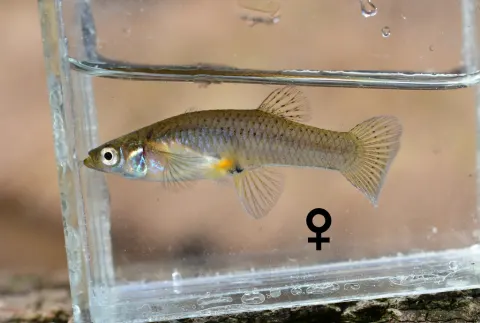
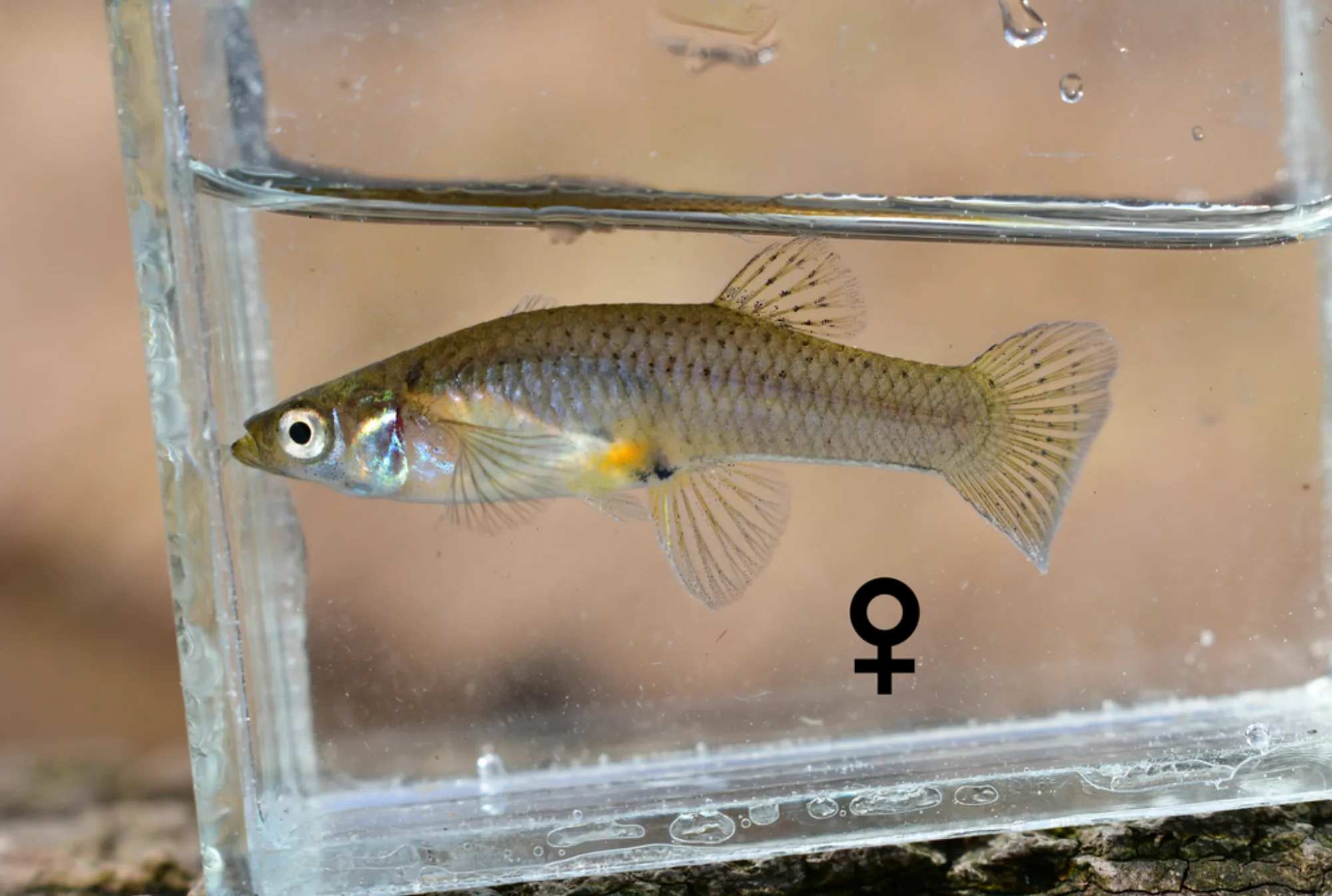
Small and dull grey, the Mosquitofish has a large abdomen, rounded fins and a mouth that points upwards. Females can reach 7 cm, while males reach 4 cm; an adult female also has a dark spot towards the rear of her abdomen. Several similar fish are commonly mistaken for it, so identification can be difficult.
Its native range stretches from southern Illinois and Indiana through the Mississippi River and its tributaries to the Gulf Coast in northeastern Mexico. It is most abundant in shallow water sheltered from larger fish, and it can withstand low oxygen and high salt concentrations. It can also survive temperatures up to 42 °C for short periods, although sustained temperatures at or above 35 °C are typically lethal. Introductions for mosquito control have carried the fish into habitats around the world, where it can harm native aquatic life by competing with, eating or injuring other small fish.
Despite its name, mosquito larvae form only a small part of its varied diet, which also includes zooplankton, insects, other invertebrates and detritus. Mosquitofish sometimes eat their own young, while bass, catfish and bluegill are among the predators that eat them. Females give birth to live young after a gestation of 16 to 28 days, and many have broods of 60 or more. Larger females can produce larger broods, and females may have two to six broods in a reproductive season. The fish lives for less than a year on average, with males having considerably shorter lives than females.
Written from the English Wikipedia article Mosquitofish (CC BY-SA 4.0).
- Records
- 25,151
- Countries
- 6
- Atlas places
- 2
These are open occurrence records, so they show where people looked for and recorded the Mosquitofish as much as where it lives. Cells are up to 25 km across, and every location is generalised to its cell.
Generalised encounter areas, not exact locations. Each shape is a grid cell coloured by how likely the species is there.
- Very likelyUnited States25 km zone · medium confidence · 18178 records · updated 80 days ago
- Very likelyFrance25 km zone · high confidence · 4593 records · updated 80 days ago
- Very likelyMexico25 km zone · high confidence · 1120 records · updated 80 days ago
- Very likelyTaiwan25 km zone · high confidence · 1002 records · updated 80 days ago
- Very likelyJapan25 km zone · high confidence · 217 records · updated 80 days ago
- Very likelyCanada25 km zone · medium confidence · 41 records · updated 80 days ago
Conservation status not assessed here yet, so every location is generalised to its grid cell.