Common Snipe
Gallinago gallinago
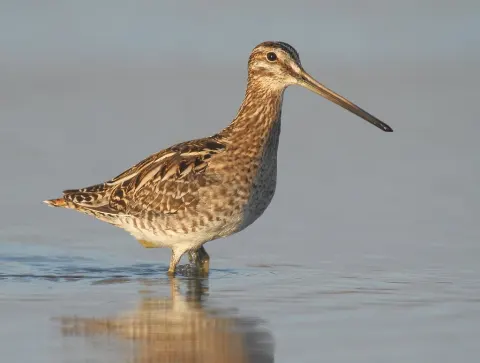
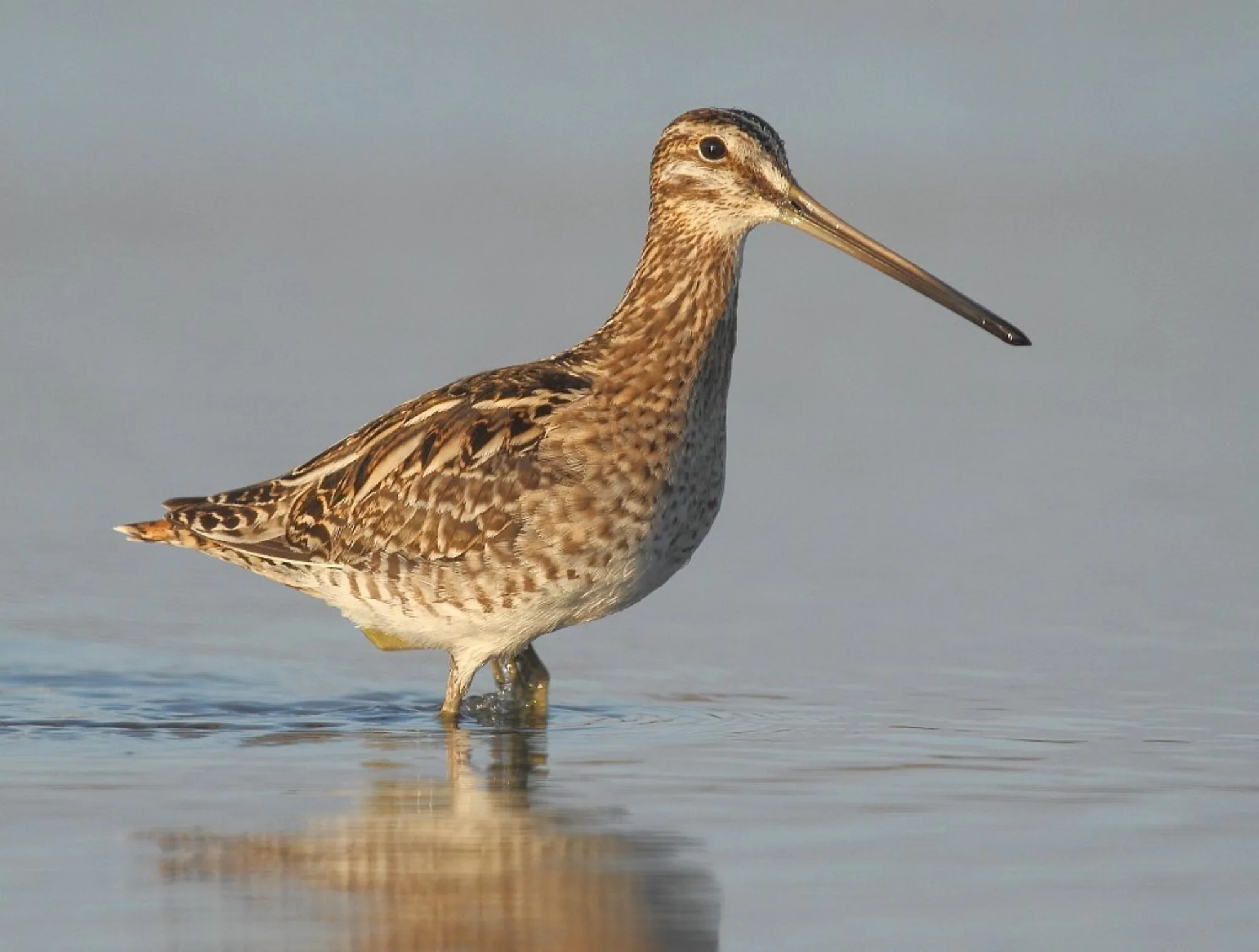
Look for a small, stocky wader with mottled brown plumage, straw-yellow stripes along its back and a pale underside. The Common Snipe has short greenish-grey legs and a strikingly long, straight dark bill, while a dark line through each eye sits between lighter stripes. Its pointed wings may be most obvious when it takes flight: a startled bird gives a sharp call and escapes in a series of zigzags. Usually shy and well camouflaged, it stays close to ground vegetation and often waits until an approach is close before flushing.
Its breeding grounds span the Palearctic, from Iceland and northern Europe across Siberia to Kamchatka and the Kuril Islands, and include bogs, marshes, wet meadows and tundra. In Europe, the southern limit reaches Ukraine and Bulgaria, as well as northern Italy, central France and northern Portugal, though western populations are scattered. It migrates for winter: European birds move to southern and western Europe and Africa, while Asian migrants head to tropical southern Asia. In soft mud, it probes for food or picks it out by sight, taking mainly insects and earthworms as well as some plant material.
In courtship, the male circles high before making shallow dives accompanied by a drumming sound, sometimes likened to a sheep or goat bleating. The nest is concealed on the ground, where the female incubates four dark olive eggs marked with brown for 18 to 21 days. Both parents care for the young, which fledge in 10 to 20 days. At the southern edge of the European breeding range, populations are declining, with field drainage and agricultural intensification the main causes; some areas of England and Germany have lost their populations entirely.
Written from the English Wikipedia article Common snipe (CC BY-SA 4.0).
- Records
- 449,692
- Countries
- 25
No atlas park has a record of the Common Snipe in or around it yet.
These are open occurrence records, so they show where people looked for and recorded the Common Snipe as much as where it lives. Cells are up to 25 km across, and every location is generalised to its cell.
Generalised encounter areas, not exact locations. Each shape is a grid cell coloured by how likely the species is there.
- Very likelyUnited Kingdom25 km zone · high confidence · 100686 records · updated 81 days ago
- Very likelyNorway25 km zone · high confidence · 95642 records · updated 81 days ago
- Very likelyBelgium25 km zone · high confidence · 60996 records · updated 81 days ago
- Very likelyFrance25 km zone · high confidence · 32949 records · updated 81 days ago
- Very likelySpain25 km zone · high confidence · 32870 records · updated 81 days ago
- Very likelyTaiwan25 km zone · high confidence · 31664 records · updated 81 days ago
- Very likelyIceland25 km zone · high confidence · 18926 records · updated 81 days ago
- Very likelyPortugal25 km zone · high confidence · 14495 records · updated 81 days ago
- Very likelyNetherlands25 km zone · high confidence · 12981 records · updated 81 days ago
- Very likelyFinland25 km zone · high confidence · 8493 records · updated 81 days ago
Conservation status not assessed here yet, so every location is generalised to its grid cell.