Tope
Galeorhinus galeus
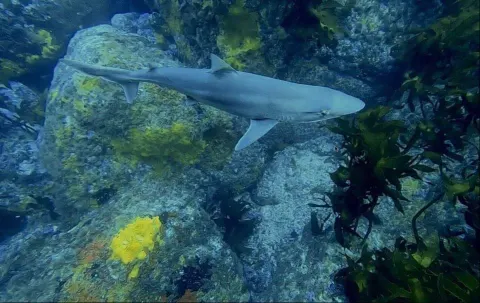
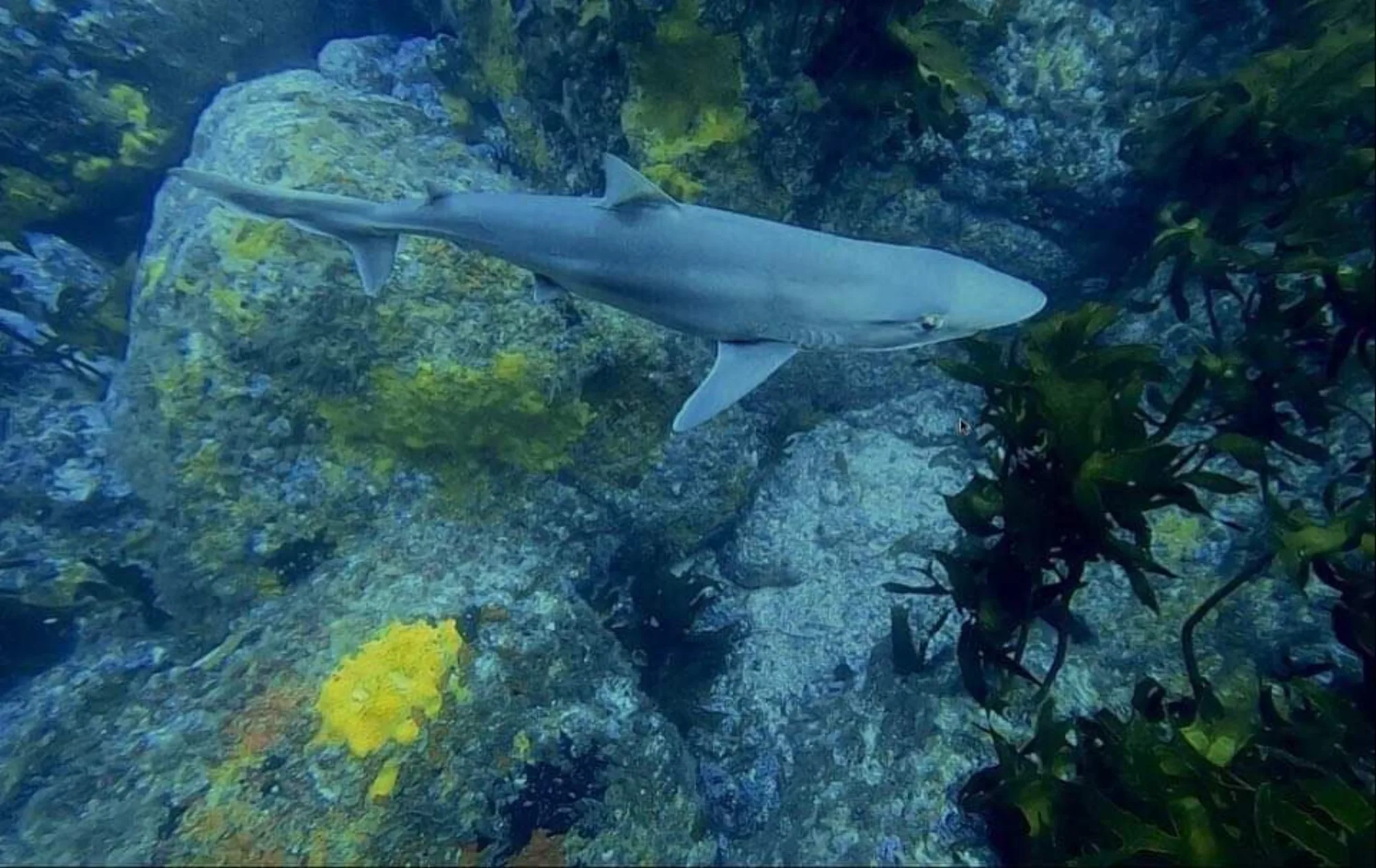
With a long snout and a slim body, the Tope is a houndshark that can grow to nearly 2 m long. Its back is dark bluish grey, its belly white, and young sharks have black markings on their fins. A large, crescent-shaped mouth and a triangular first dorsal fin add to its distinctive profile. It lives in temperate seas around the world, mainly near the seabed around coasts, at depths down to about 800 m. Its range includes the Mediterranean, the coasts of southern Africa, parts of the Atlantic and Pacific, southern Australia and New Zealand.
The Tope migrates widely: sharks tagged in the United Kingdom have later been found around the Azores, Canary Islands and Iceland. In Australia, tagged sharks have travelled 1,200 km along the coast, while others have reached New Zealand. It feeds mainly on fish, taking prey in open water as well as near the seabed. Off California, stomach contents showed an opportunistic diet that included sardines, flatfish, rockfish and squid. After a pregnancy of about one year, females give birth in sheltered bays and estuaries, returning to traditional pupping areas. The young stay in these nurseries when the adults move into deeper water.
Fishing puts pressure on the species across its range, with sharks targeted for their flesh, fins and liver oil. They are caught mainly in gillnets and on longlines, and pups are sometimes caught close to shore. Nursery habitats can also be degraded by siltation, while deep-sea cables and their magnetic fields may disrupt migration routes.
Written from the English Wikipedia article School shark (CC BY-SA 4.0).
- Records
- 80,326
- Countries
- 4
- Atlas places
- 8
- Channel Islands National Park· United States
- Westland Tai Poutini National Park· New Zealand
- Rakiura National Park· New Zealand
- Paparoa National Park· New Zealand
- Abel Tasman National Park· New Zealand
- Aoraki / Mount Cook National Park· New Zealand
- Catlins Conservation Park· New Zealand
- Fiordland National Park· New Zealand
These are open occurrence records, so they show where people looked for and recorded the Tope as much as where it lives. Cells are up to 25 km across, and every location is generalised to its cell.
Generalised encounter areas, not exact locations. Each shape is a grid cell coloured by how likely the species is there.
- Very likelyUnited States25 km zone · high confidence · 71544 records · updated 80 days ago
- Very likelyNew Zealand25 km zone · high confidence · 5967 records · updated 80 days ago
- Very likelyAustralia25 km zone · medium confidence · 2798 records · updated 80 days ago
- LikelyPortugal25 km zone · medium confidence · 17 records · updated 80 days ago
Conservation status not assessed here yet, so every location is generalised to its grid cell.