Tiger Shark
Galeocerdo cuvier
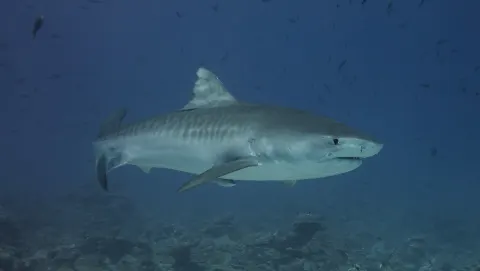
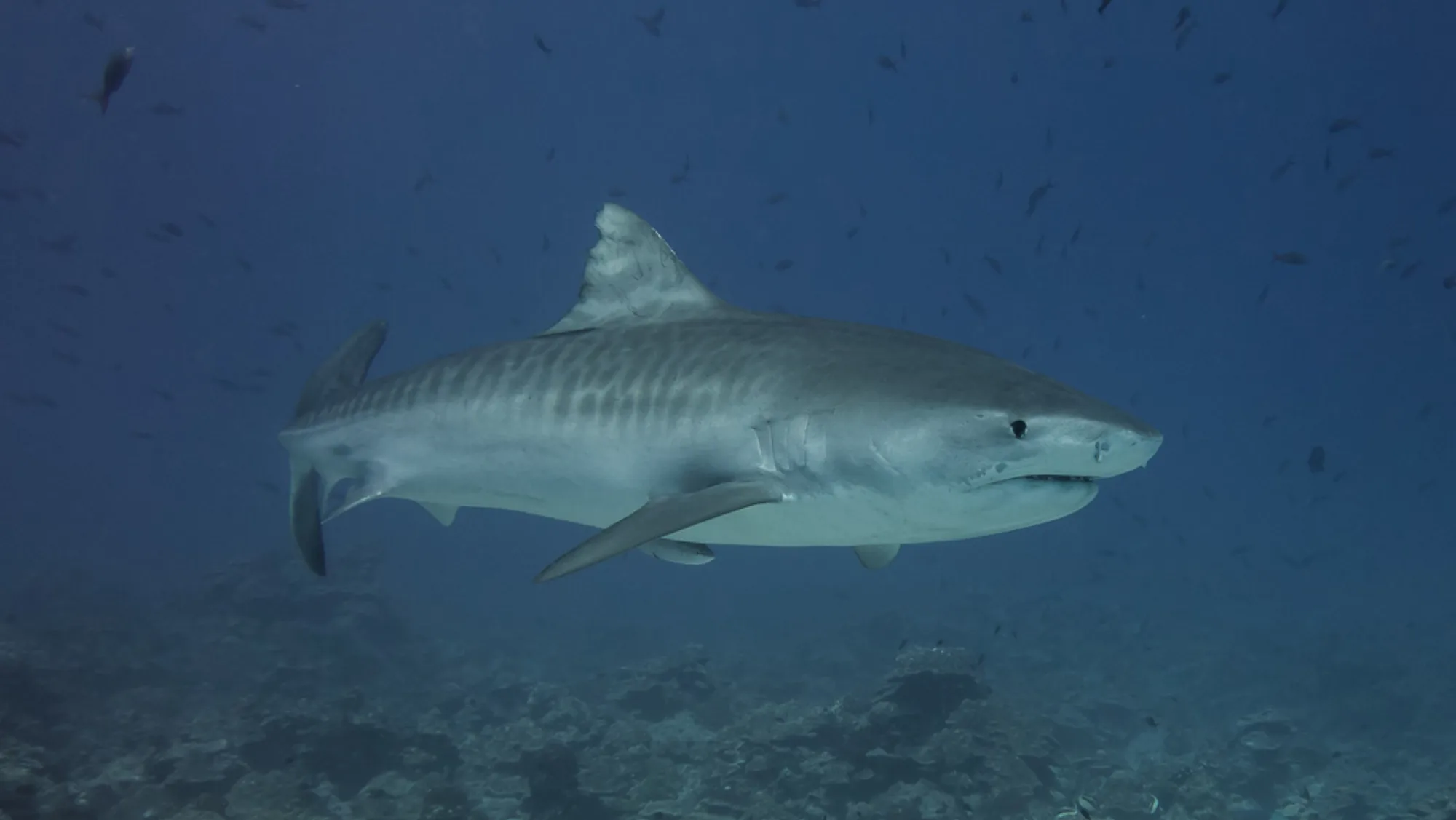
Dark stripes give the Tiger Shark its name, though they are clearest in young animals and fade with age. Its skin ranges from grey-blue to light green-grey, with a white or pale yellow underside. Adults commonly reach 3.5 to 4.7 m in length, and females grow larger than males.
Found in tropical and subtropical waters around the world, this shark often stays close to shore. It tends to use deep water along reefs, but enters shallower channels in pursuit of prey. It also visits shallow reefs, harbours, canals and river mouths. Places where travellers might encounter it include the Caribbean Sea, the Maldives, Australia and Indonesia. Around Fuvahmulah in the Maldives, researchers recorded at least 239 individual tiger sharks, with adult females showing a particularly strong tendency to return to the area.
A solitary hunter, the tiger shark is most active at night, when it swims towards shore to feed, moving into deeper water by day. It usually swims slowly but can burst forward to catch prey. Young sharks feed mainly on small fish, jellyfish and molluscs, while adults take a wider range, including sea turtles, birds, dolphins and other sharks. They also scavenge dead animals and sometimes swallow discarded objects. Females mate once every three years, and their young develop inside the mother's body for up to 16 months before being born alive. Litters range from 10 to 80 pups. Fishing threatens the species: tiger sharks are caught both deliberately and incidentally, and killed for their fins, flesh, liver and skin. Several heavily fished populations have declined, and continued demand for fins could drive further losses.
Written from the English Wikipedia article Tiger shark (CC BY-SA 4.0).
- Records
- 31,416
- Countries
- 20
- Atlas places
- 2
These are open occurrence records, so they show where people looked for and recorded the Tiger Shark as much as where it lives. Cells are up to 25 km across, and every location is generalised to its cell.
Generalised encounter areas, not exact locations. Each shape is a grid cell coloured by how likely the species is there.
- Very likelyAustralia25 km zone · high confidence · 31069 records · updated 80 days ago
- Very likelyUnited Kingdom25 km zone · medium confidence · 50 records · updated 80 days ago
- Very likelyNorfolk Island25 km zone · medium confidence · 39 records · updated 80 days ago
- LikelyFaroe Islands25 km zone · medium confidence · 82 records · updated 80 days ago
- LikelyMexico25 km zone · medium confidence · 48 records · updated 80 days ago
- LikelyUnited States25 km zone · medium confidence · 24 records · updated 80 days ago
- LikelyFiji25 km zone · medium confidence · 18 records · updated 80 days ago
- LikelyBrazil25 km zone · medium confidence · 14 records · updated 80 days ago
- LikelyMarshall Islands25 km zone · medium confidence · 12 records · updated 80 days ago
- LikelySvalbard & Jan Mayen25 km zone · medium confidence · 12 records · updated 80 days ago
Conservation status not assessed here yet, so every location is generalised to its grid cell.