Atlantic Cod
Gadus morhua
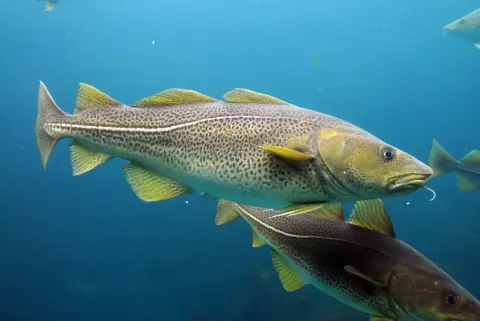
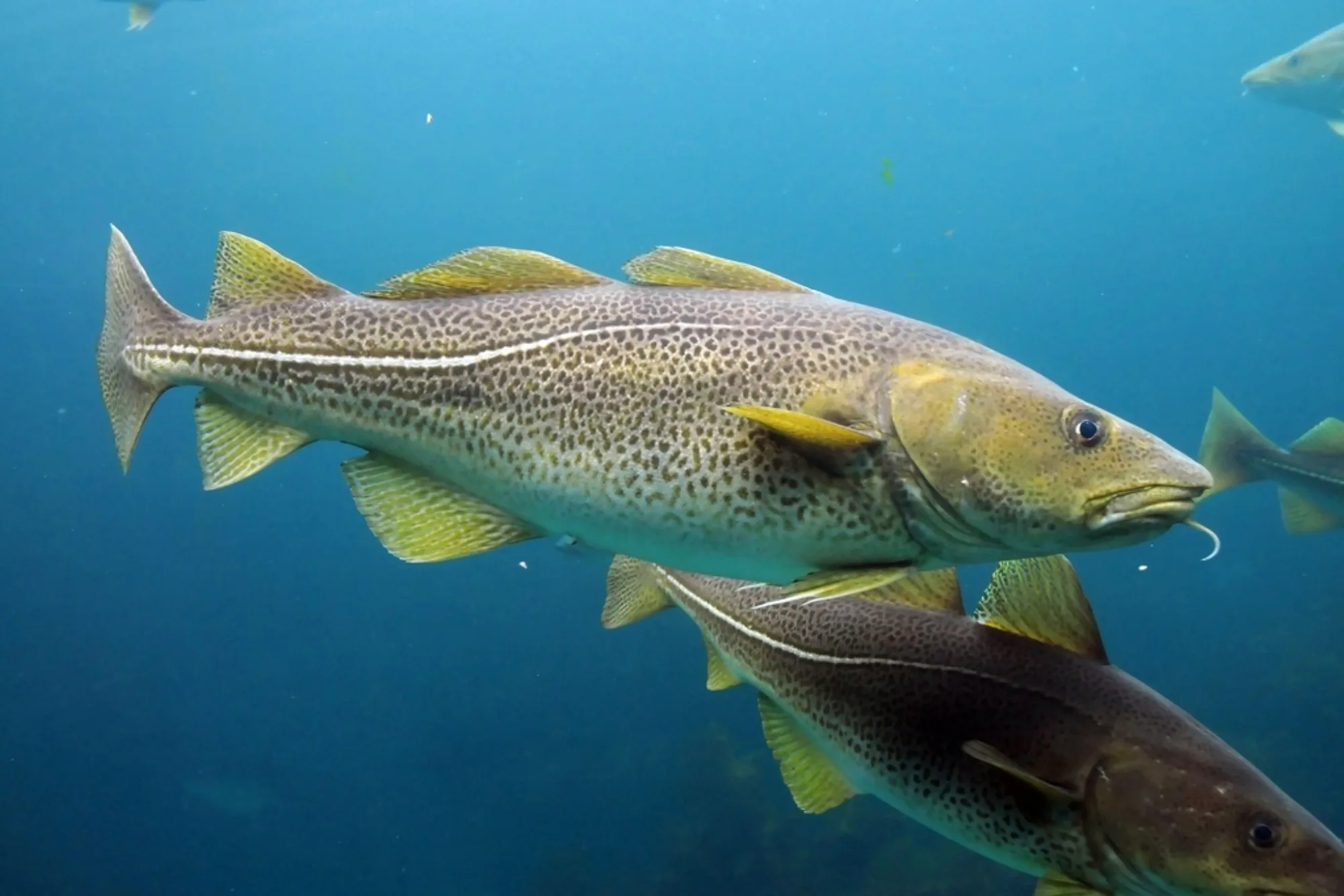
Brown or green above and silver underneath, the Atlantic Cod has spots across its back and a visible stripe along its side. This fish typically grows to 100 to 140 cm and can live for up to 25 years. In the western Atlantic it ranges north of Cape Hatteras and around Greenland and the Labrador Sea. In the east, it occurs from the Bay of Biscay to the Arctic Ocean, including the North Sea, Baltic Sea and waters around Iceland. Its habitat extends across the continental shelf, from the shore to depths of 300 m.
Atlantic cod travel in large shoals arranged by size, with larger fish scouting ahead, particularly on inshore feeding migrations after spawning. They feed during these journeys, and the shoal changes its structure when it encounters food. Smaller cod mainly eat crustaceans, while larger fish feed mostly on other fish, including herring and capelin. Young cod can also become prey for adults; when predators are actively hunting, juveniles hide among cobbles or in kelp. Most populations spawn from January to May, often migrating between separate feeding and spawning grounds. Eggs and newly hatched larvae drift freely on currents, which carry some larvae towards nursery areas.
Heavy fishing has put many stocks at risk, and several that collapsed in the 1990s have still not fully recovered despite fishing having stopped. The collapse was driven in part by bottom trawling that damaged whole ecosystems, as well as technology that helped fishers locate and catch cod. In the Baltic, decades of overfishing have combined with poor water circulation, low salt levels and a shortage of oxygen near the bottom to threaten cod stocks.
Written from the English Wikipedia article Atlantic cod (CC BY-SA 4.0).
- Records
- 1,821,744
- Countries
- 10
No atlas park has a record of the Atlantic Cod in or around it yet.
These are open occurrence records, so they show where people looked for and recorded the Atlantic Cod as much as where it lives. Cells are up to 25 km across, and every location is generalised to its cell.
Generalised encounter areas, not exact locations. Each shape is a grid cell coloured by how likely the species is there.
- Very likelyCanada25 km zone · high confidence · 1667177 records · updated 81 days ago
- Very likelyBelgium25 km zone · high confidence · 44529 records · updated 81 days ago
- Very likelyUnited States25 km zone · high confidence · 40647 records · updated 81 days ago
- Very likelyUnited Kingdom25 km zone · high confidence · 39461 records · updated 81 days ago
- Very likelySweden25 km zone · high confidence · 15520 records · updated 81 days ago
- Very likelyLatvia25 km zone · high confidence · 6294 records · updated 81 days ago
- Very likelyNetherlands25 km zone · high confidence · 3624 records · updated 81 days ago
- Very likelyNorway25 km zone · high confidence · 2369 records · updated 81 days ago
- Very likelySt. Pierre & Miquelon25 km zone · high confidence · 2123 records · updated 81 days ago
Conservation status not assessed here yet, so every location is generalised to its grid cell.