Rufous Hornero
Furnarius rufus
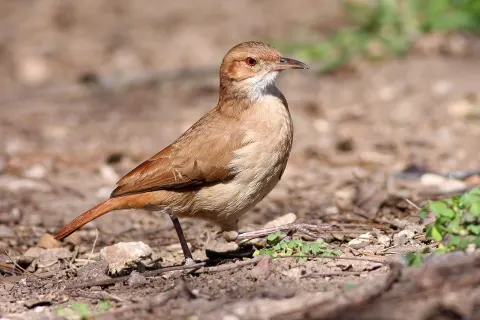
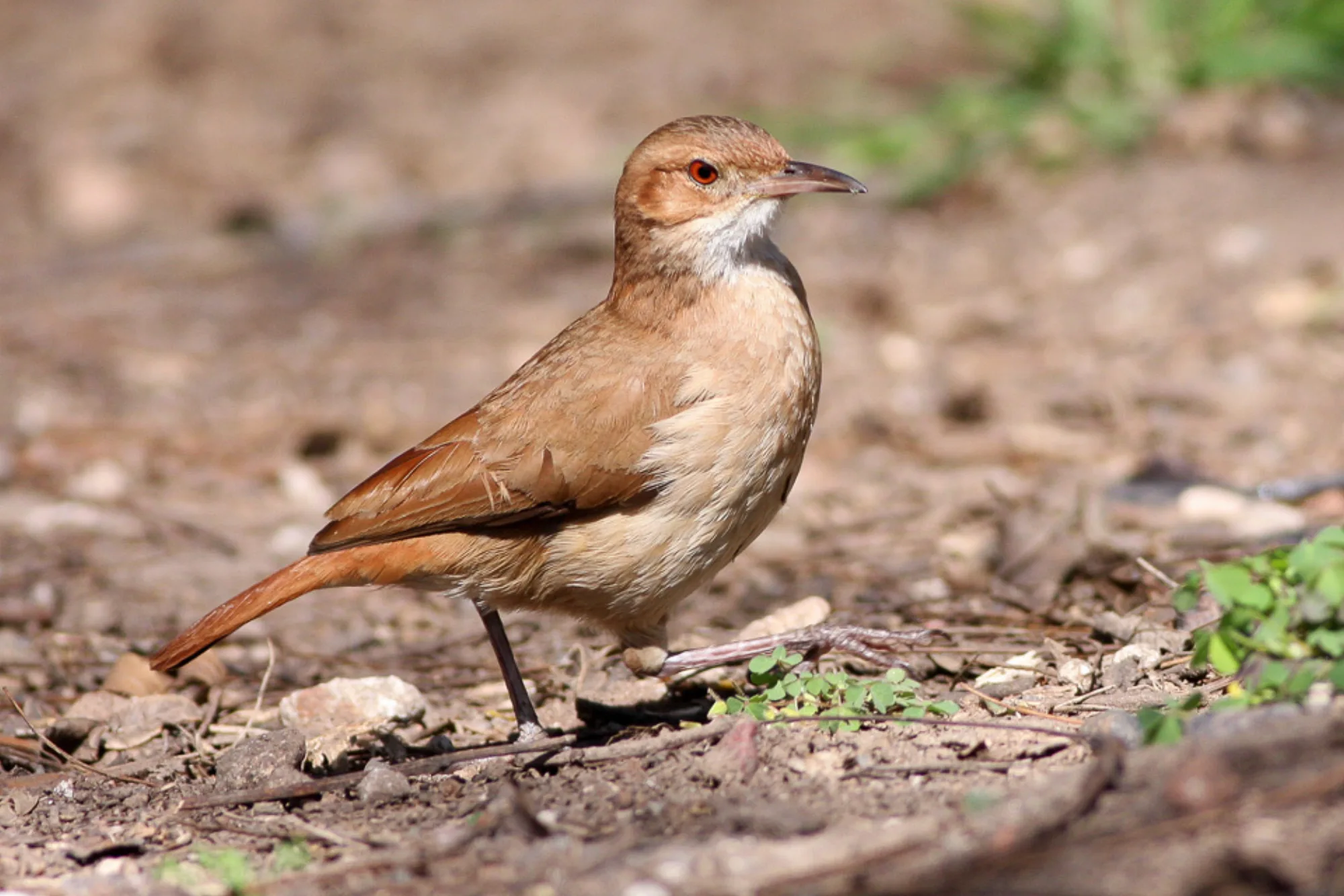
Look for the Rufous Hornero walking across the ground in eastern South America, searching for insects and other small arthropods. This medium-sized ovenbird measures 18 to 20 centimetres, with a short, square tail and a slender, slightly curved bill. Its back is reddish brown, its underparts are pale buffy brown, and its throat is whitish. Males and females look alike, while young birds are slightly paler below. Listen for pairs singing together: both birds beat their wings at their sides, with the male's faster trill matched by faster wingbeats.
Its range stretches across parts of Brazil, Bolivia, Paraguay, Uruguay and Argentina, reaching northern Patagonia. Common habitats include savannas, pastures, agricultural land and scrub that has grown back after disturbance; it also lives in city suburbs. Horneros forage on foot and sometimes pick up scraps such as bread crumbs. Pairs stay together throughout the year, often keeping their bond for life, and both parents incubate the eggs and feed the young. They build a large, thick clay nest shaped like an oven, placing it in a tree or on a fence post, telephone pole or building. Nest building can take as little as 5 days, although it usually takes longer and occasionally lasts months. Eggs are laid between August and December, usually with two to four in a clutch. Young birds can remain in their parents' territory until the next breeding season. Birds of prey, small mammals, domestic cats and snakes prey on adults and young, while the covered nest probably lowers the risk of predation. Human changes to the landscape have benefited this bird, and human activities are not considered a threat to it.
Written from the English Wikipedia article Rufous hornero (CC BY-SA 4.0).
- Records
- 387,853
- Countries
- 5
- Atlas places
- 8
These are open occurrence records, so they show where people looked for and recorded the Rufous Hornero as much as where it lives. Cells are up to 25 km across, and every location is generalised to its cell.
Generalised encounter areas, not exact locations. Each shape is a grid cell coloured by how likely the species is there.
- Very likelyArgentina25 km zone · high confidence · 191308 records · updated 86 days ago
- Very likelyBrazil25 km zone · high confidence · 144181 records · updated 86 days ago
- Very likelyUruguay25 km zone · high confidence · 34849 records · updated 86 days ago
- Very likelyParaguay25 km zone · high confidence · 10557 records · updated 86 days ago
- Very likelyBolivia25 km zone · high confidence · 6958 records · updated 86 days ago
Conservation status not assessed here yet, so every location is generalised to its grid cell.