Panther Chameleon
Furcifer pardalis
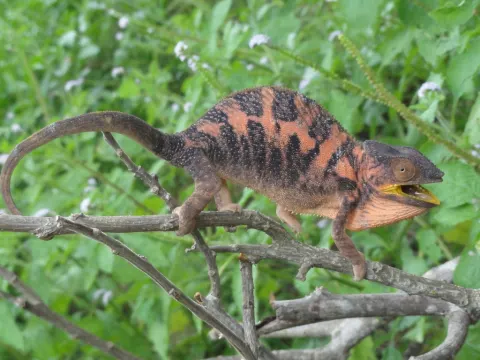
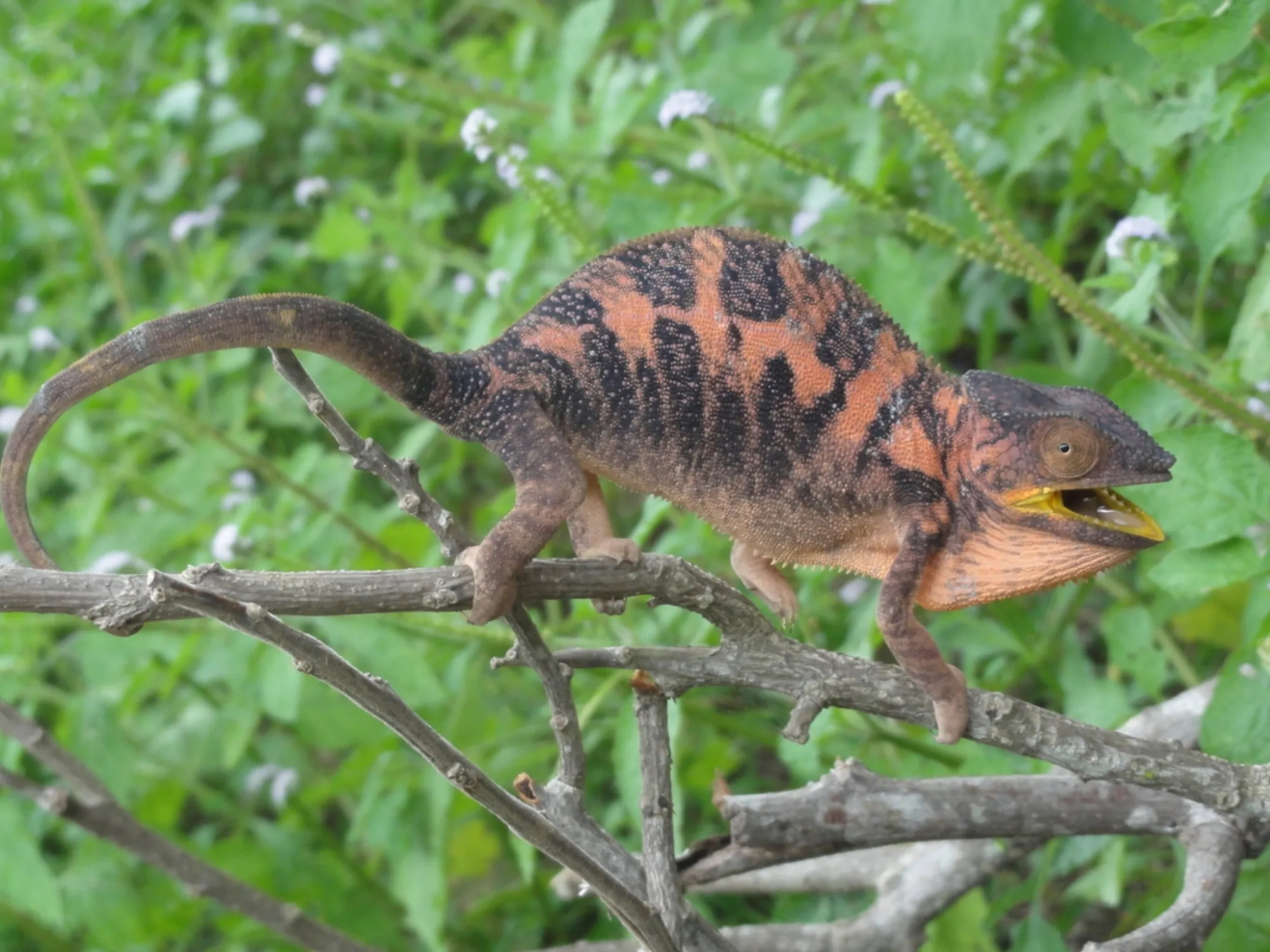
A flash of colour among the branches may reveal a Panther Chameleon, a lizard native to Madagascar. It grows 40 to 51 cm long, with females generally smaller than males. Colour varies from place to place: animals from Nosy Be, Ankify and Ambanja are typically blue, while those from Ambilobe, Antsiranana and Sambava can be red, green or orange. Females tend to be tan and brown, sometimes with touches of pink, peach or bright orange. Strongly gripping feet help the chameleon hold on to narrow branches, while claws give it traction as it climbs bark.
The species occurs widely in Madagascar's eastern and northeastern lowlands, inhabiting eastern rainforests as well as the northwest's drier patches of forest and savannah. It has also been introduced to Réunion, Mauritius and Florida. Human activity has degraded the original vegetation across its range, yet the chameleon appears to thrive in altered habitat and is often found near roads, homes and plantations. Usually solitary and highly territorial, it basks in sunlight when it needs warmth. Rival males change colour and inflate their bodies when they meet, and sometimes fight if neither retreats. A long tongue shoots out to catch prey, mainly invertebrates living on land; plant material is eaten very rarely.
Females carrying eggs turn dark brown or black with orange stripes and may defend themselves against approaching males. They lay 10 to 40 eggs in a clutch, and the eggs typically hatch after 240 days. Few individuals survive beyond a year in the wild. Its colour and size are among the reasons it is in high demand in the international pet trade.
Written from the English Wikipedia article Panther chameleon (CC BY-SA 4.0).
- Records
- 415
- Countries
- 4
No atlas park has a record of the Panther Chameleon in or around it yet.
These are open occurrence records, so they show where people looked for and recorded the Panther Chameleon as much as where it lives. Cells are up to 25 km across, and every location is generalised to its cell.
Generalised encounter areas, not exact locations. Each shape is a grid cell coloured by how likely the species is there.
- Very likelyRéunion25 km zone · medium confidence · 249 records · updated 81 days ago
- Very likelyMadagascar25 km zone · medium confidence · 161 records · updated 81 days ago
- PossibleMauritius25 km zone · medium confidence · 4 records · updated 81 days ago
- PossibleUnited States25 km zone · medium confidence · 1 record · updated 81 days ago
Conservation status not assessed here yet, so every location is generalised to its grid cell.